

Stufin
Home Quick Cart Profile

RF433 MHz Transmitter Receiver Wireless Module

Buy Now on Stufin

Component Name

RF433 MHz Transmitter Receiver Wireless Module

Overview

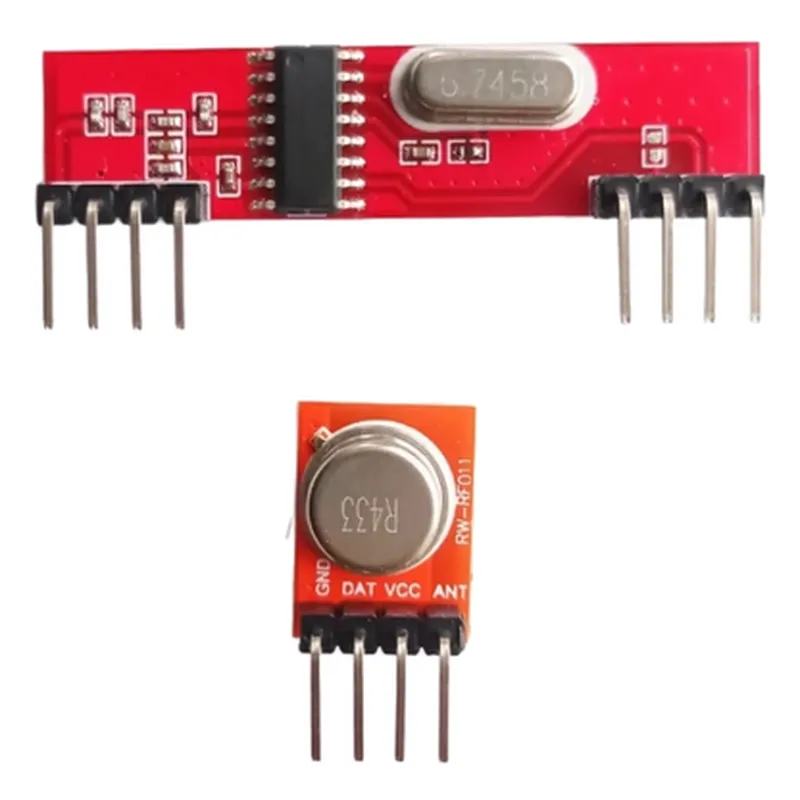
The RF433 MHz Transmitter Receiver Wireless Module is a compact, low-power wireless communication module designed for use in a wide range of Internet of Things (IoT) applications. This module consists of a transmitter and receiver pair, operating at a frequency of 433 MHz, enabling reliable and efficient data transmission between devices.

Functionality

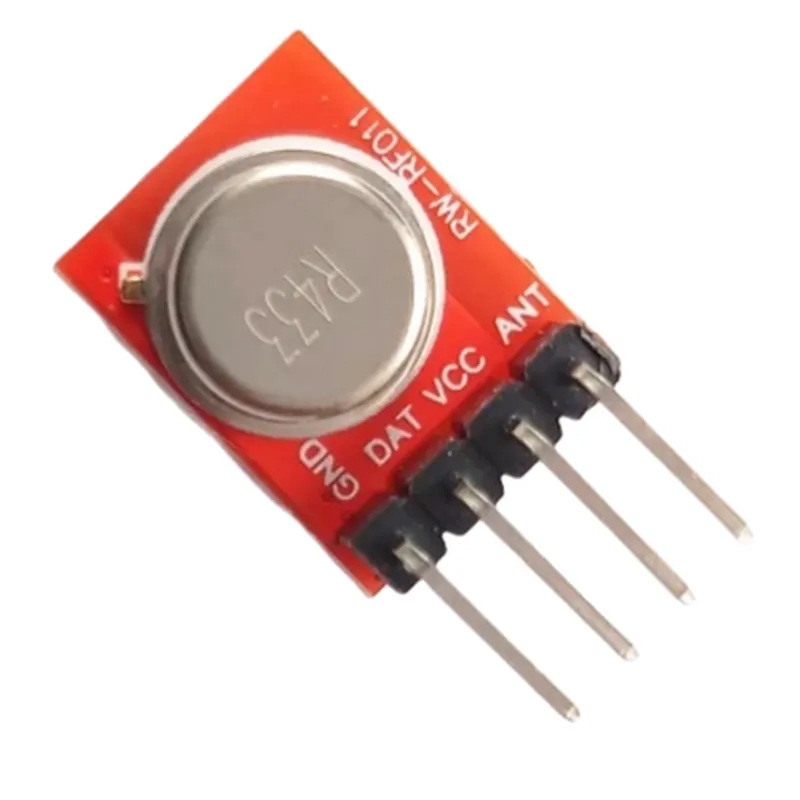
  • Transmitter (TX): The transmitter is responsible for converting digital data from a microcontroller or other digital devices into radio frequency (RF) signals, which are then transmitted over the air.
  • Receiver (RX): The receiver captures the transmitted RF signals and converts them back into digital data, which is then sent to a microcontroller or other digital devices for processing.
The RF433 MHz Transmitter Receiver Wireless Module is designed to facilitate wireless communication between devices, allowing them to transmit and receive data wirelessly. The module consists of two primary components

Key Features

  • Operating Frequency: 433 MHz, a widely used frequency band for IoT applications, offering a good balance between range and interference immunity.
  • Transmission Range: Up to 100 meters (330 feet) in open air, depending on the environment and antenna configuration.
  • Data Transfer Rate: Up to 2.4 kbps, suitable for most IoT applications, including remote control, sensor monitoring, and home automation.
  • Low Power Consumption: Typical current consumption of 10 mA (transmit) and 5 mA (receive), making it suitable for battery-powered devices.
  • Simple Implementation: Easy to integrate into existing projects, with a straightforward API and compatible with most microcontrollers.
  • Multiple Data Transmission Modes: Supports multiple transmission modes, including point-to-point, point-to-multipoint, and broadcast.
  • Error Detection and Correction: Built-in error detection and correction mechanisms ensure reliable data transmission and reception.
  • Compact Design: Small form factor (typically 30 x 15 x 5 mm) allows for easy integration into compact devices and applications.
  • Operating Voltage: 3.3 V to 5 V, making it compatible with most digital devices and microcontrollers.
  • Compliance: Complies with relevant regulatory standards, including FCC, CE, and RoHS.

Applications

  • Home Automation Systems
  • Remote Control Systems
  • Wireless Sensor Networks
  • Industrial Automation
  • IoT Devices (e.g., smart home devices, wearables, and trackable devices)
  • Robotics and RC Systems
  • Medical Devices
The RF433 MHz Transmitter Receiver Wireless Module is suitable for a wide range of IoT applications, including

Conclusion

The RF433 MHz Transmitter Receiver Wireless Module offers a reliable, efficient, and easy-to-use wireless communication solution for IoT applications. Its low power consumption, compact design, and multiple data transmission modes make it an ideal choice for a wide range of use cases, from simple remote control systems to complex industrial automation applications.

Pin Configuration

  • RF433 MHz Transmitter Receiver Wireless Module Documentation
  • Pinout Description
  • The RF433 MHz Transmitter Receiver Wireless Module has a total of 8 pins, which are used to connect the module to a microcontroller or other devices for wireless communication. Here is a detailed description of each pin:
  • Pin 1: VCC (Power Supply)
  • Description: This pin is used to power the module. It should be connected to a 5V power supply.
  • Function: Provides power to the module.
  • Recommended Connection: Connect to a 5V power source, such as a battery or a voltage regulator.
  • Pin 2: GND (Ground)
  • Description: This pin is the ground reference point for the module.
  • Function: Provides a common ground for the module.
  • Recommended Connection: Connect to the ground of the circuit or the negative terminal of the power source.
  • Pin 3: DATA (Transmit/Receive Data)
  • Description: This pin is used to transmit or receive data through the wireless channel.
  • Function: Serial data input/output for transmission and reception of data.
  • Recommended Connection: Connect to a digital I/O pin of a microcontroller, such as an Arduino or Raspberry Pi, for data transmission and reception.
  • Pin 4: VDD (Voltage Regulator Output)
  • Description: This pin provides a regulated 5V output from the onboard voltage regulator.
  • Function: Can be used to power external devices that require a 5V supply.
  • Recommended Connection: Connect to external devices that require a 5V power supply, such as sensors or other modules.
  • Pin 5: NC (Not Connected)
  • Description: This pin is not connected to any internal component and is reserved for future use.
  • Function: None.
  • Recommended Connection: Leave unconnected.
  • Pin 6: ANT (Antenna)
  • Description: This pin is used to connect an external antenna for improving the wireless transmission range.
  • Function: Connects to an external antenna to enhance wireless transmission.
  • Recommended Connection: Connect to an external antenna, such as a wire antenna or a patch antenna, to improve wireless transmission range.
  • Pin 7: TX (Transmit Enable)
  • Description: This pin is used to enable the transmitter mode of the module.
  • Function: Activates the transmitter mode when driven high.
  • Recommended Connection: Connect to a digital I/O pin of a microcontroller, such as an Arduino or Raspberry Pi, to control the transmitter mode.
  • Pin 8: RX (Receive Enable)
  • Description: This pin is used to enable the receiver mode of the module.
  • Function: Activates the receiver mode when driven high.
  • Recommended Connection: Connect to a digital I/O pin of a microcontroller, such as an Arduino or Raspberry Pi, to control the receiver mode.
  • Connection Structure
  • When connecting the RF433 MHz Transmitter Receiver Wireless Module to a microcontroller or other devices, ensure that the pins are connected as follows:
  • VCC (Pin 1) to 5V power supply
  • GND (Pin 2) to ground
  • DATA (Pin 3) to digital I/O pin of microcontroller (e.g., Arduino or Raspberry Pi)
  • VDD (Pin 4) to external device requiring 5V power supply (optional)
  • NC (Pin 5) leave unconnected
  • ANT (Pin 6) to external antenna (optional)
  • TX (Pin 7) to digital I/O pin of microcontroller (e.g., Arduino or Raspberry Pi)
  • RX (Pin 8) to digital I/O pin of microcontroller (e.g., Arduino or Raspberry Pi)
  • Ensure that the connections are secure and follow proper wiring practices to avoid damage to the module or other devices.

Code Examples

RF433 MHz Transmitter Receiver Wireless Module Documentation
Overview
The RF433 MHz Transmitter Receiver Wireless Module is a low-power, low-cost wireless communication module designed for IoT applications. It operates at a frequency of 433 MHz and supports point-to-point or point-to-multipoint communication. This module consists of a transmitter and receiver pair, allowing for bidirectional wireless communication between devices.
Pinout
The RF433 MHz Transmitter Receiver Wireless Module has the following pinout:
Transmitter Module:
	+ VCC: Power supply (3.3V or 5V)
	+ GND: Ground
	+ DATA: Data input ( logic level)
 Receiver Module:
	+ VCC: Power supply (3.3V or 5V)
	+ GND: Ground
	+ DATA: Data output (logic level)
Code Examples
### Example 1: Basic Transmission and Reception using Arduino
This example demonstrates how to use the RF433 MHz Transmitter Receiver Wireless Module with Arduino boards to transmit and receive data.
Transmitter Code (Arduino)
```cpp
#include <RCSwitch.h>
RCSwitch transmitter = RCSwitch();
void setup() {
  transmitter.enableTransmit(10); // Pin 10 for transmitting
}
void loop() {
  char data[] = "Hello, world!";
  transmitter.send(data, strlen(data));
  delay(500);
}
```
Receiver Code (Arduino)
```cpp
#include <RCSwitch.h>
RCSwitch receiver = RCSwitch();
void setup() {
  receiver.enableReceive(11); // Pin 11 for receiving
}
void loop() {
  if (receiver.available()) {
    char data[32];
    uint8_t length = receiver.getReceivedValue(data, 32);
    Serial.println(data);
  }
}
```
### Example 2: Remote Control System using Raspberry Pi
This example demonstrates how to use the RF433 MHz Transmitter Receiver Wireless Module with a Raspberry Pi to create a simple remote control system.
Transmitter Code (Python)
```python
import RPi.GPIO as GPIO
import time
GPIO.setmode(GPIO.BCM)
GPIO.setup(17, GPIO.OUT)
while True:
    # Send command to turn on a remote device
    GPIO.output(17, GPIO.HIGH)
    time.sleep(0.1)
    GPIO.output(17, GPIO.LOW)
    time.sleep(0.1)
```
Receiver Code (Python)
```python
import RPi.GPIO as GPIO
import time
GPIO.setmode(GPIO.BCM)
GPIO.setup(23, GPIO.IN, pull_up_down=GPIO.PUD_DOWN)
while True:
    if GPIO.input(23):
        print("Received signal!")
        # Perform action based on received signal
```
Note: In both examples, ensure that the transmitter and receiver modules are properly connected to the corresponding pins on the microcontroller boards.