3mm White Blue LED (Pack of 10)


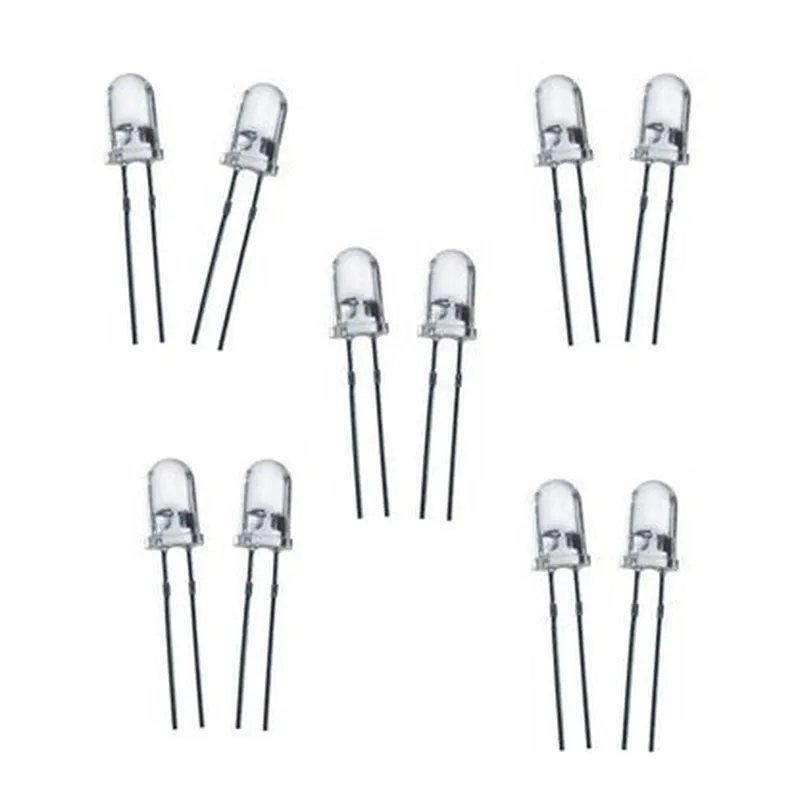
3mm White Blue LED (Pack of 10)
The 3mm White Blue LED is a light-emitting diode (LED) component that emits a bright white-blue light when an electric current passes through it. This pack of 10 LEDs is ideal for various IoT projects, prototyping, and electronic applications where a high-intensity light source is required.
The 3mm White Blue LED functions as a semiconductor device that converts electrical energy into visible light. When a voltage is applied across the LED, electrons recombine with holes, releasing energy in the form of photons, which produces the white-blue light. The LED requires a power source, typically a voltage supply, to operate.
| The 3mm White Blue LED is suitable for various IoT applications, including |
LED indicators for IoT devices and sensors
Backlighting for LCD displays and switches
Status indicators for smart home devices
Decorative lighting for wearables and fashion electronics
Pilot lights for industrial control panels
| When working with the 3mm White Blue LED, ensure to |
Handle the LEDs by the edges to prevent damage to the pins
Avoid overheating the LED, as it can reduce its lifespan
Use a voltage regulator or resistor to limit the current and prevent burnout
Follow proper soldering techniques to prevent damage to the LED or PCB
By following proper usage guidelines and taking necessary precautions, the 3mm White Blue LED (Pack of 10) can provide a reliable and efficient light source for your IoT projects and applications.
Component Documentation: 3mm White Blue LED (Pack of 10)OverviewThe 3mm White Blue LED is a compact, high-brightness LED component suitable for a wide range of applications, including IoT projects, robotics, and electronics prototyping. This pack of 10 LEDs provides a convenient and cost-effective way to integrate white-blue lighting into your design.Technical SpecificationsLED Type: 3mm Through-Hole
Color: White-Blue
Brightness: 1500-2000 mcd
Forward Voltage: 3.2-3.5V
Forward Current: 20mA
Reverse Voltage: 5V
Operating Temperature: -20C to 80CConnecting the LEDTo use the 3mm White Blue LED, connect the longer leg (Anode) to the positive voltage supply, and the shorter leg (Cathode) to the negative voltage supply or a resistor, as shown below:```
+-----------+
| LED |
| (White |
| Blue) |
+-----------+
| |
| Anode |
| (Long |
| Leg) |
+ +
| |
| Cathode |
| (Short |
| Leg) |
+ +
```Code Examples### Example 1: Simple LED Blinking with ArduinoThis example demonstrates how to connect the LED to an Arduino board and make it blink using the built-in `digitalWrite()` function.```c++
const int ledPin = 13; // Choose any digital pin on your Arduino boardvoid setup() {
pinMode(ledPin, OUTPUT);
}void loop() {
digitalWrite(ledPin, HIGH); // Turn the LED on
delay(1000); // Wait for 1 second
digitalWrite(ledPin, LOW); // Turn the LED off
delay(1000); // Wait for 1 second
}
```### Example 2: Controlling LED Brightness with Raspberry Pi (Python)This example shows how to connect the LED to a Raspberry Pi and control its brightness using PWM (Pulse-Width Modulation) with Python.```python
import RPi.GPIO as GPIO
import time# Set up GPIO mode
GPIO.setmode(GPIO.BCM)# Define the LED pin
led_pin = 17# Set up the LED pin as an output
GPIO.setup(led_pin, GPIO.OUT)# Create a PWM object with a frequency of 100 Hz
pwm = GPIO.PWM(led_pin, 100)# Set the initial brightness to 50%
pwm.start(50)while True:
# Increase brightness
for duty_cycle in range(50, 101):
pwm.ChangeDutyCycle(duty_cycle)
time.sleep(0.1)# Decrease brightness
for duty_cycle in range(100, 49, -1):
pwm.ChangeDutyCycle(duty_cycle)
time.sleep(0.1)
```Note: In both examples, make sure to use an appropriate resistor to limit the current flowing through the LED. The recommended resistor value can be calculated using Ohm's Law: `R = (V_supply - V_forward_voltage) / I_forward_current`.