1000mm Trapezoidal 4 Start Lead Screw 8mm Thread 2mm Pitch Lead Screw with Copper Nut


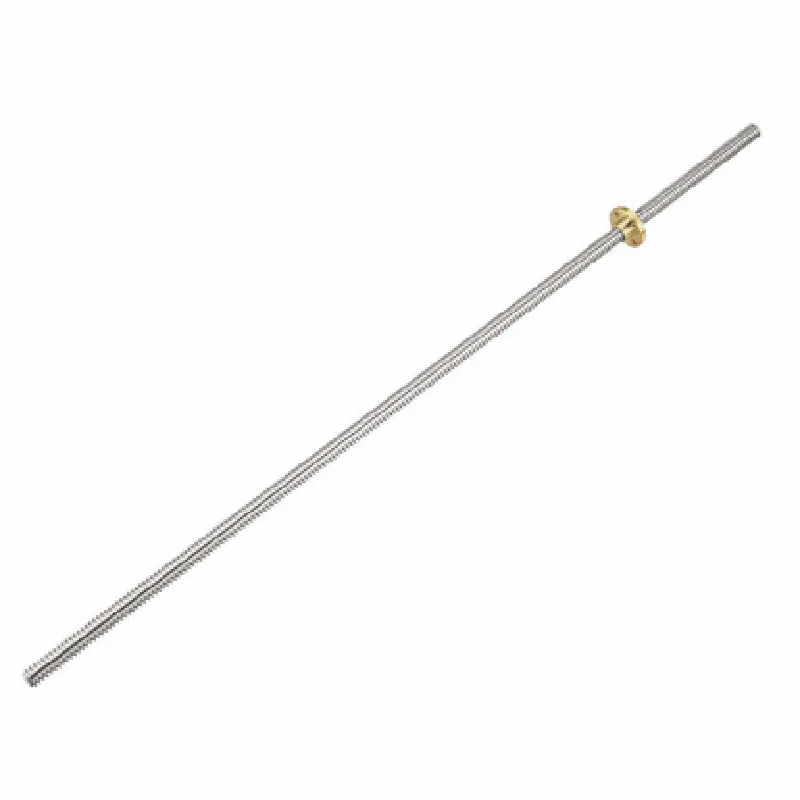
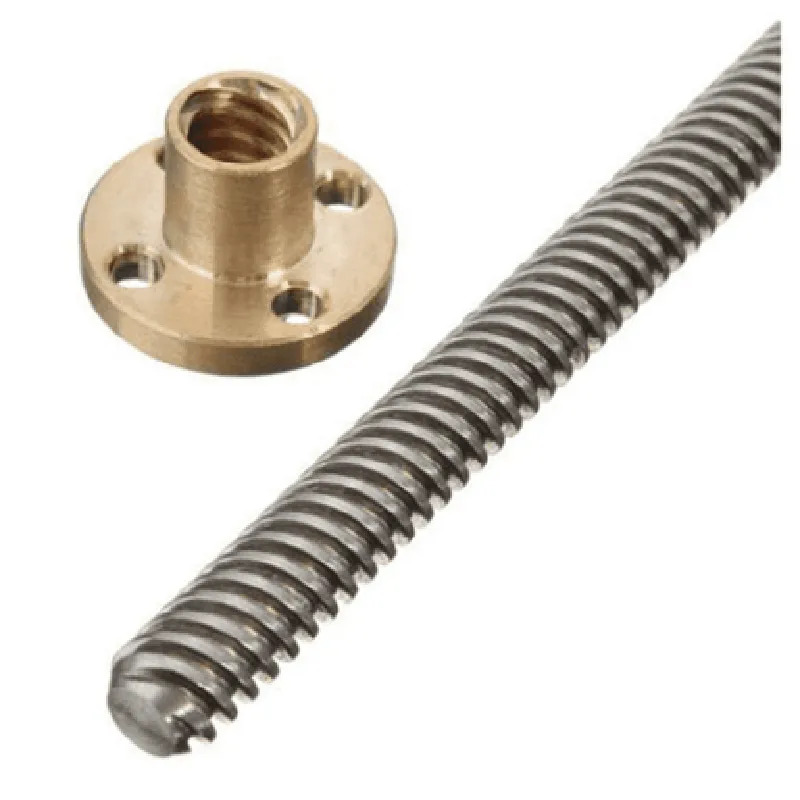
1000mm Trapezoidal 4 Start Lead Screw 8mm Thread 2mm Pitch Lead Screw with Copper Nut
The 1000mm Trapezoidal 4 Start Lead Screw 8mm Thread 2mm Pitch Lead Screw with Copper Nut is a linear motion component designed for precision movement and positioning applications in various industrial, robotic, and IoT systems. This lead screw assembly consists of a trapezoidal thread lead screw, a copper nut, and a matching thread configuration.
| The primary function of this lead screw assembly is to convert rotary motion into linear motion, providing smooth, accurate, and efficient movement. The trapezoidal thread lead screw is designed to mate with the copper nut, which rides along the thread, allowing for precise linear displacement. This mechanism enables the conversion of motor rotation into precise linear movement, making it an essential component in various applications, such as |
CNC machines and 3D printers
Robotics and automation systems
Linear actuators and positioning systems
IoT devices and smart home automation systems
High-strength steel or stainless steel
Copper
8mm
2mm
4
1000mm
Hardened and ground
0.05mm/100mm
CNC machines and 3D printers
Robotics and automation systems
Linear actuators and positioning systems
IoT devices and smart home automation systems
Precision engineering and manufacturing equipment
The lead screw assembly can be mounted using various methods, including clamping, bolting, or adhesive bonding. Proper alignment and secure fastening are essential to ensure smooth operation and prevent thread damage.
-20C to 80C
Up to 1000 rpm (dependent on application and motor selection)
Dependent on application, motor selection, and system design
RoHS and CE compliant
Meets industry standards for precision lead screws and linear motion components
1-year limited warranty
Technical support and documentation available upon request
1000mm Trapezoidal 4 Start Lead Screw 8mm Thread 2mm Pitch Lead Screw with Copper NutOverviewThe 1000mm Trapezoidal 4 Start Lead Screw 8mm Thread 2mm Pitch Lead Screw with Copper Nut is a high-precision linear motion component designed for high-performance applications. It features a trapezoidal thread profile, 4-start design, and a copper nut for efficient and smooth motion.Technical SpecificationsLength: 1000mm
Thread Type: Trapezoidal
Thread Size: 8mm
Pitch: 2mm
Starts: 4
Material: Steel (lead screw) and Copper (nut)
Accuracy: 0.05mm/300mmCode ExamplesHere are three code examples demonstrating how to use the 1000mm Trapezoidal 4 Start Lead Screw 8mm Thread 2mm Pitch Lead Screw with Copper Nut in various contexts:Example 1: Stepper Motor Control with ArduinoIn this example, we will use the lead screw with a stepper motor to create a linear motion system. We will use the Arduino platform and the A4988 stepper motor driver.```cpp
#include <Stepper.h>#define STEPS_PER_REVOLUTION 200
#define MICROSTEPS 16
#define LEAD_SCREW_PITCH 2
#define STEPPER_MOTOR_PIN_DIR 2
#define STEPPER_MOTOR_PIN_STEP 3
#define STEPPER_MOTOR_PIN_ENABLE 4Stepper stepper(STEPS_PER_REVOLUTION, STEPPER_MOTOR_PIN_DIR, STEPPER_MOTOR_PIN_STEP, STEPPER_MOTOR_PIN_ENABLE);void setup() {
Serial.begin(9600);
stepper.setMicrostepMode(MICROSTEPS);
}void loop() {
// Move the lead screw 100mm forward
stepper.move(100 / LEAD_SCREW_PITCH MICROSTEPS);
delay(1000);
// Move the lead screw 50mm backward
stepper.move(-50 / LEAD_SCREW_PITCH MICROSTEPS);
delay(1000);
}
```Example 2: CNC Machine Control with PythonIn this example, we will use the lead screw as part of a CNC machine control system. We will use Python and the PySerial library to communicate with the CNC machine's controller.```python
import serial
import time# Initialize the serial connection
ser = serial.Serial('COM3', 9600, timeout=1)# Define the lead screw pitch and steps per revolution
LEAD_SCREW_PITCH = 2
STEPS_PER_REVOLUTION = 200# Define the CNC machine's G-code commands
def send_gcode(gcode):
ser.write(gcode.encode() + b'
')
response = ser.readline().decode().strip()
return response# Move the CNC machine's axis 100mm forward
send_gcode(f'G1 F100 X100')# Wait for 1 second
time.sleep(1)# Move the CNC machine's axis 50mm backward
send_gcode(f'G1 F100 X-50')
```Example 3: Robotics Application with ROS (Robot Operating System)In this example, we will use the lead screw as part of a robotic arm control system. We will use ROS and Python to control the robot's movements.```python
import rospy
import math
from std_msgs.msg import Float64# Define the lead screw pitch and steps per revolution
LEAD_SCREW_PITCH = 2
STEPS_PER_REVOLUTION = 200# Define the robot's joint angles
joint_angles = {
'joint1': 0.0,
'joint2': 0.0,
'joint3': 0.0
}# Define the ROS publisher
publisher = rospy.Publisher('robot_arm_joint_angles', Float64, queue_size=10)def move_robot_arm(angle):
# Calculate the lead screw's movement based on the joint angle
movement = angle math.pi / 180 LEAD_SCREW_PITCH / STEPS_PER_REVOLUTION
joint_angles['joint1'] = movement
publisher.publish(joint_angles)if __name__ == '__main__':
rospy.init_node('robot_arm_controller')
rospy.loginfo('Robot arm controller initialized')# Move the robot arm to 30 degrees
move_robot_arm(30)
rospy.sleep(1)# Move the robot arm to 60 degrees
move_robot_arm(60)
rospy.sleep(1)
```These code examples demonstrate how to use the 1000mm Trapezoidal 4 Start Lead Screw 8mm Thread 2mm Pitch Lead Screw with Copper Nut in various contexts, including Arduino, Python, and ROS. The lead screw can be used in a wide range of applications, including robotics, CNC machines, and linear motion systems.