

Stufin
Home Quick Cart Profile

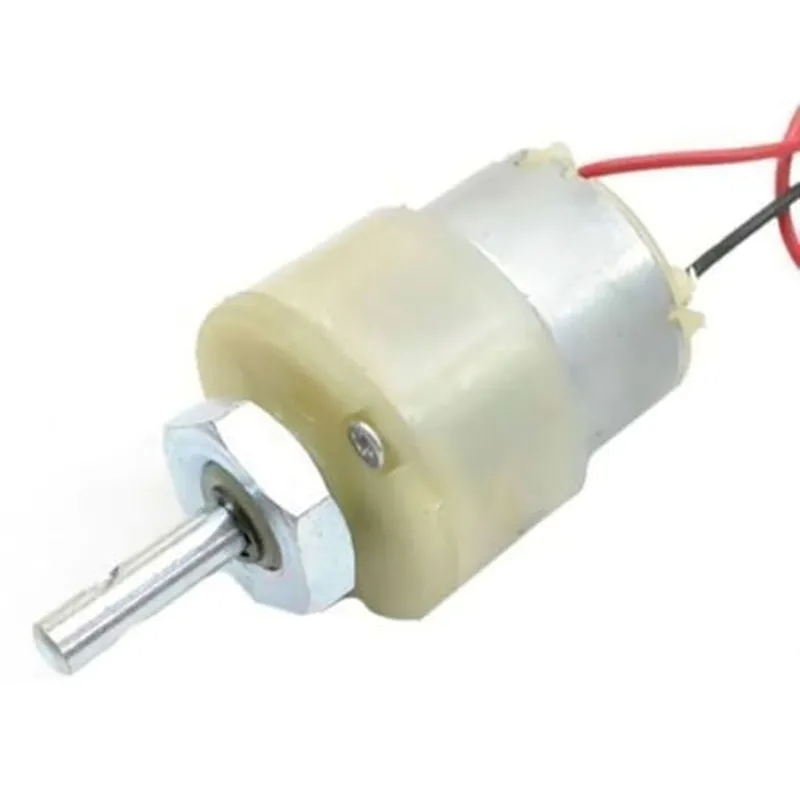
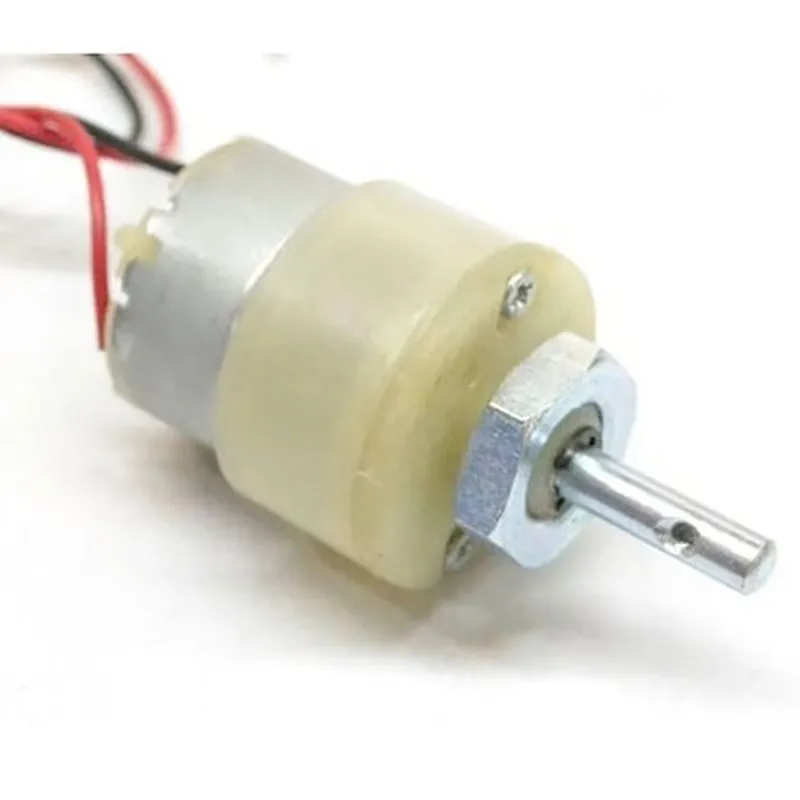
100RPM 12V DC Motor

Buy Now on Stufin

Component Name

100RPM 12V DC Motor

Overview

The 100RPM 12V DC Motor is a high-performance, compact, and efficient direct current (DC) motor designed for a wide range of applications in the Internet of Things (IoT) and robotics. This motor is ideal for small-scale automation systems, robotic platforms, and IoT devices requiring precise speed control and high torque output.

Functionality

The 100RPM 12V DC Motor is a brushed DC motor that converts electrical energy into mechanical energy. When a 12V DC power supply is applied to the motor, it generates a rotational force that produces a speed of 100 revolutions per minute (RPM). The motor's functionality can be summarized as follows

Converts 12V DC power into mechanical energy

Produces a rotational speed of 100 RPM

Provides high torque output for efficient mechanical actuation

Supports precise speed control through external regulation of input voltage or pulse-width modulation (PWM)

Key Features

  • Voltage Rating: 12V DC
  • Speed Rating: 100 RPM
  • Power Rating: 10W
  • Torque Rating: 0.3 Nm
  • Current Rating: 800mA
  • Efficiency: 80% (typical)
  • Motor Type: Brushed DC Motor
  • Bearings: Ball bearings for smooth and quiet operation
  • Insulation: Class B insulation (up to 130C)
  • Diameter: 28mm
  • Length: 50mm
  • Shaft: 2mm diameter, 10mm length
  • Mounting: M3 screw holes for secure mounting
  • Protection: Over-voltage, over-current, and over-temperature protection

Mechanical Characteristics

Rotor Inertia

0.15 g/cm

Bearing Life

500 hours (typical)

Vibration

1.0 mm/s (typical)

Electrical Characteristics

Resistance

10 ohms (typical)

Inductance

2.5 mH (typical)

Capacitance

100 nF (typical)

Environmental Characteristics

Operating Temperature

-20C to 50C

Storage Temperature

-30C to 70C

Humidity

5% to 95% RH (non-condensing)

Certifications and Compliance

RoHS Compliant

Yes

CE Marking

Yes

UL Recognition

Yes

Applications

The 100RPM 12V DC Motor is suitable for a wide range of IoT and robotics applications, including

Small-scale automation systems

Robotic platforms

IoT devices

Healthcare devices

Industrial automation systems

Automotive systems

By providing high torque output, precise speed control, and efficient operation, the 100RPM 12V DC Motor is an ideal component for various IoT and robotics applications.

Pin Configuration

  • 100RPM 12V DC Motor Pinout and Connection Guide
  • The 100RPM 12V DC Motor is a compact and efficient motor suitable for a wide range of IoT applications. The motor has a simple 2-pin interface, making it easy to integrate into your projects. Below is a detailed explanation of the pins and how to connect them:
  • Pinout:
  • Pin 1: Positive (Red Wire)
  • + Function: Power supply positive terminal
  • + Voltage: 12V DC
  • + Description: This pin connects to the positive terminal of the power supply. Make sure to connect a 12V DC power source to this pin to operate the motor.
  • Pin 2: Negative (Black Wire)
  • + Function: Power supply negative terminal
  • + Voltage: 0V (GND)
  • + Description: This pin connects to the negative terminal of the power supply. Ensure a secure connection to the ground (GND) or negative terminal of the power source.
  • Connection Structure:
  • To connect the motor, follow these steps:
  • 1. Connect the Positive (Red Wire) Pin 1 to the 12V DC Power Source:
  • Use a suitable gauge wire (e.g., 20 AWG) to connect Pin 1 to the positive terminal of your 12V DC power supply.
  • Ensure the power supply can provide the required current for the motor (check the motor's datasheet for current ratings).
  • 2. Connect the Negative (Black Wire) Pin 2 to the Ground (GND) or Negative Terminal:
  • Use a suitable gauge wire (e.g., 20 AWG) to connect Pin 2 to the negative terminal of your power supply or a secure ground point.
  • Make sure the ground connection is secure and can handle the return current from the motor.
  • Important Notes:
  • Before connecting the motor, ensure the power supply is rated for the motor's voltage and current requirements.
  • Use suitable gauge wires to minimize voltage drop and ensure reliable operation.
  • Avoid reversing the polarity of the motor connections, as this can damage the motor or power supply.
  • If you're using a motor driver or controller, refer to the driver's datasheet for specific connection guidelines.
  • By following these connection guidelines, you can safely and effectively operate your 100RPM 12V DC Motor in your IoT projects.

Code Examples

100RPM 12V DC Motor Documentation
Overview
The 100RPM 12V DC Motor is a compact and efficient direct current motor designed for a wide range of IoT applications. With a maximum rotation speed of 100 revolutions per minute and a voltage rating of 12V, this motor is suitable for applications requiring moderate speed and torque.
Technical Specifications
Voltage: 12V DC
 Current: 100mA (max)
 Speed: 100RPM (max)
 Torque: 1.5 kg-cm (max)
 Dimensions: 28mm (diameter) x 40mm (length)
 Weight: 50g
 Interface: 2-wire (positive and negative terminals)
Code Examples
### Example 1: Basic Motor Control using Arduino
This example demonstrates how to control the 100RPM 12V DC Motor using an Arduino board.
Hardware Requirements:
Arduino Board (e.g., Arduino Uno)
 100RPM 12V DC Motor
 12V Power Supply
 Breadboard and jumper wires
Software Requirements:
Arduino IDE (version 1.8.x or later)
Code:
```c++
const int motorPin = 9; // Pin 9 for motor control
void setup() {
  pinMode(motorPin, OUTPUT);
}
void loop() {
  // Turn the motor on
  digitalWrite(motorPin, HIGH);
  delay(1000); // Run the motor for 1 second
// Turn the motor off
  digitalWrite(motorPin, LOW);
  delay(1000); // Wait for 1 second
}
```
In this example, pin 9 of the Arduino board is used to control the motor. The `digitalWrite()` function is used to set the motor pin high (5V) to turn the motor on and low (0V) to turn it off. The `delay()` function is used to introduce a 1-second delay between motor on and off cycles.
### Example 2: Motor Speed Control using Raspberry Pi and Python
This example demonstrates how to control the speed of the 100RPM 12V DC Motor using a Raspberry Pi and Python.
Hardware Requirements:
Raspberry Pi (e.g., Raspberry Pi 4)
 100RPM 12V DC Motor
 12V Power Supply
 Breadboard and jumper wires
 L293D Motor Driver IC (optional)
Software Requirements:
Raspbian OS (version 10 or later)
 Python 3.x
Code:
```python
import RPi.GPIO as GPIO
import time
# Set up GPIO mode
GPIO.setmode(GPIO.BCM)
# Define motor pin
motor_pin = 18
# Set up motor pin as an output
GPIO.setup(motor_pin, GPIO.OUT)
try:
    while True:
        # Set motor speed (0-100% duty cycle)
        for duty_cycle in range(0, 101, 10):
            GPIO.PWM(motor_pin, 50).start(duty_cycle)
            time.sleep(0.5)  # Wait for 0.5 seconds
        for duty_cycle in range(100, -1, -10):
            GPIO.PWM(motor_pin, 50).start(duty_cycle)
            time.sleep(0.5)  # Wait for 0.5 seconds
except KeyboardInterrupt:
    # Clean up
    GPIO.cleanup()
```
In this example, the RPi.GPIO library is used to control the motor pin (GPIO 18) as a PWM output. The `GPIO.PWM()` function is used to generate a PWM signal with a 50Hz frequency and variable duty cycle (0-100%). The duty cycle is incremented and decremented in steps of 10 to demonstrate motor speed control.
Note: If you're using a motor driver IC like L293D, you'll need to modify the code to accommodate the specific driver IC's requirements.