

Stufin
Home Quick Cart Profile

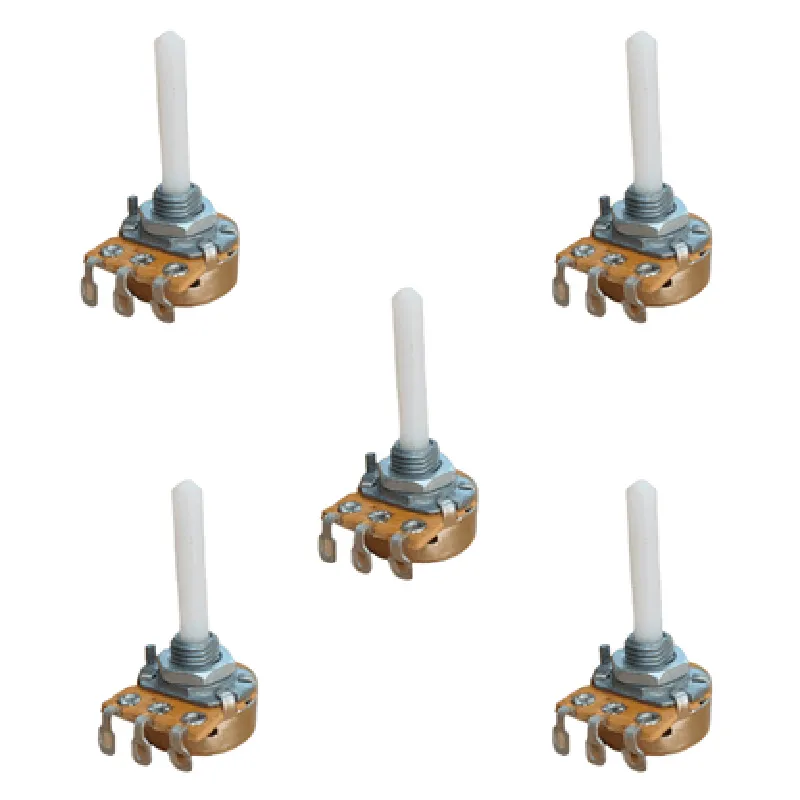
10K 16mm Rotary Pot(Pack of 5)

Buy Now on Stufin

Component Name

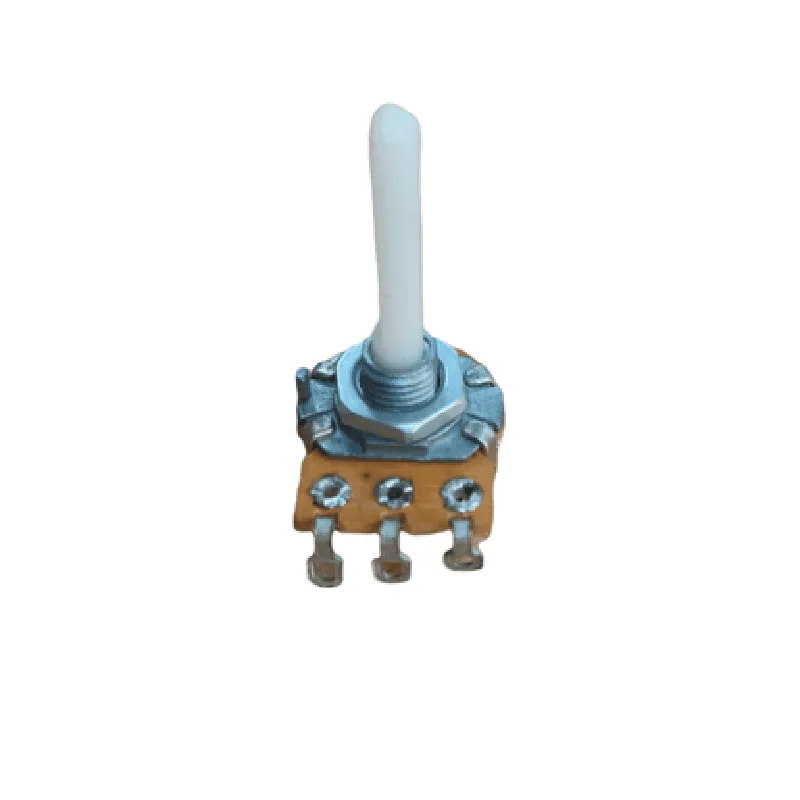
10K 16mm Rotary Pot (Pack of 5)

Overview

The 10K 16mm Rotary Pot is a variable resistor device designed for precision control and adjustment in a wide range of IoT applications. This component is available in a pack of 5, offering a cost-effective solution for prototyping and development.

Functionality

The 10K 16mm Rotary Pot is a three-terminal device that operates as a variable resistor, allowing users to vary the resistance between the center pin and one of the two outer pins. This is achieved by rotating the shaft of the potentiometer, which varies the resistance value. The potentiometer's resistance value ranges from 0 to 10k, providing a high degree of precision and control.

Key Features

  • Rotary Shaft: The potentiometer features a 16mm diameter rotary shaft with a splash-proof design, ensuring reliable operation in various environmental conditions.
  • 10k Resistance: The device offers a maximum resistance value of 10k, providing a wide range of adjustment possibilities.
  • Three-Terminal Design: The potentiometer has three terminals: the center pin (connected to the wiper) and two outer pins (connected to the ends of the resistive track).
  • High-Quality Construction: The component is built with high-quality materials, ensuring durability and reliability in IoT applications.
  • Compact Size: The 16mm diameter and compact design make the potentiometer suitable for use in space-constrained projects.
  • Pack of 5: The component is available in a pack of 5, offering a cost-effective solution for prototyping and development.

Electrical Characteristics

Resistance Value

10k (nominal)

Power Rating

0.1W (max)

Operating Temperature

-20C to 70C

Insulation Resistance

100M (min)

Dielectric Strength

500V (min)

Mechanical Characteristics

Shaft Diameter

16mm

Shaft Length

12mm

Body Diameter

16mm

Body Height

10mm

Weight

15g (approx.)

Applications

The 10K 16mm Rotary Pot is suitable for a wide range of IoT applications, including

Audio equipment (volume controls, tone controls)

Robotics and automation systems

Medical devices (e.g., ECG machines, ultrasound devices)

Industrial control systems

Musical instruments and equipment

Prototyping and development boards

Precautions and Handling

Handle the component with care to avoid mechanical damage or electrical shock.

Use a soft, dry cloth to clean the component, avoiding any harsh chemicals or abrasive materials.

Ensure the component is mounted securely to prevent vibration or movement during operation.

Warranty and Support

The 10K 16mm Rotary Pot is backed by a limited warranty, covering defects in materials and workmanship for a specified period. Technical support and documentation are available through the manufacturer's website or authorized distributors.

Pin Configuration

  • Component Overview:
  • The 10K 16mm Rotary Pot (Pack of 5) is a type of potentiometer that is commonly used in various IoT projects, such as robotics, automation, and sensor applications. It is a rotational potentiometer that provides a 10k linear output resistance, which can be used to detect rotational angles or positions.
  • Pinouts:
  • The 10K 16mm Rotary Pot has three pins, which are connected as follows:
  • Pin 1:
  • Terminal: CCW (Counter-ClockWise)
  • Function: This pin is connected to one end of the 10k resistive track.
  • Description: When the potentiometer is rotated counter-clockwise, the resistance between Pin 1 and Pin 3 increases, while the resistance between Pin 1 and Pin 2 decreases.
  • Pin 2:
  • Terminal: Wiper
  • Function: This pin is connected to the wiper (moving contact) of the potentiometer.
  • Description: The wiper moves along the resistive track as the potentiometer is rotated. The voltage at Pin 2 varies linearly with the rotational angle, making it an output pin.
  • Pin 3:
  • Terminal: CW (ClockWise)
  • Function: This pin is connected to the other end of the 10k resistive track.
  • Description: When the potentiometer is rotated clockwise, the resistance between Pin 3 and Pin 2 increases, while the resistance between Pin 3 and Pin 1 decreases.
  • Connection Structure:
  • To connect the pins of the 10K 16mm Rotary Pot, follow these steps:
  • Connect Pin 1 (CCW) to a stable voltage source (VCC) or a fixed voltage reference.
  • Connect Pin 2 (Wiper) to an analog input pin of a microcontroller or an analog-to-digital converter (ADC).
  • Connect Pin 3 (CW) to a stable ground (GND) or a fixed voltage reference.
  • Example Connection Diagram:
  • ```
  • +-----------+
  • | VCC |
  • +-----------+
  • |
  • |
  • v
  • +-----------+
  • | Pin 1 |
  • | (CCW) |
  • +-----------+
  • |
  • |
  • v
  • +-----------+
  • | Pin 2 |
  • | (Wiper) |
  • +-----------+
  • |
  • |
  • v
  • +-----------+
  • | GND |
  • +-----------+
  • |
  • |
  • v
  • +-----------+
  • | Pin 3 |
  • | (CW) |
  • +-----------+
  • ```
  • By connecting the pins as described above, you can read the rotational angle or position of the potentiometer using an analog input pin of a microcontroller or an ADC. The output voltage at Pin 2 will vary linearly with the rotational angle, allowing you to detect changes in the potentiometer's position.

Code Examples

Component Documentation: 10K 16mm Rotary Pot (Pack of 5)
Overview
The 10K 16mm Rotary Pot is a variable resistor used to divide a voltage source into two parts, providing a continuous range of values. This component is commonly used in IoT projects for analog signal processing, voltage division, and signal attenuation. This pack includes 5 pieces of 10K 16mm rotary pots.
Pinout
The 10K 16mm Rotary Pot has three terminals:
Terminal 1 (CCW): The counter-clockwise terminal, connected to one end of the resistive track.
  Terminal 2 (Wiper): The movable center terminal, connected to the wiper of the potentiometer.
  Terminal 3 (CW): The clockwise terminal, connected to the other end of the resistive track.
Technical Specifications
Resistance: 10 k
 Power Rating: 0.25 W
 Operating Temperature: -20C to 70C
 Rotary Angle: 300
 Shaft Diameter: 6 mm
 Body Diameter: 16 mm
 Height: 10 mm
Code Examples
### Example 1: Reading Potentiometer Values using Arduino
In this example, we'll use the 10K 16mm Rotary Pot to read analog values using an Arduino Uno board.
```cpp
const int potPin = A0;  // Connect the wiper terminal to analog pin A0
void setup() {
  Serial.begin(9600);
}
void loop() {
  int potValue = analogRead(potPin);
  int potAngle = map(potValue, 0, 1023, 0, 300);
  Serial.print("Potentiometer angle: ");
  Serial.print(potAngle);
  Serial.println(" degrees");
  delay(100);
}
```
### Example 2: Controlling an LED Brightness using Raspberry Pi and Python
In this example, we'll use the 10K 16mm Rotary Pot to control the brightness of an LED connected to a Raspberry Pi using Python.
```python
import RPi.GPIO as GPIO
import time
# Set up GPIO mode and pin numbering
GPIO.setmode(GPIO.BCM)
GPIO.setup(17, GPIO.OUT)  # Connect the LED to GPIO pin 17
try:
    while True:
        pot_value = int(input("Enter a value (0-1023): "))
        pot_angle = int(pot_value  300 / 1023)
        brightness = pot_angle / 300.0
        GPIO.output(17, brightness)
        print("LED brightness: {:.2f}%".format(brightness  100))
        time.sleep(0.1)
except KeyboardInterrupt:
    GPIO.cleanup()
```
### Example 3: Implementing a Simple Audio Volume Control using ESP32 and MicroPython
In this example, we'll use the 10K 16mm Rotary Pot to control the volume of an audio signal using an ESP32 board and MicroPython.
```python
import machine
import utime
# Set up the potentiometer pin
pot = machine.ADC(32)  # Connect the wiper terminal to ADC pin 32
while True:
    pot_value = pot.read_u16()
    volume = pot_value / 65535.0
    print("Volume: {:.2f}%".format(volume  100))
    utime.sleep(0.1)
```
Remember to modify the pin connections and code according to your specific use case and microcontroller platform.