The bearing uses balls to minimize contact between moving parts, resulting in reduced friction and increased efficiency.


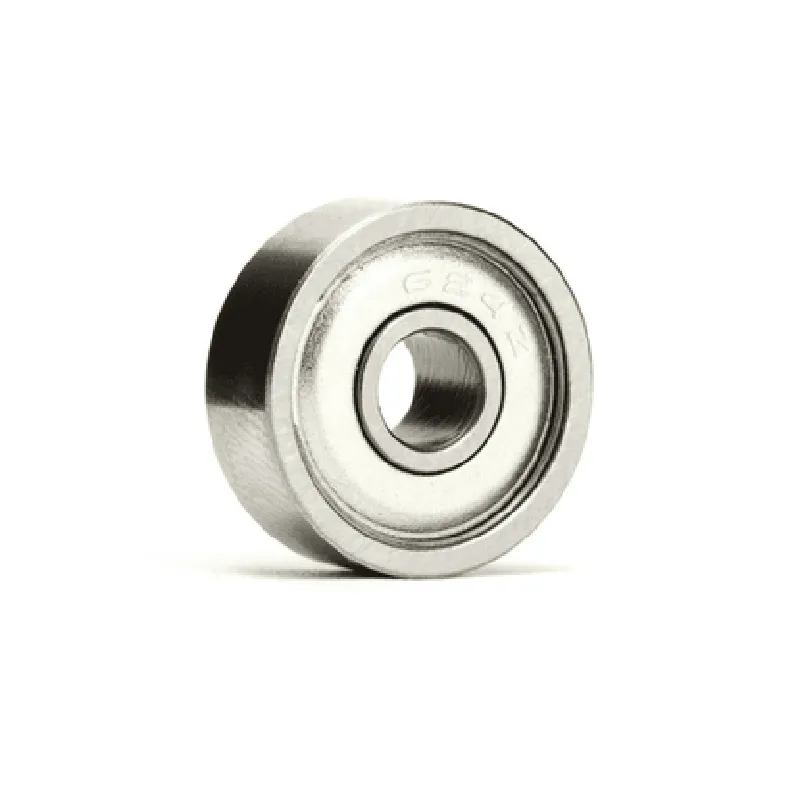
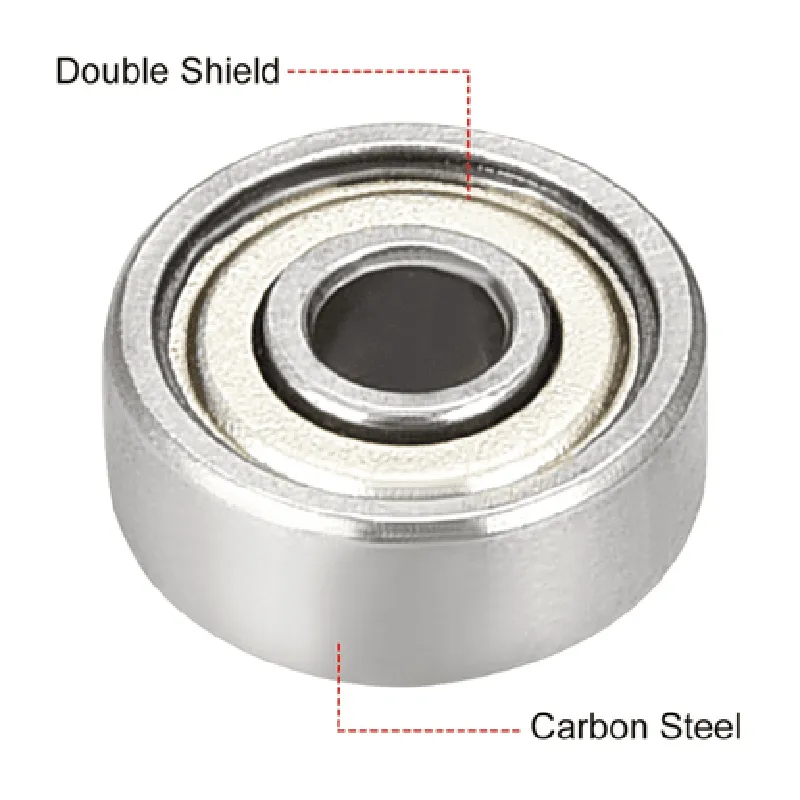
The bearing uses balls to minimize contact between moving parts, resulting in reduced friction and increased efficiency.
The bearing is designed to withstand radial forces, enabling it to handle the weight and stress of moving parts in a 3D printer.
The bearing's high-precision design ensures accurate and consistent movement, which is essential for 3D printing applications.
Key Features
4mm
12mm
4mm
High-carbon chromium steel (Chrome steel) for high strength, durability, and resistance to corrosion.
624ZZ bearings contain 7 balls, which are made of high-quality steel and are precisely machined for optimal performance.
The bearing features Z-Z shielding, which means it has metal shields on both sides to prevent dust and contaminants from entering the bearing and to retain the lubricant.
The bearing is pre-lubricated with a high-quality grease that reduces friction and wear.
The bearing is designed for high-speed applications, with a maximum rotational speed of up to 25,000 rpm.
The bearing can operate in temperatures ranging from -20C to 120C (-4F to 248F).
Benefits
The Radial Ball Bearing 624ZZ enables smooth and accurate movement, resulting in higher-quality 3D prints.
The bearing's high-precision design and low-friction operation minimize vibration, ensuring a more stable and reliable 3D printing process.
The bearing's low-friction design reduces energy consumption and heat generation, leading to increased efficiency and longer component lifespan.
The bearing is easy to install and maintain, reducing downtime and increasing overall productivity.
Applications
| The Radial Ball Bearing 624ZZ is specifically designed for use in 3D printing applications, including |
3D printers
CNC machines
Robotics
Automation equipment
Precision machinery
Conclusion
The Radial Ball Bearing 624ZZ is a high-performance, compact bearing designed to provide smooth, accurate, and reliable movement in 3D printing applications. Its high-precision design, low-friction operation, and ability to handle radial loads make it an essential component for achieving high-quality prints and maximizing efficiency in 3D printing systems.
Radial Ball Bearing 624ZZ for 3D Printer DocumentationOverviewThe Radial Ball Bearing 624ZZ is a high-quality, precision-engineered bearing designed specifically for 3D printing applications. It features a steel ball bearing with a radial design, making it ideal for use in linear motion systems, such as 3D printer axes. This bearing provides smooth, quiet operation and high precision, ensuring consistent print quality and reduced wear on moving parts.SpecificationsInner diameter: 4mm
Outer diameter: 13mm
Thickness: 5mm
Material: Steel
Load capacity: 560N (radial), 175N (axial)
Speed rating: Up to 20,000 RPM
Operating temperature: -20C to 150CExamples of Use### Example 1: 3D Printer X-Axis AssemblyIn this example, we'll demonstrate how to use the Radial Ball Bearing 624ZZ in a 3D printer X-axis assembly.```c
// Assumptions:
// - The 3D printer's X-axis motor is connected to a GT2 belt and pulley system.
// - The X-axis carriage is designed to accommodate the Radial Ball Bearing 624ZZ.// Mechanical assembly:
// 1. Mount the Radial Ball Bearing 624ZZ to the X-axis carriage using M3 screws.
// 2. Attach the GT2 belt pulley to the motor shaft.
// 3. Connect the GT2 belt to the pulley and the X-axis carriage.// Firmware configuration (Marlin example):
#define X_AXIS_BEARING_TYPE 624ZZ
#define X_AXIS_BEARING_PRELOAD 10 // Optional: adjust preload to optimize performance
```### Example 2: DIY Linear ActuatorIn this example, we'll demonstrate how to use the Radial Ball Bearing 624ZZ in a DIY linear actuator project.```c
// Assumptions:
// - The DIY linear actuator uses a NEMA 17 stepper motor and a GT2 belt drive.
// - The actuator's moving carriage is designed to accommodate the Radial Ball Bearing 624ZZ.// Mechanical assembly:
// 1. Mount the Radial Ball Bearing 624ZZ to the moving carriage using M3 screws.
// 2. Attach the GT2 belt pulley to the motor shaft.
// 3. Connect the GT2 belt to the pulley and the moving carriage.// Arduino code example (using AccelStepper library):
#include <AccelStepper.h>AccelStepper stepper(AccelStepper::DRIVER, 2, 3); // NEMA 17 stepper motorvoid setup() {
stepper.setMaxSpeed(1000); // Adjust speed to optimize performance
stepper.setAcceleration(500);
}void loop() {
stepper.run();
// Add your linear actuator logic here
}
```### Example 3: Robot Arm Joint (Advanced)In this example, we'll demonstrate how to use the Radial Ball Bearing 624ZZ in a robot arm joint assembly.```c
// Assumptions:
// - The robot arm joint uses a servo motor and a custom-designed linkage system.
// - The joint's moving components are designed to accommodate the Radial Ball Bearing 624ZZ.// Mechanical assembly:
// 1. Mount the Radial Ball Bearing 624ZZ to the moving joint component using M3 screws.
// 2. Attach the servo motor to the fixed joint component.
// 3. Connect the linkage system to the moving joint component and the servo motor.// Robot Operating System (ROS) code example (using ros_control and Gazebo):
#include <ros/ros.h>
#include <ros_control/ joint_command.h>class RobotArmJoint {
public:
RobotArmJoint() {
// Initialize joint command publishers and subscribers
joint_command_pub_ = nh_.advertise<ros_control::JointCommand>("joint_command", 10);
joint_state_sub_ = nh_.subscribe("joint_state", 10, &RobotArmJoint::jointStateCallback, this);
}void jointStateCallback(const ros_control::JointState::ConstPtr& state) {
// Update joint state and calculate desired position
// ...
}void sendJointCommand(double position, double velocity, double acceleration) {
ros_control::JointCommand cmd;
cmd.position = position;
cmd.velocity = velocity;
cmd.acceleration = acceleration;
joint_command_pub_.publish(cmd);
}
};int main(int argc, char argv) {
ros::init(argc, argv, "robot_arm_joint");
RobotArmJoint joint;
ros::spin();
return 0;
}
```These examples demonstrate the versatility of the Radial Ball Bearing 624ZZ in various IoT and robotics applications. By following proper assembly and configuration guidelines, you can achieve smooth, precise motion and reliable performance in your projects.