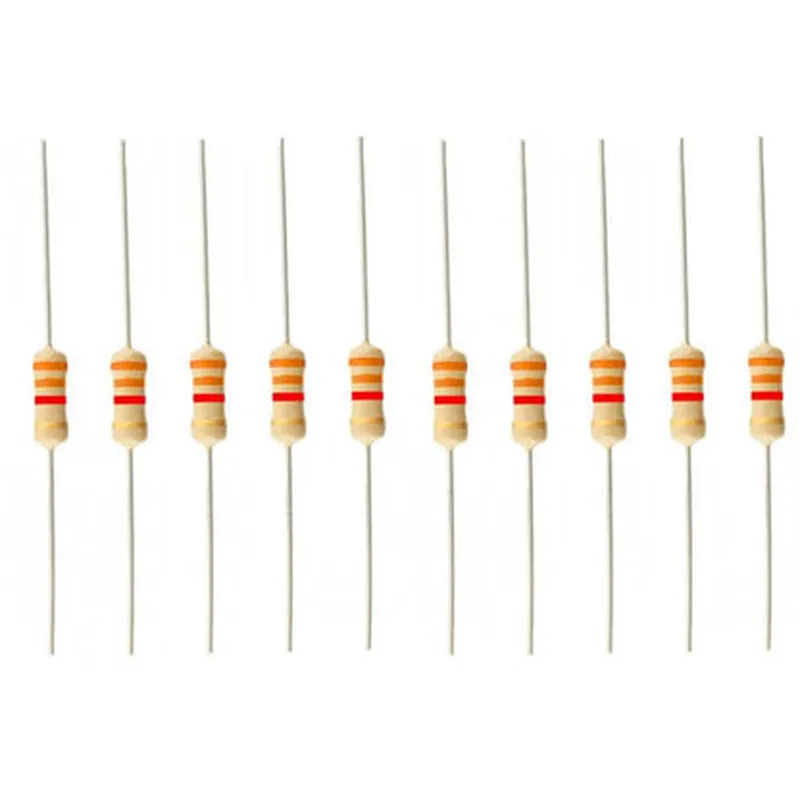
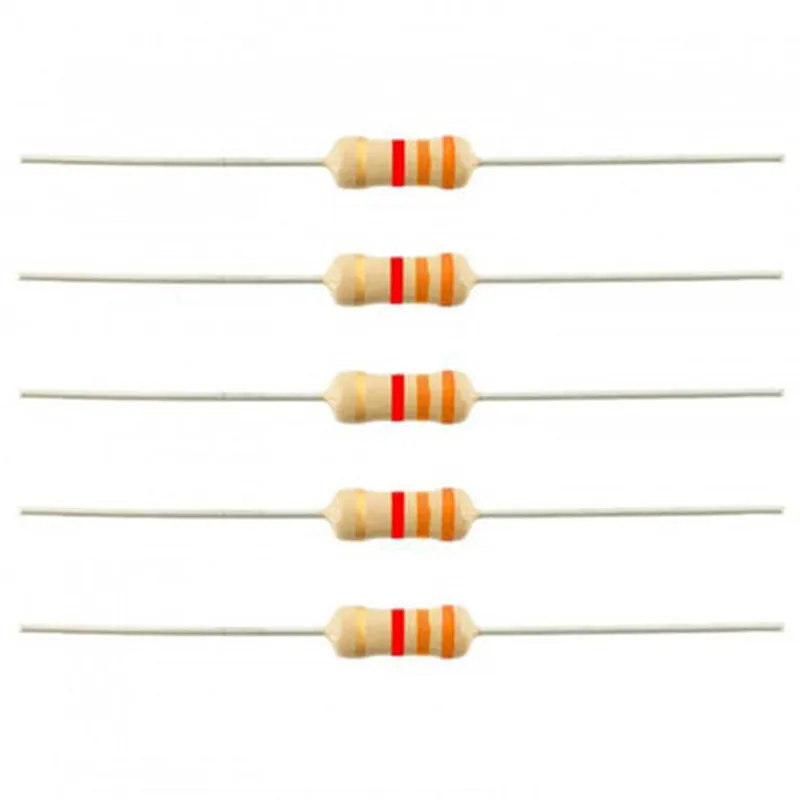
3.3k Ohm Resistor (Pack of 10) Documentation
The 3.3k Ohm Resistor is a common electronic component used to limit the flow of electrical current in a circuit. This pack of 10 resistors is perfect for prototyping, DIY projects, and production runs. The 3.3k Ohm resistance value is a popular choice for many applications, including voltage dividers, signal attenuation, and impedance matching.
Resistance: 3.3k Ohm (3300 )
 Power Rating: 1/4 Watt
 Tolerance: 5%
 Package: Through-Hole Resistor (THR)
 Quantity: 10 pieces per pack
### Example 1: Voltage Divider Circuit (Arduino)
In this example, we'll use the 3.3k Ohm resistor as part of a voltage divider circuit to reduce the voltage from a 5V power supply to 3.3V, suitable for powering a 3.3V microcontroller like the Arduino.
```cpp
const int inputVoltage = 5;  // Input voltage from power supply
const int resistor1 = 3300;  // 3.3k Ohm resistor
const int resistor2 = 2200;  // 2.2k Ohm resistor (optional)
void setup() {
  // Calculate the output voltage using the voltage divider formula
  float outputVoltage = inputVoltage  (resistor2 / (resistor1 + resistor2));
  Serial.print("Output Voltage: ");
  Serial.print(outputVoltage);
  Serial.println("V");
}
void loop() {
  // No code required here
}
```
### Example 2: Signal Attenuation (Raspberry Pi)
In this example, we'll use the 3.3k Ohm resistor to attenuate a digital signal from a sensor or another device to prevent damage to the Raspberry Pi's GPIO pins.
```python
import RPi.GPIO as GPIO
# Set up GPIO mode
GPIO.setmode(GPIO.BCM)
# Define the GPIO pin and signal voltage
gpio_pin = 17
signal_voltage = 5.0  # Voltage of the incoming signal
# Calculate the attenuated voltage using the voltage divider formula
attenuated_voltage = signal_voltage  (3300 / (3300 + 2200))  # Assuming a 2.2k Ohm resistor
# Print the attenuated voltage
print("Attenuated Voltage: {:.2f}V".format(attenuated_voltage))
# Clean up GPIO
GPIO.cleanup()
```
### Example 3: Impedance Matching (Circuit Simulator)
In this example, we'll use the 3.3k Ohm resistor to match the impedance of a transmission line to prevent signal reflections and ensure maximum power transfer.
```python
import numpy as np
from scipy import signal
# Define the transmission line impedance (e.g., 50 Ohm)
Z0 = 50
# Calculate the normalized impedance (Z/Z0)
Z_norm = 3300 / Z0
# Use the normalized impedance to calculate the reflection coefficient (Gamma)
Gamma = (Z_norm - 1) / (Z_norm + 1)
# Print the reflection coefficient
print("Reflection Coefficient (Gamma): {:.4f}".format(Gamma))
```
When using these resistors, ensure that you follow proper soldering and assembly techniques to prevent damage or electrical shock.
 Always check the datasheet and specifications of other components in your circuit to ensure compatibility and proper operation.
 These code examples are for illustrative purposes only and may require modifications for your specific application.