

Stufin
Home Quick Cart Profile

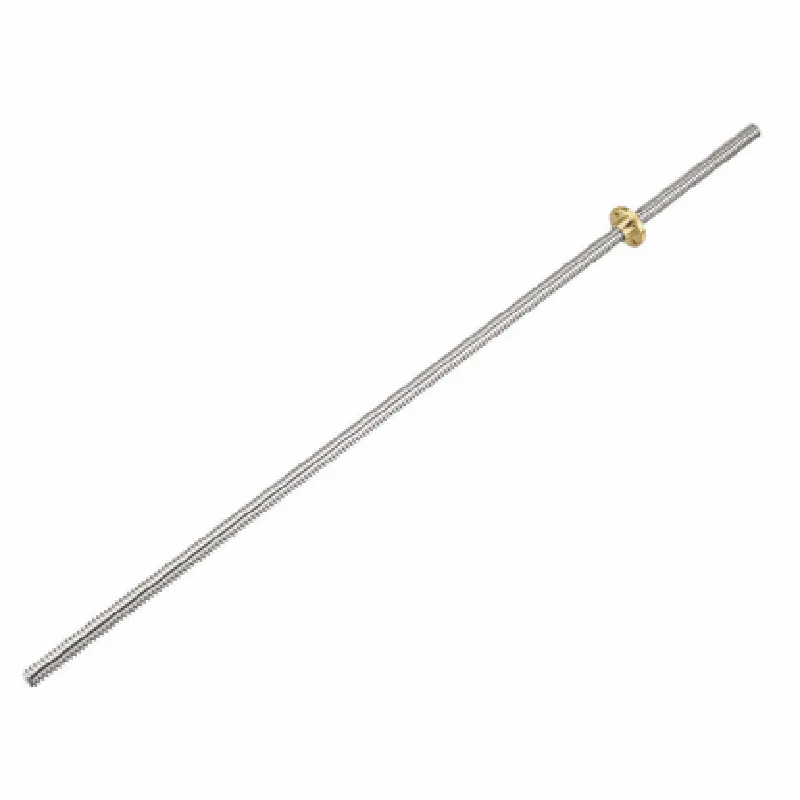
600mm Trapezoidal 4 Start Lead Screw 8mm Thread 2mm Pitch Lead Screw with Copper Nut

Buy Now on Stufin

Component Description

600mm Trapezoidal 4 Start Lead Screw 8mm Thread 2mm Pitch Lead Screw with Copper Nut

Overview

The 600mm Trapezoidal 4 Start Lead Screw 8mm Thread 2mm Pitch Lead Screw with Copper Nut is a high-precision linear motion component designed for various applications, including robotics, CNC machines, 3D printers, and other industrial automation systems. This lead screw is engineered to provide smooth, accurate, and reliable linear movement, making it an ideal choice for applications requiring precise positioning and control.

Functionality

The lead screw's primary function is to convert rotary motion into linear motion. When paired with a motor, the lead screw's threaded shaft rotates, causing the copper nut to move linearly along the shaft, translating the rotary motion into precise linear movement. This functionality enables the control of linear actuators, sliders, and other mechanisms that require precise positioning and movement.

Key Features

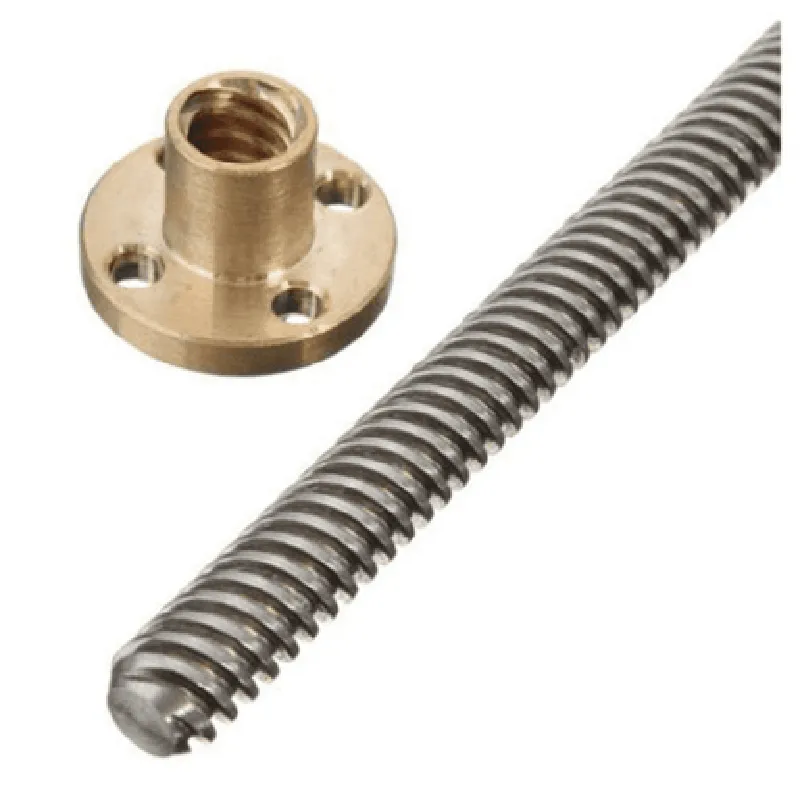
  • Trapezoidal Thread Profile: The lead screw features a trapezoidal thread profile, which provides a larger contact area between the thread and the nut, resulting in increased strength, stability, and resistance to wear and tear.
  • 4-Start Thread: The lead screw has a 4-start thread, which means that the thread has four distinct starts, allowing for faster linear movement and increased efficiency.
  • 8mm Thread Diameter: The thread diameter of the lead screw is 8mm, providing a robust and stable connection with the copper nut.
  • 2mm Pitch: The pitch of the lead screw is 2mm, which is the distance between two consecutive threads. This pitch provides a good balance between linear movement and thread strength.
  • Copper Nut: The copper nut is designed to work in conjunction with the lead screw, providing a smooth and reliable linear movement. The copper material offers excellent thermal conductivity, corrosion resistance, and lubricity, ensuring low friction and wear resistance.
  • Length: The lead screw has a total length of 600mm, making it suitable for a wide range of applications that require precise linear movement over a moderate distance.
  • Material: The lead screw is made from high-quality steel, ensuring strength, durability, and resistance to corrosion and wear.

Technical Specifications

Thread profile

Trapezoidal

Thread starts

4

Thread diameter

8mm

Pitch

2mm

Length

600mm

Material

High-quality steel

Nut material

Copper

Operating temperature

-20C to 150C

Applications

The 600mm Trapezoidal 4 Start Lead Screw 8mm Thread 2mm Pitch Lead Screw with Copper Nut is suitable for various applications, including

Robotics and automation systems

CNC machines and milling machines

3D printers and rapid prototyping systems

Linear actuators and sliders

Industrial automation systems

Medical devices and equipment

Conclusion

The 600mm Trapezoidal 4 Start Lead Screw 8mm Thread 2mm Pitch Lead Screw with Copper Nut is a high-performance linear motion component designed to provide precise and reliable movement in various industrial and automation applications. Its trapezoidal thread profile, 4-start thread, and copper nut ensure smooth operation, low friction, and high accuracy, making it an ideal choice for demanding applications.

Pin Configuration

  • Component Documentation: 600mm Trapezoidal 4 Start Lead Screw 8mm Thread 2mm Pitch Lead Screw with Copper Nut
  • Overview
  • The 600mm Trapezoidal 4 Start Lead Screw 8mm Thread 2mm Pitch Lead Screw with Copper Nut is a precision-engineered component designed for linear motion applications in robotics, CNC machines, and other industrial automation systems. This documentation provides a detailed explanation of the component's pins, their functions, and a step-by-step guide on how to connect them.
  • Pinout Diagram
  • The component features a copper nut with four pins, labeled as follows:
  • | Pin Number | Pin Function |
  • | --- | --- |
  • | 1 | Motor Shaft Connection |
  • | 2 | Ground (GND) |
  • | 3 | Direction Control (DIR) |
  • | 4 | Step Signal (STEP) |
  • Pin Description
  • 1. Motor Shaft Connection (Pin 1)
  • Function: Connects the motor shaft to the lead screw
  • Description: This pin is designed to securely attach the motor shaft to the lead screw, ensuring smooth and precise linear motion.
  • 2. Ground (GND) (Pin 2)
  • Function: Provides a common ground connection for the system
  • Description: This pin is connected to the system's ground plane, ensuring a stable and reliable operation of the lead screw and motor.
  • 3. Direction Control (DIR) (Pin 3)
  • Function: Controls the direction of the lead screw's rotation
  • Description: This pin is used to control the direction of the lead screw's rotation. Applying a logical high or low signal to this pin determines the direction of rotation.
  • 4. Step Signal (STEP) (Pin 4)
  • Function: Provides the step signal for the stepper motor
  • Description: This pin is connected to the stepper motor driver's step input, which generates the step signal necessary for the motor to rotate the lead screw.
  • Connecting the Pins (Structure)
  • To connect the pins, follow the steps below:
  • Step 1: Connect the Motor Shaft
  • Connect the motor shaft to Pin 1 (Motor Shaft Connection). Ensure a secure and snug fit to prevent any slippage or misalignment.
  • Step 2: Connect Ground
  • Connect Pin 2 (Ground) to the system's ground plane or a suitable ground point. This ensures a stable and reliable operation of the lead screw and motor.
  • Step 3: Connect Direction Control
  • Connect Pin 3 (Direction Control) to the direction control input of the stepper motor driver or a suitable control signal source. Apply a logical high or low signal to this pin to control the direction of the lead screw's rotation.
  • Step 4: Connect Step Signal
  • Connect Pin 4 (Step Signal) to the step input of the stepper motor driver or a suitable step signal source. This provides the necessary step signal for the motor to rotate the lead screw.
  • Important Notes
  • Ensure proper insulation and secure connections to prevent electrical noise, interference, or short circuits.
  • Consult the datasheet and user manual of the stepper motor driver and control system for specific connection requirements and recommendations.
  • Always follow proper safety precautions when working with electrical components and systems.
  • By following this documentation, you should be able to correctly connect the pins of the 600mm Trapezoidal 4 Start Lead Screw 8mm Thread 2mm Pitch Lead Screw with Copper Nut and ensure its proper operation in your application.

Code Examples

Component Documentation: 600mm Trapezoidal 4 Start Lead Screw 8mm Thread 2mm Pitch Lead Screw with Copper Nut
Overview
The 600mm Trapezoidal 4 Start Lead Screw 8mm Thread 2mm Pitch Lead Screw with Copper Nut is a high-precision linear motion component designed for various industrial, robotic, and automation applications. This lead screw features a trapezoidal thread profile, 4-start design, and a copper nut for efficient and smooth motion transmission.
Technical Specifications
Length: 600mm
 Thread size: 8mm
 Pitch: 2mm
 Starts: 4
 Thread profile: Trapezoidal
 Nut material: Copper
 Thread direction: Right-hand thread
 Precision class: High precision (grade C7 or better)
Code Examples
### Example 1: Basic Stepper Motor Control using Arduino
In this example, we will demonstrate how to control the lead screw using an Arduino board and a stepper motor driver. We will use the A4988 stepper motor driver to control a NEMA 17 stepper motor connected to the lead screw.
Hardware Requirements
Arduino Uno board
 A4988 Stepper Motor Driver
 NEMA 17 Stepper Motor
 600mm Trapezoidal 4 Start Lead Screw 8mm Thread 2mm Pitch Lead Screw with Copper Nut
Code
```c
#include <Stepper.h>
// Define constants for the stepper motor
const int stepsPerRevolution = 200;  // 200 steps per revolution
const int motorSpeed = 100;  // RPM
// Create a Stepper object
Stepper myStepper(stepsPerRevolution, 8, 9, 10, 11);
void setup() {
  // Initialize the stepper motor
  myStepper.setSpeed(motorSpeed);
}
void loop() {
  // Move the lead screw 100mm forward
  myStepper.step(100  (2  3.14159 / (2  2))); // Convert mm to steps
  delay(1000);
// Move the lead screw 50mm backward
  myStepper.step(-50  (2  3.14159 / (2  2))); // Convert mm to steps
  delay(1000);
}
```
### Example 2: Linear Motion Control using Python and Raspberry Pi
In this example, we will demonstrate how to control the lead screw using a Raspberry Pi board and a Python script. We will use the RPi.GPIO library to control a stepper motor driver connected to the lead screw.
Hardware Requirements
Raspberry Pi board
 RPi.GPIO library
 Stepper motor driver (e.g., L293D)
 NEMA 17 Stepper Motor
 600mm Trapezoidal 4 Start Lead Screw 8mm Thread 2mm Pitch Lead Screw with Copper Nut
Code
```python
import RPi.GPIO as GPIO
import time
# Define constants for the stepper motor
stepsPerRevolution = 200  # 200 steps per revolution
motorSpeed = 100  # RPM
# Set up GPIO pins for the stepper motor driver
GPIO.setmode(GPIO.BCM)
GPIO.setup(17, GPIO.OUT)  # Step pin
GPIO.setup(23, GPIO.OUT)  # Direction pin
# Define a function to move the lead screw
def move_lead_screw(mm, direction):
  steps = int(mm  (2  3.14159 / (2  2)))  # Convert mm to steps
  if direction == "forward":
    GPIO.output(23, GPIO.HIGH)
  else:
    GPIO.output(23, GPIO.LOW)
  
  for i in range(steps):
    GPIO.output(17, GPIO.HIGH)
    time.sleep(0.001)
    GPIO.output(17, GPIO.LOW)
    time.sleep(0.001)
# Move the lead screw 50mm forward
move_lead_screw(50, "forward")
time.sleep(1)
# Move the lead screw 25mm backward
move_lead_screw(25, "backward")
time.sleep(1)
```
These code examples demonstrate how to use the 600mm Trapezoidal 4 Start Lead Screw 8mm Thread 2mm Pitch Lead Screw with Copper Nut in various contexts. By modifying the code to suit your specific application, you can achieve precise linear motion control using this component.