100 Ohm Preset Potentiometer (Pack of 5)


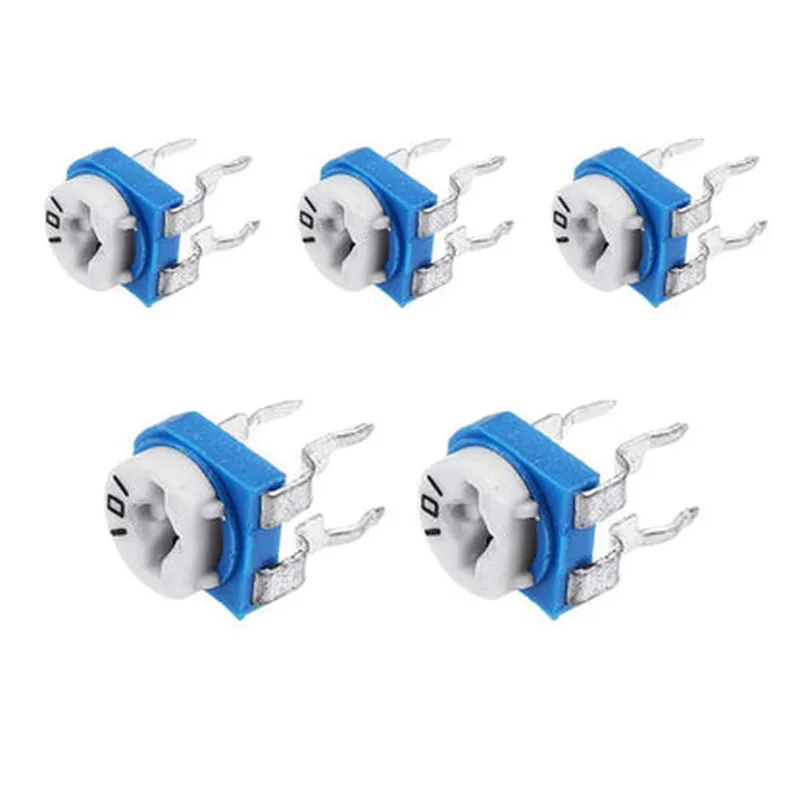
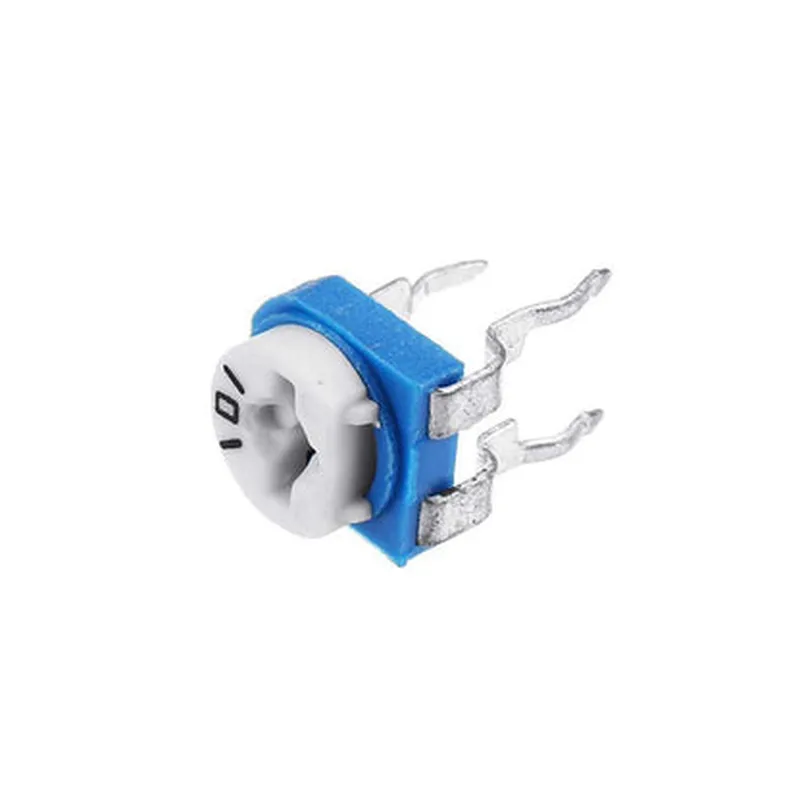
100 Ohm Preset Potentiometer (Pack of 5)
The 100 Ohm Preset Potentiometer is a type of variable resistor that allows for precise adjustment of electrical resistance in a circuit. This component is a pack of 5 identical potentiometers, each with a maximum resistance of 100 ohms. It is commonly used in electronic circuits to control voltage, current, or signal levels.
| The primary function of the 100 Ohm Preset Potentiometer is to vary the amount of resistance in a circuit, allowing for fine-tuning of signal levels, voltage dividers, and impedance matching applications. The potentiometer's rotational shaft can be adjusted to change the resistance value between the three terminals, which are typically denoted as | |
| Terminal 1 (T1) | One end of the resistive track |
| Terminal 2 (T2) | Wiper terminal (moving contact) |
| Terminal 3 (T3) | Other end of the resistive track |
When the shaft is rotated, the wiper terminal (T2) moves along the resistive track, creating a variable resistance between T1 and T2, and T2 and T3. This allows for precise control over the circuit's impedance, voltage, or current.
For detailed specifications, please refer to the manufacturer's datasheet, which can be provided upon request.
By following proper handling and usage guidelines, the 100 Ohm Preset Potentiometer (Pack of 5) can provide reliable and accurate resistance adjustment in a variety of electronic circuits.
100 Ohm Preset Potentiometer - (Pack of 5) Component DocumentationOverviewThe 100 Ohm Preset Potentiometer is a rotary potentiometer that provides a precise and adjustable resistance value of 100 Ohms. This component is commonly used in electronic circuits to control the volume, tone, or other parameters of electronic devices. This pack of 5 potentiometers is ideal for prototyping or small-scale production.Pinout and DimensionsThe 100 Ohm Preset Potentiometer has a standard 3-pin configuration:Pin 1: CCW (Counter-ClockWise) terminal
Pin 2: Wiper terminal
Pin 3: CW (ClockWise) terminalThe potentiometer has a cylindrical body with a diameter of 9mm and a height of 10mm. The shaft length is 15mm, and the rotation angle is 300.Electrical CharacteristicsResistance: 100 Ohms 10%
Power Rating: 0.5W
Operating Temperature: -20C to 70C
Insulation Resistance: 100M min.Example 1: Basic Analog Input with ArduinoIn this example, we will use the 100 Ohm Preset Potentiometer to control the brightness of an LED connected to an Arduino board.Components:100 Ohm Preset Potentiometer
Arduino Board (e.g., Arduino Uno)
LED
220 Ohm Resistor
Breadboard and jumper wiresCode:
```c++
const int potPin = A0; // Analog input pin for potentiometer
const int ledPin = 9; // Digital output pin for LEDvoid setup() {
pinMode(ledPin, OUTPUT);
}void loop() {
int potValue = analogRead(potPin); // Read potentiometer value (0-1023)
int brightness = map(potValue, 0, 1023, 0, 255); // Map pot value to LED brightness (0-255)
analogWrite(ledPin, brightness); // Set LED brightness
delay(10);
}
```
Example 2: Audio Volume Control with Raspberry PiIn this example, we will use the 100 Ohm Preset Potentiometer to control the volume of a audio output connected to a Raspberry Pi.Components:100 Ohm Preset Potentiometer
Raspberry Pi (e.g., Raspberry Pi 4)
Audio Jack
Breadboard and jumper wiresCode:
```python
import RPi.GPIO as GPIO
import timeGPIO.setmode(GPIO.BCM)pot_pin = 17 # GPIO pin for potentiometer
audio_pin = 18 # GPIO pin for audio outputGPIO.setup(pot_pin, GPIO.IN)
GPIO.setup(audio_pin, GPIO.OUT)while True:
pot_value = GPIO.input(pot_pin) # Read potentiometer value (0 or 1)
if pot_value == 1:
volume = 100 # Maximum volume
else:
volume = 0 # Minimum volume
os.system(f"amixer -D pulse sset Master {volume}%") # Set audio volume using amixer
time.sleep(0.05)
```
Note: The above examples are for demonstration purposes only and may require additional components, libraries, or setup to function properly.