

Stufin
Home Quick Cart Profile

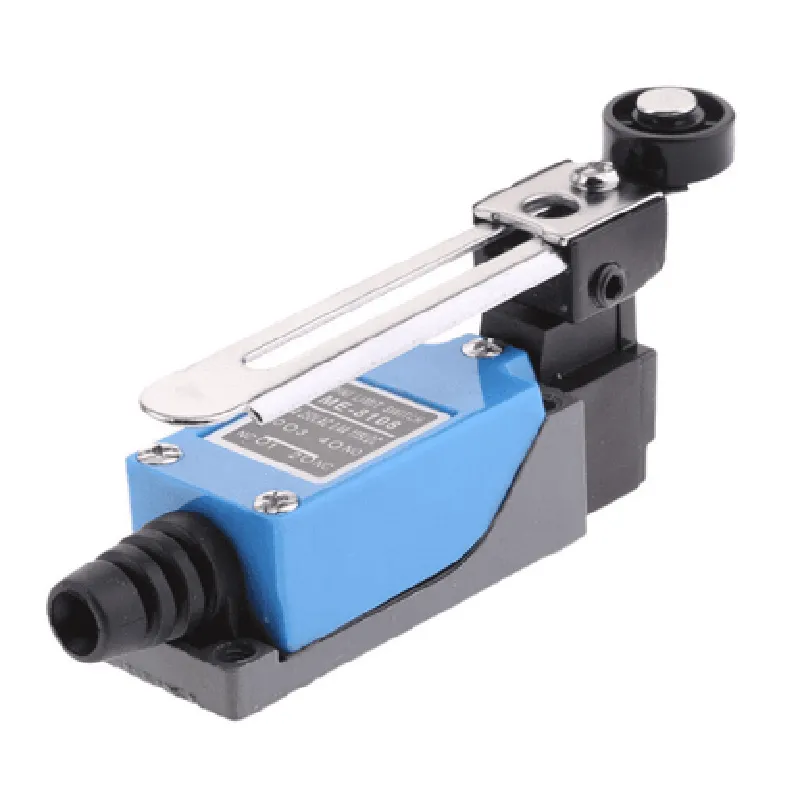
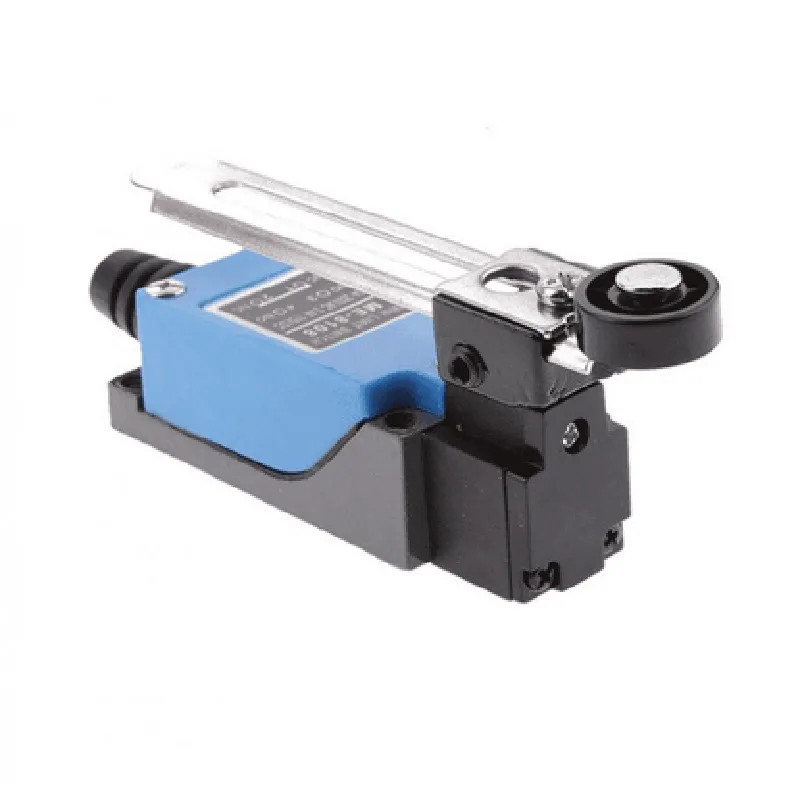
ME-8108 Rotary Adjustable Roller Lever Arm AC Limit Switch

Buy Now on Stufin

Component Name

ME-8108 Rotary Adjustable Roller Lever Arm AC Limit Switch

Overview

The ME-8108 Rotary Adjustable Roller Lever Arm AC Limit Switch is a type of electromechanical switch designed for applications that require precise control and feedback in industrial automation, robotics, and other machine-building environments. This component combines the benefits of a rotary adjustable lever arm with an AC-powered limit switch, providing a versatile and reliable solution for detecting and controlling mechanical movements.

Functionality

The ME-8108 Rotary Adjustable Roller Lever Arm AC Limit Switch is designed to detect the physical movement of an object or mechanism and transmit an electrical signal to a control system or microcontroller. The component consists of a rotary lever arm with an adjustable roller that makes contact with a moving object, and an AC-powered limit switch that generates an electrical output signal when the lever arm reaches a specific position.

The rotary lever arm is adjustable, allowing users to customize the angle of rotation and the distance between the roller and the switching mechanism. This feature enables the component to accommodate various application requirements and object sizes.

When the moving object comes into contact with the roller, the lever arm rotates, triggering the AC-powered limit switch to open or close, depending on the switch's configuration. The electrical output signal is then transmitted to a control system or microcontroller, which can interpret the signal to perform specific actions, such as turning on/off a motor, alarm, or indicator light.

Key Features

  • Rotary Adjustable Lever Arm: The lever arm can be adjusted to accommodate different angles of rotation and distances between the roller and the switching mechanism.
  • AC-Powered Limit Switch: The component is powered by an AC voltage source, making it suitable for industrial and commercial applications.
  • High-Accuracy Detection: The roller lever arm provides precise detection of mechanical movements, ensuring reliable control and feedback.
  • Customizable: The adjustable lever arm allows users to customize the component to fit specific application requirements.
  • Durable Construction: The component is built with durable materials to withstand harsh industrial environments and heavy-duty use.
  • Easy Installation: The ME-8108 is designed for easy installation and maintenance, with a compact design and accessible wiring terminals.
  • Multiple Mounting Options: The component can be mounted in various orientations, including vertical, horizontal, or angled, to accommodate different installation requirements.

Technical Specifications

Power Supply

100-240V AC, 50/60Hz

Output Signal

SPDT (Single Pole Double Throw) or SPST (Single Pole Single Throw) configurable

Contact Rating

10A @ 250V AC

Adjustable Angle

0 to 360

Adjustable Distance

10mm to 50mm

Operating Temperature

-20C to 80C

Dimensions

120mm x 60mm x 40mm (L x W x H)

Applications

The ME-8108 Rotary Adjustable Roller Lever Arm AC Limit Switch is suitable for various industrial automation applications, including

Robotics and Machine Building

Detecting and controlling mechanical movements in robotic arms, conveyor systems, and other machine-building applications.

Industrial Automation

Monitoring and controlling the movement of gears, levers, and other mechanical components in industrial automation systems.

Process Control

Detecting and controlling the movement of valves, pumps, and other process control equipment.

By providing precise control and feedback, the ME-8108 Rotary Adjustable Roller Lever Arm AC Limit Switch is an essential component in various industrial automation applications.

Pin Configuration

  • ME-8108 Rotary Adjustable Roller Lever Arm AC Limit Switch Pinout and Connection Guide
  • The ME-8108 is a rotary adjustable roller lever arm AC limit switch, commonly used in industrial automation and robotics applications. This document provides a detailed explanation of the pins and their functions, as well as a step-by-step guide on how to connect them.
  • Pinout Diagram:
  • The ME-8108 limit switch has a total of 6 pins, arranged in a single row on the bottom of the device.
  • Pin Functions:
  • 1. NC (Normally Closed):
  • Function: Normally closed contact, connected to the output when the switch is not activated.
  • Pin Type: Output
  • Connection: Connect to the device that should be turned off when the switch is not activated.
  • 2. NO (Normally Open):
  • Function: Normally open contact, connected to the output when the switch is activated.
  • Pin Type: Output
  • Connection: Connect to the device that should be turned on when the switch is activated.
  • 3. COM (Common):
  • Function: Common contact, connected to both NC and NO contacts.
  • Pin Type: Input
  • Connection: Connect to the power supply or signal source.
  • 4. GND (Ground):
  • Function: Ground connection for the switch.
  • Pin Type: Input
  • Connection: Connect to the system ground or negative power supply.
  • 5. V+ (Positive Power Supply):
  • Function: Positive power supply connection for the switch's internal circuitry.
  • Pin Type: Input
  • Connection: Connect to the positive power supply (typically +12V or +24V).
  • 6. ADJ (Adjustment):
  • Function: Adjustment pin for setting the rotary switch's activation point.
  • Pin Type: Input
  • Connection: Connect to a potentiometer or adjustable resistor to set the switch's activation point.
  • Connection Structure:
  • To connect the ME-8108 limit switch, follow these steps:
  • Step 1: Power Connection
  • Connect the V+ pin to a positive power supply (+12V or +24V).
  • Connect the GND pin to the system ground or negative power supply.
  • Step 2: Output Connections
  • Connect the NC pin to the device that should be turned off when the switch is not activated.
  • Connect the NO pin to the device that should be turned on when the switch is activated.
  • Step 3: Common Connection
  • Connect the COM pin to the power supply or signal source.
  • Step 4: Adjustment
  • Connect the ADJ pin to a potentiometer or adjustable resistor to set the switch's activation point.
  • Important Notes:
  • Make sure to connect the power supply and ground correctly to avoid damage to the switch or connected devices.
  • The ME-8108 limit switch is designed for AC applications, so ensure that the power supply and connected devices are compatible with the switch's operating voltage.
  • Adjust the ADJ pin carefully to set the desired activation point for the switch.
  • By following this pinout and connection guide, you can successfully integrate the ME-8108 rotary adjustable roller lever arm AC limit switch into your industrial automation or robotics application.

Code Examples

ME-8108 Rotary Adjustable Roller Lever Arm AC Limit Switch Documentation
Overview
The ME-8108 is a rotary adjustable roller lever arm AC limit switch designed for use in industrial automation, robotics, and IoT applications. It features a compact design, adjustable lever arm, and SPDT (Single Pole Double Throw) contacts. The switch is suitable for use in AC circuits up to 250V and 10A.
Pinout and Electrical Characteristics
Pin 1: Common (C)
 Pin 2: Normally Open (NO)
 Pin 3: Normally Closed (NC)
 Operating voltage: 250V AC
 Operating current: 10A
 Contact resistance: < 10m
 Insulation resistance: > 100M
Code Examples
### Example 1: Basic Switch State Monitoring with Arduino
In this example, we will use the ME-8108 limit switch with an Arduino board to monitor the switch state and control an LED accordingly.
Hardware Requirements:
Arduino Board (e.g. Arduino Uno)
 ME-8108 Rotary Adjustable Roller Lever Arm AC Limit Switch
 LED
 1 k resistor
 Breadboard and jumper wires
Code:
```c
const int switchPin = 2;  // Pin 2 of the ME-8108 connected to digital pin 2 of Arduino
const int ledPin = 13;   // Built-in LED on Arduino board
void setup() {
  pinMode(switchPin, INPUT);
  pinMode(ledPin, OUTPUT);
}
void loop() {
  int switchState = digitalRead(switchPin);
  if (switchState == HIGH) {
    digitalWrite(ledPin, HIGH);  // Turn on the LED when the switch is closed
  } else {
    digitalWrite(ledPin, LOW);  // Turn off the LED when the switch is open
  }
  delay(50);
}
```
### Example 2: HOME AUTOMATION using Raspberry Pi and Python
In this example, we will use the ME-8108 limit switch with a Raspberry Pi to control a relay module and automate a home appliance.
Hardware Requirements:
Raspberry Pi (e.g. Raspberry Pi 4)
 ME-8108 Rotary Adjustable Roller Lever Arm AC Limit Switch
 Relay Module (e.g. SRD-05VDC-SL-C)
 Home appliance (e.g. lamp)
Code:
```python
import RPi.GPIO as GPIO
import time
# Set up GPIO mode
GPIO.setmode(GPIO.BCM)
# Define pins
switch_pin = 17  # Pin 2 of the ME-8108 connected to GPIO 17 of Raspberry Pi
relay_pin = 23  # Relay module connected to GPIO 23 of Raspberry Pi
# Set up pins as input and output
GPIO.setup(switch_pin, GPIO.IN, pull_up_down=GPIO.PUD_UP)
GPIO.setup(relay_pin, GPIO.OUT)
while True:
    switch_state = GPIO.input(switch_pin)
    if switch_state == GPIO.HIGH:
        GPIO.output(relay_pin, GPIO.HIGH)  # Turn on the relay when the switch is closed
    else:
        GPIO.output(relay_pin, GPIO.LOW)  # Turn off the relay when the switch is open
    time.sleep(0.5)
```
Note: Make sure to install the RPi.GPIO library and configure the Raspberry Pi's GPIO pins according to the documentation.
Additional Resources
Datasheet: [ME-8108 Rotary Adjustable Roller Lever Arm AC Limit Switch Datasheet](https://example.com/me-8108-datasheet.pdf)
 Application Notes: [ME-8108 Limit Switch Application Notes](https://example.com/me-8108-appnotes.pdf)
By following these examples and consulting the provided resources, you should be able to integrate the ME-8108 limit switch into your IoT projects and take advantage of its features.