100K 16mm Rotary Potentiometer (Pack of 5)


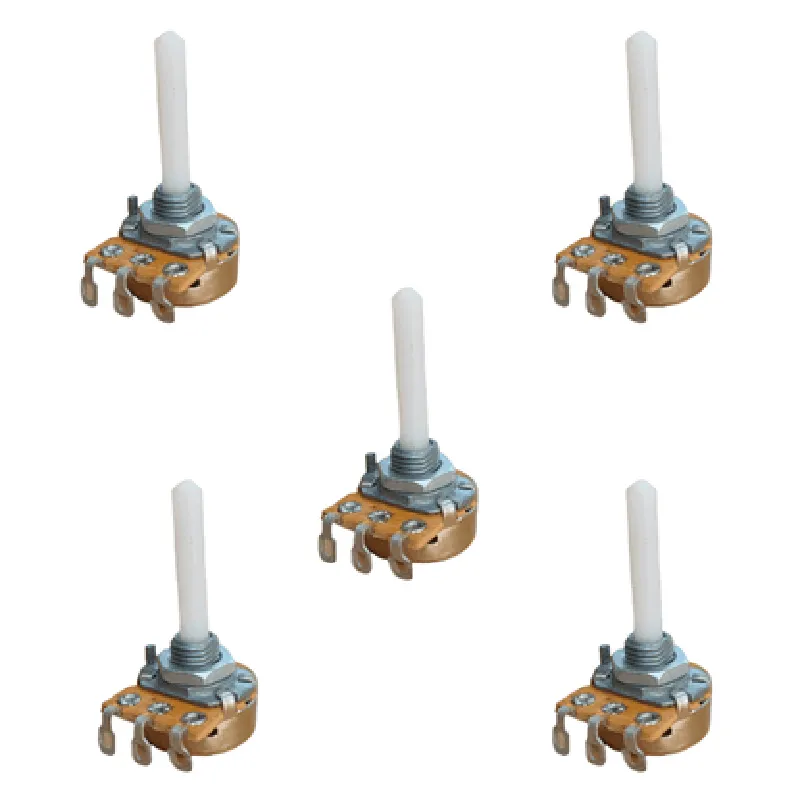
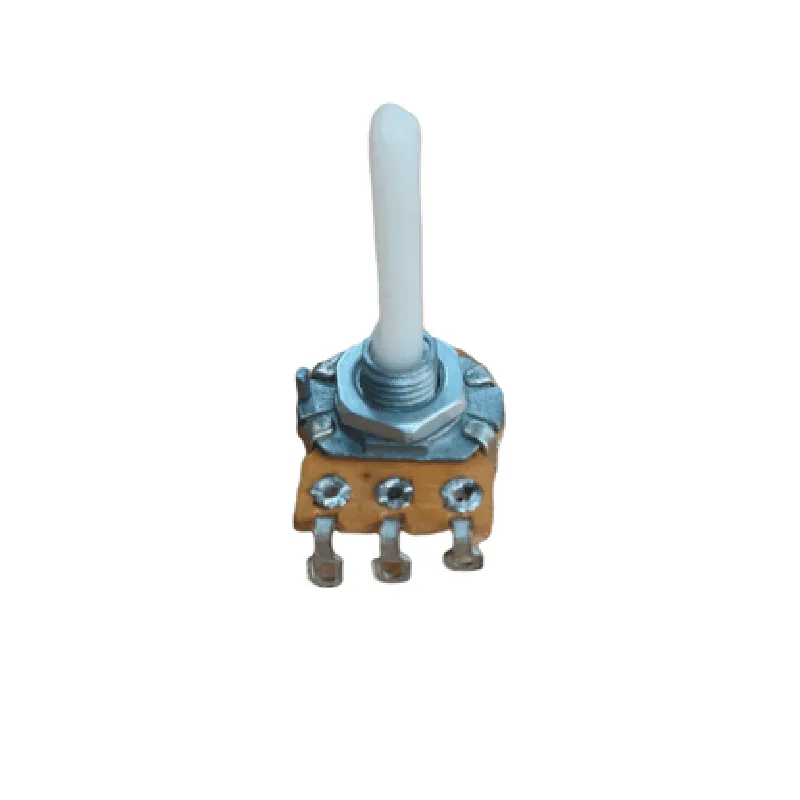
100K 16mm Rotary Potentiometer (Pack of 5)
The 100K 16mm Rotary Potentiometer is a type of variable resistor used to measure and control angular displacement, rotation, or position. This pack of 5 potentiometers is designed for various applications in the Internet of Things (IoT), robotics, and electronic projects. The rotary potentiometer provides a smooth and precise variation in resistance, making it an ideal component for sensing and control systems.
The 100K 16mm Rotary Potentiometer operates by converting the mechanical rotation of the shaft into a proportional change in electrical resistance. When the shaft is turned, the wiper (a moving contact) slides along the resistive track, dividing the total resistance into two parts. The resistance between the wiper and one end of the track increases, while the resistance between the wiper and the other end decreases. This variation in resistance is directly proportional to the angular displacement of the shaft.
| Parameter | Value |
| --- | --- |
| Resistance | 100 k |
| Rotation Angle | 300 |
| Shaft Diameter | 16 mm |
| Shaft Length | 25 mm |
| Wiper Travel | 300 |
| Linearity | 1% |
| Operating Temperature | -20C to 70C |
| Power Rating | 0.5 W |
| Insulation Resistance | 100 M |
16 mm
25 mm
25 mm
Plastic
Metal
| The rotary potentiometer has a standard 3-pin configuration | |
| Pin 1 | CW (Clockwise) Terminal |
| Pin 2 | Wiper Terminal |
| Pin 3 | CCW (Counter-Clockwise) Terminal |
| _mounting and Installation |
The rotary potentiometer can be mounted using the provided screws or adhesive. Ensure proper alignment and secure fastening to prevent vibration or movement during operation. Additionally, follow proper soldering and wiring practices to avoid damage or electrical noise.
Component Documentation: 100K 16mm Rotary Pot (Pack of 5)OverviewThe 100K 16mm Rotary Pot is a precision potentiometer designed for accurate and reliable angular position sensing. This component is commonly used in various IoT applications, including robotics, automation, and human-machine interfaces. The pack of 5 provides a cost-effective solution for prototyping and production.SpecificationsResistance: 100 k
Rotary angle: 0 - 340 degrees
Power rating: 0.1 W
Operating temperature: -20C to 70C
Dimensions: 16 mm diameter, 10 mm height
Pinout: 3-pin (CCW, Wiper, CW)Code Examples### Example 1: Reading Rotary Pot Position with ArduinoIn this example, we'll use an Arduino Uno board to read the rotary pot position and print the corresponding analog value to the serial console.Hardware Requirements100K 16mm Rotary Pot
Arduino Uno board
Breadboard and jumper wiresCode
```c++
const int potPin = A0; // Analog input pin for rotary potvoid setup() {
Serial.begin(9600);
}void loop() {
int potValue = analogRead(potPin);
Serial.print("Rotary pot position: ");
Serial.println(potValue);
delay(50);
}
```
ExplanationIn this example, we connect the rotary pot wiper (middle pin) to Arduino's analog input pin A0. We then use the `analogRead()` function to read the analog value from the pot, which ranges from 0 to 1023. The `Serial.println()` function is used to print the value to the serial console.### Example 2: Using Rotary Pot as a Volume Control with Raspberry PiIn this example, we'll use a Raspberry Pi to read the rotary pot position and control the system volume.Hardware Requirements100K 16mm Rotary Pot
Raspberry Pi (any model)
Breadboard and jumper wires
Speaker or audio output deviceCode
```python
import RPi.GPIO as GPIO
import osGPIO.setmode(GPIO.BCM)
pot_pin = 17 # GPIO pin for rotary pot
GPIO.setup(pot_pin, GPIO.IN)def set_volume(pot_value):
volume = int(pot_value / 1023 100) # Map 0-1023 to 0-100
os.system(f"amixer -D pulse sset Master {volume}%")while True:
pot_value = GPIO.input(pot_pin)
set_volume(pot_value)
time.sleep(0.05)
```
ExplanationIn this example, we connect the rotary pot wiper (middle pin) to a GPIO input pin on the Raspberry Pi. We then use the `GPIO.input()` function to read the digital value from the pot. The `set_volume()` function maps the pot value to a system volume percentage, and the `os.system()` function is used to set the system volume using the `amixer` command.These examples demonstrate how to use the 100K 16mm Rotary Pot in various IoT applications. By reading the rotary pot position, you can create interactive and intuitive interfaces for your projects.