

Stufin
Home Quick Cart Profile

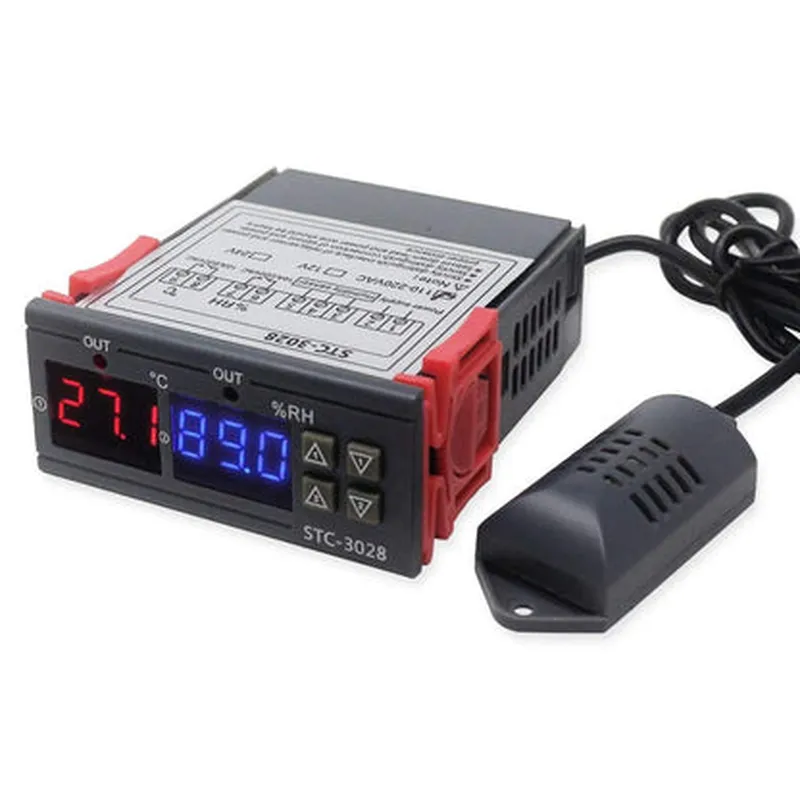
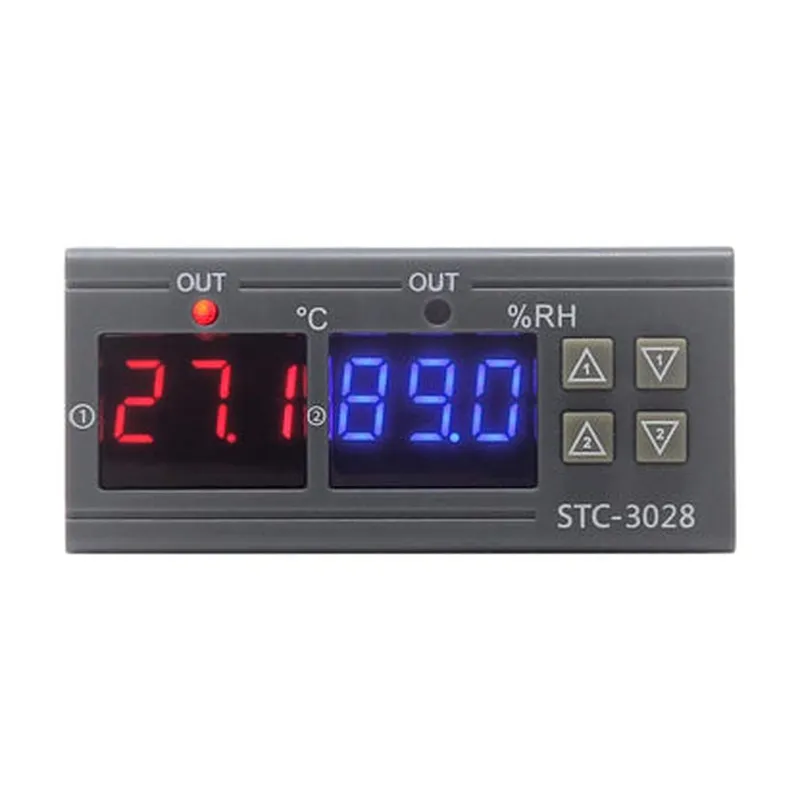
STC-3028 Digital Temperature Humidity Controller 110-220V

Buy Now on Stufin

Temperature Measurement Range

-50C to 120C

Temperature Accuracy

0.5C

Humidity Measurement Range

0-100% RH

Humidity Accuracy

3%

Power Supply

110-220V AC, 50/60Hz

Relay Output Rating

3A, 250V AC

Operating Temperature

-10C to 50C

Storage Temperature

-20C to 60C

Dimensions

72mm x 36mm x 65mm

Weight

Approx. 200g

Applications

The STC-3028 Digital Temperature Humidity Controller is suitable for use in various applications, including

Greenhouse climate control

Agricultural automation

Livestock breeding

Industrial automation systems

Laboratory environments

Food storage and processing facilities

Museums and art galleries

Server rooms and data centers

Pin Configuration

  • STC-3028 Digital Temperature Humidity Controller 110-220V Pinout Documentation
  • The STC-3028 is a digital temperature and humidity controller designed for various IoT applications. It features a compact design, high accuracy, and ease of use. This documentation outlines the pinout structure and explains each pin's function to facilitate seamless integration into your IoT projects.
  • Pinout Structure:
  • The STC-3028 has a total of 11 pins, divided into three categories: Power, Sensors, and Output.
  • Power Pins (4):
  • 1. VCC (Pin 1):
  • Function: Power supply pin (110-220V AC)
  • Description: Connect to a suitable power source within the specified voltage range.
  • 2. GND (Pin 2):
  • Function: Ground pin
  • Description: Connect to the system ground or negative terminal of the power source.
  • 3. VCC1 (Pin 9):
  • Function: Internal power supply pin (5V DC)
  • Description: This pin provides a regulated 5V DC output, which can be used to power external devices or sensors.
  • 4. GND1 (Pin 10):
  • Function: Internal ground pin
  • Description: Connect to the system ground or negative terminal of the power source.
  • Sensor Pins (4):
  • 1. TP (Pin 3):
  • Function: Temperature sensor input pin
  • Description: Connect to a temperature sensor (e.g., thermistor or thermocouple) to measure temperature.
  • 2. HP (Pin 4):
  • Function: Humidity sensor input pin
  • Description: Connect to a humidity sensor (e.g., capacitive or resistive) to measure relative humidity.
  • 3. TP- (Pin 5):
  • Function: Temperature sensor negative input pin (optional)
  • Description: Connect to the negative leg of a differential temperature sensor (if used). Otherwise, leave unconnected.
  • 4. HP- (Pin 6):
  • Function: Humidity sensor negative input pin (optional)
  • Description: Connect to the negative leg of a differential humidity sensor (if used). Otherwise, leave unconnected.
  • Output Pins (3):
  • 1. OUT1 (Pin 7):
  • Function: Relay output pin 1
  • Description: Connect to a relay or a load to control it based on the set temperature and humidity values.
  • 2. OUT2 (Pin 8):
  • Function: Relay output pin 2
  • Description: Connect to a relay or a load to control it based on the set temperature and humidity values.
  • 3. BUZ (Pin 11):
  • Function: Buzzer output pin
  • Description: Connect to a buzzer or alarm device to indicate alerts or warnings.
  • Connecting the Pins:
  • When connecting the pins, ensure that:
  • Use suitable connectors, wires, and soldering techniques to prevent damage to the device.
  • Observe proper polarity when connecting power sources, sensors, and output devices.
  • Refer to the datasheet for specific guidelines on sensor connection and output configuration.
  • By following this pinout documentation, you can successfully integrate the STC-3028 Digital Temperature Humidity Controller into your IoT projects, ensuring accurate temperature and humidity control, and efficient system automation.

Code Examples

STC-3028 Digital Temperature Humidity Controller 110-220V Documentation
Overview
The STC-3028 is a digital temperature and humidity controller designed for various applications, including HVAC, refrigeration, and industrial automation. This device features a wide input voltage range of 110-220V, making it suitable for use in diverse environments. The STC-3028 provides accurate temperature and humidity control, with programmable setpoints and hysteresis values.
Technical Specifications
Input Voltage: 110-220V AC
 Temperature Measurement Range: -20C to 60C
 Humidity Measurement Range: 0-99% RH
 Temperature Accuracy: 0.5C
 Humidity Accuracy: 5% RH
 Output Relay: 10A, 250V AC
 Communication Interface: None
Pinout
The STC-3028 has the following pinout:
| Pin | Function |
| --- | --- |
| 1 | VCC (110-220V AC) |
| 2 | GND (Ground) |
| 3 | Temperature Sensor Input |
| 4 | Humidity Sensor Input |
| 5 | Relay Output ( Normally Open) |
| 6 | Relay Output ( Normally Closed) |
Code Examples
### Example 1: Basic Temperature Control using Arduino
In this example, we will use the STC-3028 to control a temperature-based fan system using an Arduino board.
Arduino Code:
```c++
const int tempSensorPin = A0;  // Temperature sensor input pin
const int relayPin = 9;  // Relay output pin
void setup() {
  pinMode(relayPin, OUTPUT);
}
void loop() {
  int tempReading = analogRead(tempSensorPin);
  float temperature = tempReading  0.488;  // Convert to Celsius
if (temperature > 25) {
    digitalWrite(relayPin, HIGH);  // Turn on the fan
  } else {
    digitalWrite(relayPin, LOW);  // Turn off the fan
  }
  delay(1000);
}
```
### Example 2: Humidity-Based Ventilation System using Raspberry Pi
In this example, we will use the STC-3028 to control a humidity-based ventilation system using a Raspberry Pi.
Python Code:
```python
import RPi.GPIO as GPIO
import time
GPIO.setmode(GPIO.BCM)
GPIO.setup(17, GPIO.OUT)  // Relay output pin
while True:
    humidity = get_humidity()  // Read humidity value from STC-3028
    if humidity > 60:
        GPIO.output(17, GPIO.HIGH)  // Open the ventilation system
    else:
        GPIO.output(17, GPIO.LOW)  // Close the ventilation system
    time.sleep(1)
```
Note: The above code examples assume that the STC-3028 is properly connected to the microcontroller/board and that the temperature and humidity sensors are connected to the respective input pins.
These examples demonstrate how to use the STC-3028 in different contexts, highlighting its flexibility and ease of integration into various IoT applications.