

Stufin
Home Quick Cart Profile

74LS161 Synch 4-Bit Counter

Buy Now on Stufin

Component Name

74LS161 Synch 4-Bit Counter

Overview

The 74LS161 is a synchronous 4-bit counter integrated circuit (IC) that belongs to the 74LS (Low-power Schottky) logic family. This IC is designed to operate in digital systems and provides a high-speed, low-power, and synchronous counting capability.

Functionality

  • Binary Counter: The IC can be used as a 4-bit binary counter, where it counts the clock pulses and generates a binary output (Q0 - Q3) that represents the count.
  • Modulus Counter: The IC can be programmed to count up to a specific modulus (maximum count) and then reset to zero. This is achieved by connecting the Q0 - Q3 outputs to the preset enable inputs (PE0 - PE3).
  • Up/Down Counter: The IC can be used as an up/down counter by connecting the up/down input (U/D) to a control signal. When the U/D input is high, the counter counts up, and when it is low, the counter counts down.
  • Programmable Counter: The IC can be programmed to count up to a specific value and then stop. This is achieved by connecting the Q0 - Q3 outputs to the preset enable inputs (PE0 - PE3) and the load input (LD) to a control signal.
The 74LS161 is a programmable counter that can be used to count clock pulses and generate a binary output. It can be configured to operate in one of four modes

Key Features

Synchronous Operation

The 74LS161 operates synchronously, meaning that the counter output changes state on the clock pulse edge (rising or falling, depending on the mode).

4-Bit CounterThe IC has four output bits (Q0 - Q3) that represent the count.

Programmable

The IC can be programmed to count up to a specific value or modulus.

Asynchronous Reset

The IC has an asynchronous reset input (R) that can be used to reset the counter to zero.

Asynchronous Load

The IC has an asynchronous load input (LD) that can be used to load a preset value into the counter.

Up/Down CountingThe IC can be used as an up/down counter by connecting the up/down input (U/D) to a control signal.

Low Power Consumption

The 74LS161 has a low power consumption, making it suitable for battery-powered devices.

High-Speed OperationThe IC operates at high speeds, making it suitable for high-frequency applications.

Pinout

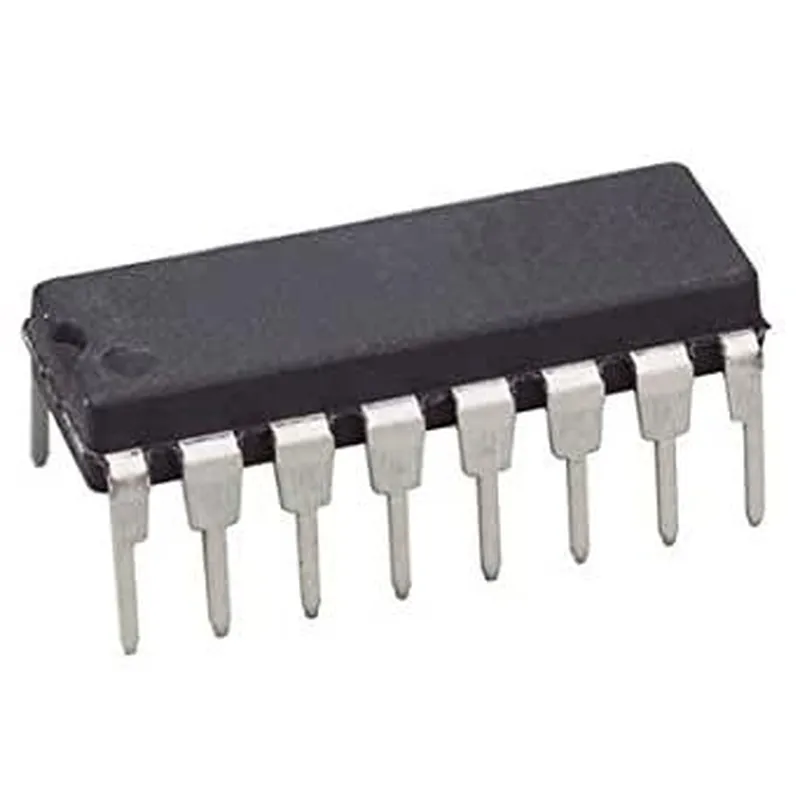
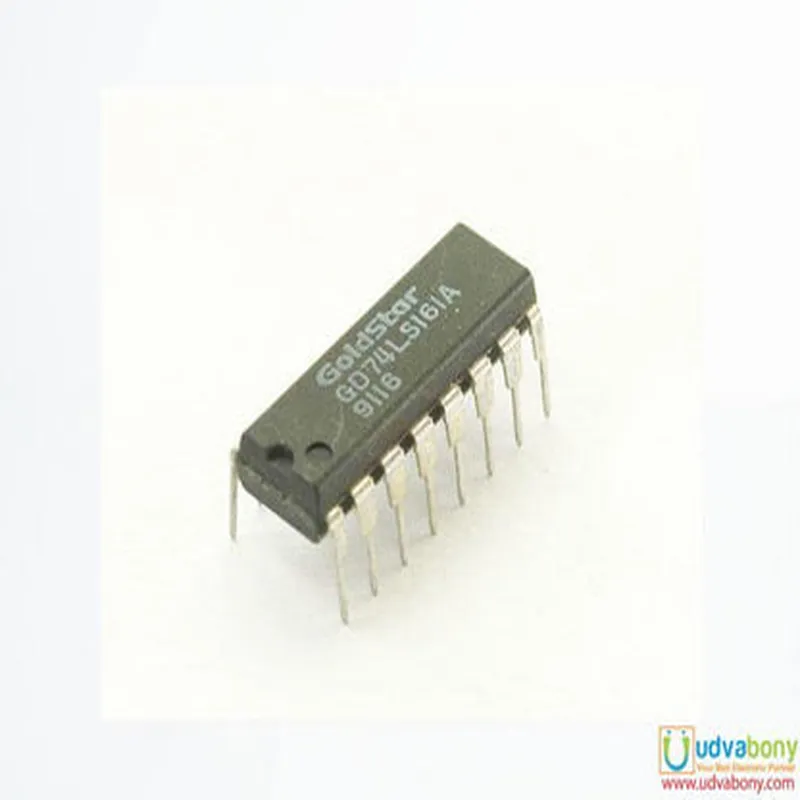
The 74LS161 has a 16-pin DIP (Dual In-Line Package) package with the following pinout

| Pin# | Pin Name | Description |

| --- | --- | --- |

| 1 | R | Asynchronous Reset Input |

| 2 | LD | Asynchronous Load Input |

| 3 | PE0 | Preset Enable Input (Bit 0) |

| 4 | PE1 | Preset Enable Input (Bit 1) |

| 5 | PE2 | Preset Enable Input (Bit 2) |

| 6 | PE3 | Preset Enable Input (Bit 3) |

| 7 | U/D | Up/Down Input |

| 8 | CLK | Clock Input |

| 9 | Q0 | Output Bit 0 |

| 10 | Q1 | Output Bit 1 |

| 11 | Q2 | Output Bit 2 |

| 12 | Q3 | Output Bit 3 |

| 13 | Vcc | Power Supply (Positive) |

| 14 | GND | Power Supply (Negative) |

Operating Conditions

supply Voltage

4.75V to 5.25V

Operating Temperature

0C to 70C

Clock Frequency

Up to 25 MHz

Applications

The 74LS161 is commonly used in digital systems that require a high-speed, low-power, and synchronous counting capability. Typical applications include

Digital Counters

The IC can be used to build digital counters for various applications.

Frequency Dividers

The IC can be used to divide a clock frequency by a specific value.

Digital Clocks

The IC can be used to build digital clocks with precise timekeeping.

Microcontrollers

The IC can be used as a peripheral component in microcontroller-based systems.

Conclusion

The 74LS161 is a versatile and high-performance synchronous 4-bit counter IC that provides a range of features and operating modes. Its low power consumption, high-speed operation, and programmability make it suitable for a wide range of applications in digital systems.

Pin Configuration

  • 74LS161 Synch 4-Bit Counter Pinout and Description
  • The 74LS161 is a synchronous 4-bit binary counter integrated circuit (IC) widely used in digital electronic circuits. It has 16 pins, and each pin has a specific function. Here's a detailed explanation of each pin, including its function and how to connect them:
  • Pin 1: RCO (Ripple Clock Output)
  • --------------------------------
  • Function: Provides a clock output signal when the counter overflows from 1111 to 0000.
  • Connection: Connect to the clock input of another counter or a logic circuit that requires a clock signal.
  • Pin 2: QA (Q1)
  • -----------------
  • Function: Output of the least significant bit (LSB) of the counter.
  • Connection: Connect to a microcontroller, logic circuit, or other devices that require the counter's output.
  • Pin 3: QB (Q2)
  • -----------------
  • Function: Output of the second least significant bit of the counter.
  • Connection: Connect to a microcontroller, logic circuit, or other devices that require the counter's output.
  • Pin 4: QC (Q3)
  • -----------------
  • Function: Output of the third least significant bit of the counter.
  • Connection: Connect to a microcontroller, logic circuit, or other devices that require the counter's output.
  • Pin 5: QD (Q4)
  • -----------------
  • Function: Output of the most significant bit (MSB) of the counter.
  • Connection: Connect to a microcontroller, logic circuit, or other devices that require the counter's output.
  • Pin 6: VCC (Positive Supply Voltage)
  • -------------------------------------
  • Function: Provides the positive power supply voltage to the IC.
  • Connection: Connect to a positive voltage source (typically +5V) through a decoupling capacitor.
  • Pin 7: ENP (Enable Parallel Load)
  • ---------------------------------
  • Function: Enables the parallel load function, allowing the counter to load a preset value from the input pins.
  • Connection: Connect to a logic high (VCC) to enable parallel load or a logic low (GND) to disable it.
  • Pin 8: ENT (Enable Count)
  • -----------------------------
  • Function: Enables the counter to count clock pulses.
  • Connection: Connect to a logic high (VCC) to enable counting or a logic low (GND) to disable it.
  • Pin 9: CP (Clock Pulse Input)
  • -------------------------------
  • Function: Receives the clock input signal that triggers the counter to increment.
  • Connection: Connect to a clock signal source, such as a crystal oscillator or a pulse generator.
  • Pin 10: D (Data Input)
  • -------------------------
  • Function: Input data for parallel loading.
  • Connection: Connect to a logic circuit or microcontroller that provides the parallel load data.
  • Pin 11: C (Data Input)
  • -------------------------
  • Function: Input data for parallel loading.
  • Connection: Connect to a logic circuit or microcontroller that provides the parallel load data.
  • Pin 12: B (Data Input)
  • -------------------------
  • Function: Input data for parallel loading.
  • Connection: Connect to a logic circuit or microcontroller that provides the parallel load data.
  • Pin 13: A (Data Input)
  • -------------------------
  • Function: Input data for parallel loading.
  • Connection: Connect to a logic circuit or microcontroller that provides the parallel load data.
  • Pin 14: GND (Ground)
  • ----------------------
  • Function: Provides the ground reference for the IC.
  • Connection: Connect to the ground plane or a negative voltage source.
  • Pin 15: NC (No Connection)
  • ---------------------------
  • Function: No internal connection.
  • Connection: Leave unconnected.
  • Pin 16: NC (No Connection)
  • ---------------------------
  • Function: No internal connection.
  • Connection: Leave unconnected.
  • Connection Structure:
  • Here's a general connection structure for the 74LS161:
  • VCC (Pin 6) -> Positive Power Supply (e.g., +5V) -> Decoupling Capacitor
  • GND (Pin 14) -> Ground Plane or Negative Voltage Source
  • CP (Pin 9) -> Clock Signal Source (e.g., Crystal Oscillator or Pulse Generator)
  • ENP (Pin 7) -> Logic High (VCC) for Enable Parallel Load or Logic Low (GND) to Disable
  • ENT (Pin 8) -> Logic High (VCC) to Enable Count or Logic Low (GND) to Disable
  • QA (Pin 2), QB (Pin 3), QC (Pin 4), and QD (Pin 5) -> Microcontroller, Logic Circuit, or other devices requiring the counter's output
  • D (Pin 10), C (Pin 11), B (Pin 12), and A (Pin 13) -> Logic Circuit or Microcontroller providing parallel load data
  • Remember to follow proper PCB design and layout guidelines when connecting the 74LS161 in your circuit.

Code Examples

74LS161 Synch 4-Bit Counter Documentation
Overview
The 74LS161 is a synchronous 4-bit binary counter integrated circuit (IC) that can be used to count up or down in binary sequence. It is a 14-pin DIP package that can operate in a wide range of digital systems. The counter has an internal look-ahead carry circuit that provides fast counting and minimizes counting errors.
Pinout
The 74LS161 has the following pinout:
| Pin Number | Pin Name | Function |
| --- | --- | --- |
| 1 | RCO | Ripple Clock Output |
| 2 | Q3 | MSB (Most Significant Bit) Output |
| 3 | Q2 | Bit 2 Output |
| 4 | Q1 | Bit 1 Output |
| 5 | Q0 | LSB (Least Significant Bit) Output |
| 6 | ENT | Enable Input (Active Low) |
| 7 | ENP | Enable Input (Active Low) |
| 8 | LD | Load Input (Active Low) |
| 9 | CLK | Clock Input |
| 10 | D3 | MSB (Most Significant Bit) Input |
| 11 | D2 | Bit 2 Input |
| 12 | D1 | Bit 1 Input |
| 13 | D0 | LSB (Least Significant Bit) Input |
| 14 | VCC | Positive Supply Voltage |
Functional Description
The 74LS161 is a synchronous counter that counts up or down based on the clock signal input. The counter has an internal look-ahead carry circuit that minimizes counting errors. The counter can be enabled or disabled using the ENT and ENP inputs. When the ENT input is low, the counter is enabled, and when the ENP input is low, the counter is enabled, and the output is reflected at the Q outputs.
Code Examples
Example 1: Simple Up-Counter
In this example, we will demonstrate how to use the 74LS161 as a simple up-counter. The counter will count up from 0 to 15 automatically.
```verilog
module up_counter(
    input wire clk,
    output reg [3:0] q
);
wire en_t = 0; // enable counter
    wire en_p = 0; // enable counter
    wire ld = 1; // load input (not used in this example)
    
    // instantiate 74LS161 counter
    counter u_counter (
        .clk(clk),
        .ent(en_t),
        .enp(en_p),
        .ld(ld),
        .q(q)
    );
endmodule
```
Example 2: Up-Down Counter
In this example, we will demonstrate how to use the 74LS161 as an up-down counter. The counter will count up or down based on the up_down input signal.
```verilog
module up_down_counter(
    input wire clk,
    input wire up_down,
    output reg [3:0] q
);
wire en_t = 0; // enable counter
    wire en_p = 0; // enable counter
    wire ld = 1; // load input (not used in this example)
    
    // instantiate 74LS161 counter
    counter u_counter (
        .clk(clk),
        .ent(en_t),
        .enp(en_p),
        .ld(ld),
        .q(q)
    );
    
    // up_down counter logic
    always @(posedge clk) begin
        if (up_down)
            q <= q + 1; // count up
        else
            q <= q - 1; // count down
    end
endmodule
```
Note: The above examples are written in Verilog and are for illustrative purposes only. The actual implementation may vary depending on the specific requirements and constraints of the project.