Stufin
Home Quick Cart Profile

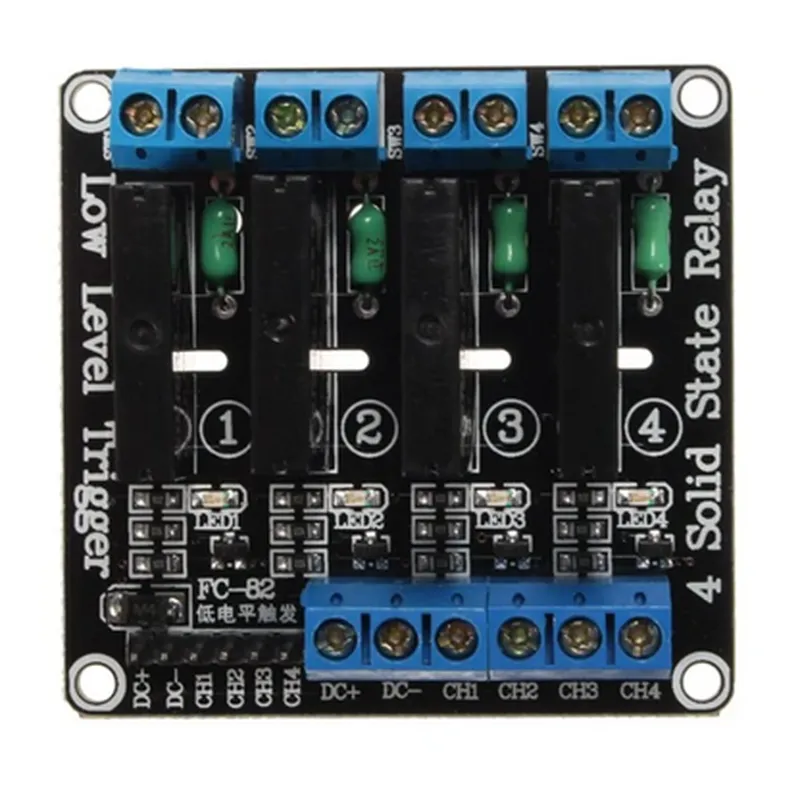
4 Channel Solid State Relay

Buy Now on Stufin

Component Name

4 Channel Solid State Relay

Overview

The 4 Channel Solid State Relay (SSR) is a high-performance, high-reliability component designed to control and switch high-power loads in a variety of applications. This relay module features four independent channels, each capable of switching up to 3A of current, making it an ideal solution for IoT projects, industrial automation, and other applications requiring reliable and efficient load control.

Functionality

The 4 Channel Solid State Relay is an electronic switch that uses semiconductor devices (thyristors or power MOSFETs) to switch on and off, replacing traditional electromechanical relays (EMRs). This design provides numerous advantages, including faster switching times, higher reliability, and reduced power consumption.

The relay module operates as follows

  • The input signal is applied to the relay's control circuit, which interprets the signal and activates the corresponding channel.
  • When the channel is activated, the internal power semiconductor devices (thyristors or power MOSFETs) are triggered, allowing current to flow through the output terminal.
  • The relay can be controlled using a digital signal (e.g., from a microcontroller) or an analog signal (e.g., from a sensor).

Key Features

  • 4 Independent Channels: Each channel can be controlled independently, allowing for simultaneous control of multiple loads.
  • High Current Rating: Each channel can switch up to 3A of current, making it suitable for a wide range of applications.
  • Solid-State Design: The relay module uses semiconductor devices, eliminating the need for moving parts, reducing wear and tear, and increasing reliability.
  • Fast Switching Times: The relay module can switch on and off rapidly, making it ideal for high-speed applications.
  • Low Power Consumption: The relay module consumes minimal power when idle, reducing overall system power requirements.
  • Isolation: Each channel is optically isolated from the control circuit, ensuring electrical isolation and reducing the risk of electrical shock.
  • Compact Size: The relay module is designed to be compact and lightweight, making it easy to integrate into tight spaces.
  • Operating Temperature Range: The relay module operates within a wide temperature range (-40C to 85C), making it suitable for use in various environmental conditions.

Specifications

Input Voltage

5V DC

Output Voltage

Up to 250V AC or 30V DC

Output Current

Up to 3A per channel

Switching Frequency

Up to 100 Hz

Operating Temperature Range

-40C to 85C

Storage Temperature Range

-40C to 125C

Dimensions

54.5mm x 27.5mm x 18.5mm

Weight

Approximately 25g

Applications

The 4 Channel Solid State Relay is suitable for a wide range of applications, including

IoT projects

Industrial automation

Home automation

Lighting control systems

Motor control systems

Power monitoring and control systems

Safety Precautions

When working with the 4 Channel Solid State Relay, it is essential to follow proper safety precautions to avoid electrical shock, fire, or other hazards. Ensure proper installation, wiring, and operation to avoid any potential risks.

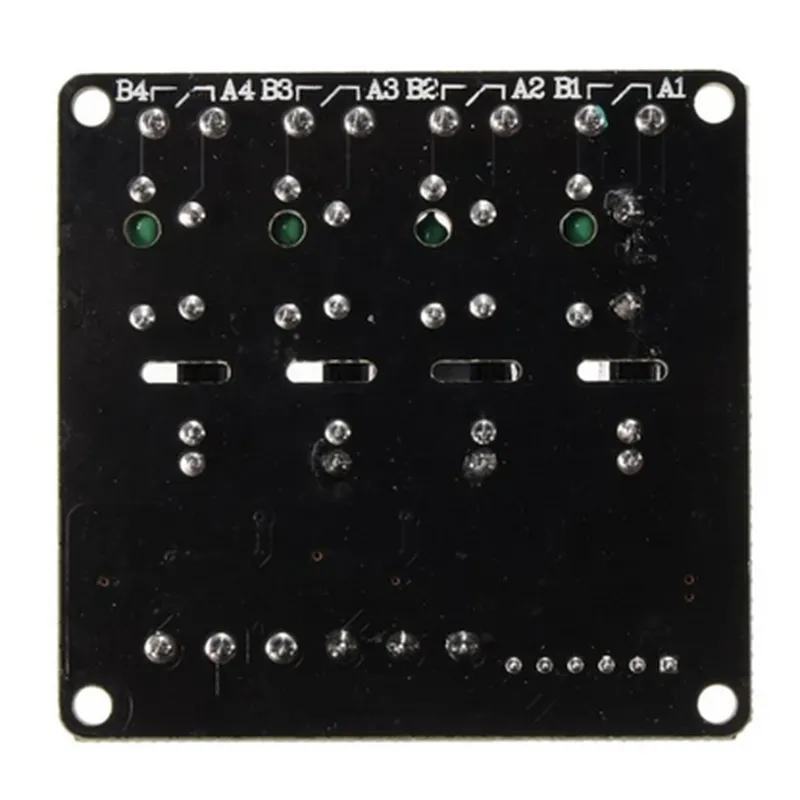
Pin Configuration

  • 4 Channel Solid State Relay Documentation
  • Introduction
  • The 4 Channel Solid State Relay is a highly reliable and efficient relay module designed for controlling high-power devices in various IoT applications. This module features four independent channels, each capable of handling up to 2A of current. The solid-state relay technology ensures fast switching times, low power consumption, and a long lifespan.
  • Pinout Description
  • The 4 Channel Solid State Relay module has a total of 16 pins, divided into four identical channels. Each channel has four pins, which are:
  • Channel 1:
  • 1. VCC:
  • Pin Description: Power supply input
  • Voltage Range: 5V
  • Current Capacity: Up to 100mA
  • Connection: Connect to a 5V power source (e.g., Arduino, Raspberry Pi, or breadboard power rail)
  • 2. IN1:
  • Pin Description: Input signal for Channel 1
  • Voltage Range: 3.3V to 5V
  • Connection: Connect to a digital output from a microcontroller (e.g., Arduino, ESP32, or Raspberry Pi)
  • 3. NO1:
  • Pin Description: Normally Open (NO) output for Channel 1
  • Voltage Range: Up to 250V AC/DC
  • Current Capacity: Up to 2A
  • Connection: Connect to the load device (e.g., LED, fan, or motor)
  • 4. COM1:
  • Pin Description: Common output for Channel 1
  • Voltage Range: Up to 250V AC/DC
  • Connection: Connect to the load device (e.g., LED, fan, or motor)
  • Channel 2, Channel 3, and Channel 4:
  • The pinout for each of these channels is identical to Channel 1, with the corresponding pins labeled as:
  • VCC2, IN2, NO2, and COM2 for Channel 2
  • VCC3, IN3, NO3, and COM3 for Channel 3
  • VCC4, IN4, NO4, and COM4 for Channel 4
  • Connection Structure
  • To connect the 4 Channel Solid State Relay module:
  • 1. Power Supply:
  • Connect VCC to a 5V power source (e.g., Arduino, Raspberry Pi, or breadboard power rail)
  • 2. Microcontroller Interface:
  • Connect IN1 to a digital output from a microcontroller (e.g., Arduino, ESP32, or Raspberry Pi) for Channel 1
  • Repeat the connection for IN2, IN3, and IN4 for Channels 2, 3, and 4, respectively
  • 3. Load Connection:
  • Connect NO1 to the load device (e.g., LED, fan, or motor) for Channel 1
  • Connect COM1 to the load device for Channel 1
  • Repeat the connections for NO2, COM2, NO3, COM3, NO4, and COM4 for Channels 2, 3, and 4, respectively
  • Important Notes
  • Ensure the relay module is properly powered before attempting to control the load devices.
  • Use a suitable current-limiting resistor or protection circuitry to prevent damage to the load devices or the relay module.
  • Always follow proper safety guidelines when working with high-voltage or high-current devices.
  • By following this documentation, you should be able to correctly connect and utilize the 4 Channel Solid State Relay module in your IoT projects.

Code Examples

4 Channel Solid State Relay (SSR) Documentation
Overview
The 4 Channel Solid State Relay (SSR) is a digital switch that allows you to control four independent channels of high-current loads using low-voltage digital signals. This component is commonly used in IoT applications to control devices such as lamps, motors, and HVAC systems.
Pinouts
The 4 Channel SSR has the following pinouts:
VCC: Power supply (typically 5V or 12V)
 GND: Ground
 IN1, IN2, IN3, IN4: Digital input channels (active low)
 CH1, CH2, CH3, CH4: Output channels (connected to load)
Example 1: Controlling LED Lamps with Arduino
In this example, we will use an Arduino Uno board to control four LED lamps using the 4 Channel SSR.
Code
```c++
const int lampPins[] = {2, 3, 4, 5}; // Digital pins connected to SSR input channels
void setup() {
  for (int i = 0; i < 4; i++) {
    pinMode(lampPins[i], OUTPUT);
  }
}
void loop() {
  // Turn on lamp 1
  digitalWrite(lampPins[0], LOW);
  delay(1000);
// Turn off lamp 1 and turn on lamp 2
  digitalWrite(lampPins[0], HIGH);
  digitalWrite(lampPins[1], LOW);
  delay(1000);
// Turn off lamp 2 and turn on lamp 3
  digitalWrite(lampPins[1], HIGH);
  digitalWrite(lampPins[2], LOW);
  delay(1000);
// Turn off lamp 3 and turn on lamp 4
  digitalWrite(lampPins[2], HIGH);
  digitalWrite(lampPins[3], LOW);
  delay(1000);
// Turn off all lamps
  for (int i = 0; i < 4; i++) {
    digitalWrite(lampPins[i], HIGH);
  }
  delay(1000);
}
```
Example 2: Controlling a Motor with Raspberry Pi
In this example, we will use a Raspberry Pi to control a DC motor using the 4 Channel SSR.
Code
```python
import RPi.GPIO as GPIO
import time
# Set up GPIO mode
GPIO.setmode(GPIO.BCM)
# Define motor control pins
motor_pins = [17, 23, 24, 25]  # Digital pins connected to SSR input channels
# Set up motor control pins as outputs
for pin in motor_pins:
    GPIO.setup(pin, GPIO.OUT)
try:
    while True:
        # Turn on motor
        GPIO.output(motor_pins[0], GPIO.LOW)
        time.sleep(2)
# Turn off motor
        GPIO.output(motor_pins[0], GPIO.HIGH)
        time.sleep(2)
# Toggle motor on and off
        for i in range(4):
            GPIO.output(motor_pins[i], GPIO.LOW)
            time.sleep(0.5)
            GPIO.output(motor_pins[i], GPIO.HIGH)
            time.sleep(0.5)
except KeyboardInterrupt:
    # Clean up GPIO on exit
    GPIO.cleanup()
```
Note: In both examples, ensure that the SSR is properly powered and the output channels are connected to the loads (LED lamps or motor) according to the datasheet and safety guidelines.
Additional Resources
Datasheet: [4 Channel Solid State Relay Datasheet](https://www.example.com/4-channel-ssr-datasheet.pdf)
 Application Notes: [Using Solid State Relays in IoT Applications](https://www.example.com/using-ssr-in-iot-applications.pdf)