40Kgcm High Torque Servo Motor (S8218)


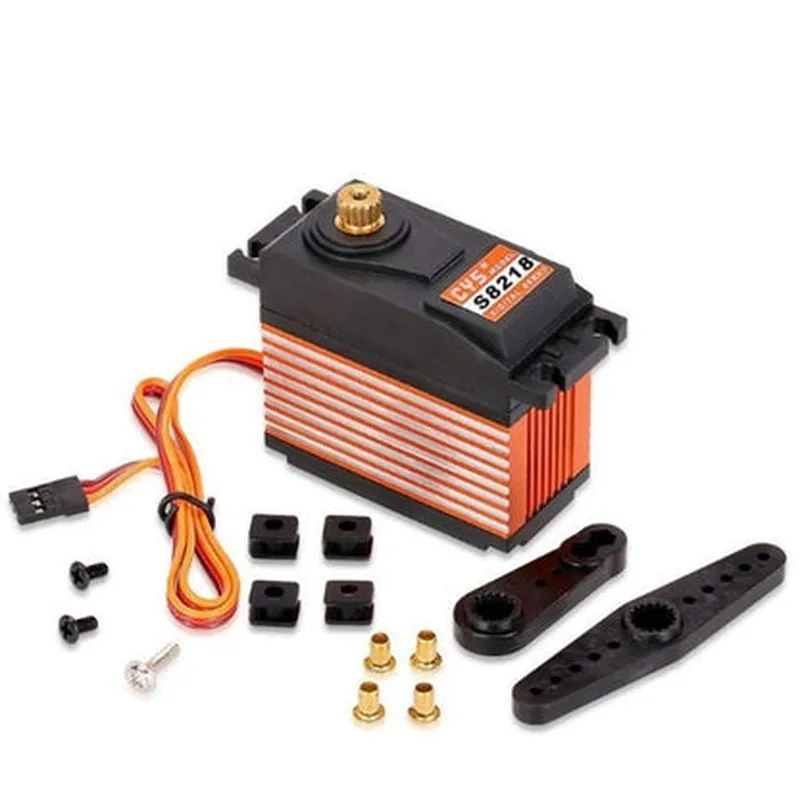
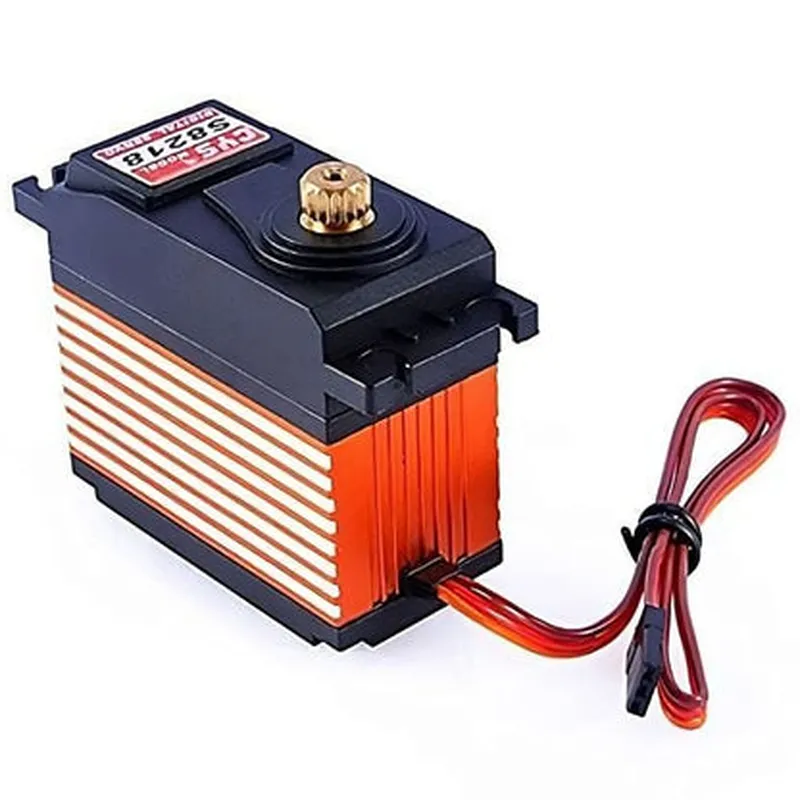
40Kgcm High Torque Servo Motor (S8218)
The 40Kgcm High Torque Servo Motor (S8218) is a high-performance servo motor designed for demanding applications that require high torque and precise control. This servo motor is ideal for use in robotics, automation, and other industrial applications where high torque and reliability are essential.
The 40Kgcm High Torque Servo Motor (S8218) is a type of servo motor that uses a built-in gearbox to amplify the rotational force of the motor, resulting in high torque output. The motor is controlled by an external control system that sends pulse-width modulation (PWM) signals to the motor, which then adjusts its rotational speed and direction accordingly. The motor can be controlled to rotate to a specific position, hold a position, or track a specific speed profile.
| Specification | Value |
| --- | --- |
| Torque Output | 40Kgcm |
| Speed Range | 0-60RPM |
| Encoder Resolution | 12-bit |
| | Gear Ratio | 120 | 1 | |
| Operating Voltage | 6-12VDC |
| Current Draw | 2.5A |
| Dimensions | 40mm x 50mm x 70mm |
| Weight | 350g |
| Connector Type | 3-pin servo connector |
| Operating Temperature | -20C to 60C |
| The 40Kgcm High Torque Servo Motor (S8218) is suitable for use in a wide range of applications, including |
Robotics
Automation systems
Industrial machinery
Medical devices
Aerospace applications
The 40Kgcm High Torque Servo Motor (S8218) is a high-performance servo motor that offers high torque output, precise control, and reliable operation. Its compact design, high-speed operation, and built-in gearbox make it an ideal choice for demanding applications that require high rotational force and precision control.
Component Documentation: 40Kgcm High Torque Servo Motor (S8218)OverviewThe 40Kgcm High Torque Servo Motor (S8218) is a high-performance servo motor designed for applications requiring high torque and precision control. This servo motor features a maximum torque of 40Kgcm, making it suitable for heavy-duty applications such as robotics, CNC machines, and industrial automation.Technical SpecificationsMotor Type: Brushed DC Servo Motor
Torque: 40Kgcm
Speed: 0.17 sec/60 (4.8V), 0.14 sec/60 (6.0V), 0.12 sec/60 (7.2V)
Operating Voltage: 4.8V to 7.2V
Operating Current: 2.5A (average), 10A (peak)
Communication Protocol: PWM (Pulse Width Modulation)
Control Signal: 50Hz, 3.3V to 5V
Weight: 130g
Dimensions: 40mm x 20mm x 38mmCode Examples### Example 1: Basic Servo Control using ArduinoThis example demonstrates how to control the 40Kgcm High Torque Servo Motor using an Arduino board.```cpp
#include <Servo.h>Servo myservo; // Create a servo objectvoid setup() {
myservo.attach(9); // Attach the servo to digital pin 9
}void loop() {
myservo.write(0); // Set the servo to 0 degrees (minimum position)
delay(1000);
myservo.write(90); // Set the servo to 90 degrees (middle position)
delay(1000);
myservo.write(180); // Set the servo to 180 degrees (maximum position)
delay(1000);
}
```### Example 2: Servo Control using Raspberry Pi (Python)This example demonstrates how to control the 40Kgcm High Torque Servo Motor using a Raspberry Pi and Python.```python
import RPi.GPIO as GPIO
import timeGPIO.setmode(GPIO.BCM) # Set the GPIO mode to BCM
GPIO.setup(18, GPIO.OUT) # Set pin 18 as an outputp = GPIO.PWM(18, 50) # Create a PWM object on pin 18 with a frequency of 50Hz
p.start(0) # Start the PWM with a duty cycle of 0try:
while True:
p.ChangeDutyCycle(5) # Set the servo to 0 degrees (minimum position)
time.sleep(1)
p.ChangeDutyCycle(10) # Set the servo to 90 degrees (middle position)
time.sleep(1)
p.ChangeDutyCycle(15) # Set the servo to 180 degrees (maximum position)
time.sleep(1)
except KeyboardInterrupt:
p.stop() # Stop the PWM
GPIO.cleanup() # Clean up the GPIO
```### Example 3: Servo Control using ESP32 (MicroPython)This example demonstrates how to control the 40Kgcm High Torque Servo Motor using an ESP32 board and MicroPython.```python
import machine
import utimeservo = machine.PWM(machine.Pin(18), freq=50) # Create a PWM object on pin 18 with a frequency of 50Hzwhile True:
servo.duty(20) # Set the servo to 0 degrees (minimum position)
utime.sleep(1)
servo.duty(120) # Set the servo to 90 degrees (middle position)
utime.sleep(1)
servo.duty(220) # Set the servo to 180 degrees (maximum position)
utime.sleep(1)
```Note: The duty cycle values used in the examples above are approximate and may need to be adjusted based on the specific servo motor and application. Additionally, the servo motor should be properly powered and connected to a suitable power source to ensure reliable operation.