11.1V


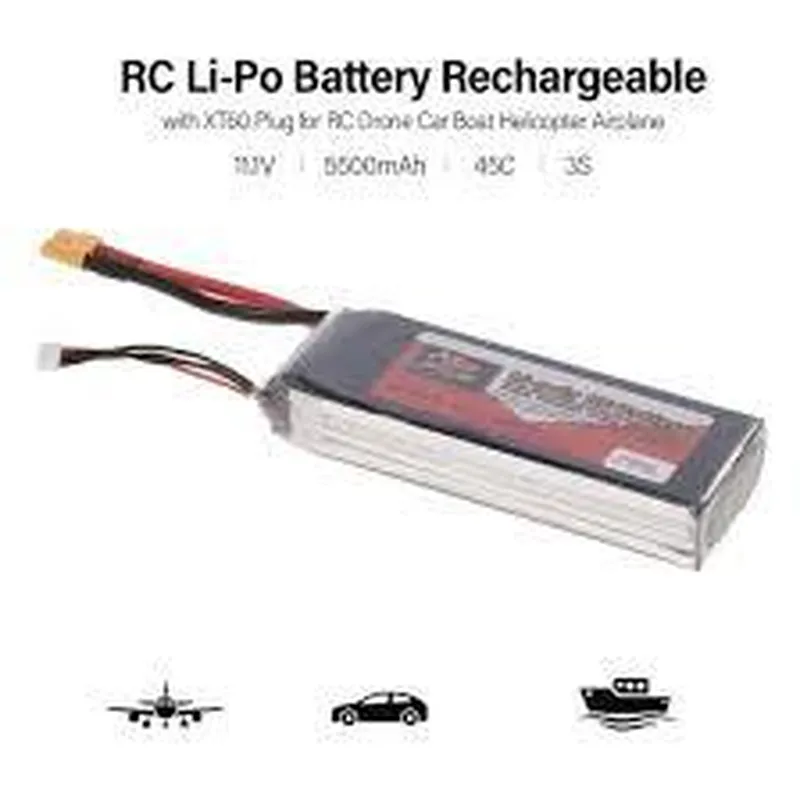
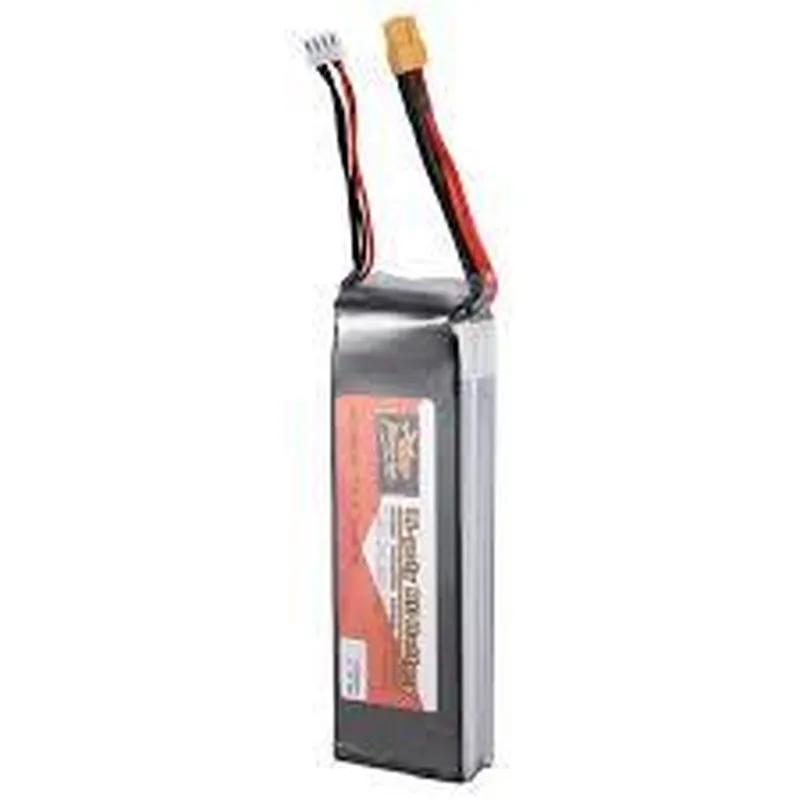
11.1V
4500mAh
>300 cycles (80% capacity retention)
2A (max)
10A (max)
<50m
TBD
TBD
Application Notes
Use a compatible LiPo charger with a maximum charging current of 2A to recharge the battery.
Avoid deep discharging (below 3V) to prolong the battery's lifespan.
Store the battery in a cool, dry place away from metal objects.
Handle the battery with care, avoiding physical damage, punctures, or short-circuits.
Safety Precautions
Lithium-polymer batteries can be hazardous if not handled properly. Avoid overcharging, deep discharging, or physical damage to prevent fires or explosions.
Ensure proper ventilation when charging or discharging the battery to prevent accumulation of flammable gases.
By following the guidelines and precautions outlined in this documentation, users can ensure safe and effective use of the 11.1V 4500mAh Lipo Battery in their IoT applications.
Component Documentation: 11.1V 4500mAh Lipo BatteryOverviewThe 11.1V 4500mAh Lipo Battery is a high-capacity lithium-ion polymer battery designed for use in various IoT applications, including robotics, drones, and portable devices. This battery features a compact design, high energy density, and a long cycle life, making it an ideal choice for projects requiring a reliable power source.SpecificationsNominal Voltage: 11.1V
Capacity: 4500mAh
Charging Voltage: 12.6V
Discharge Current: 20A (max)
Cycle Life: 300+ cycles
Dimensions: 105mm x 68mm x 25mm
Weight: 230gCode Examples### Example 1: Arduino Battery MonitoringThis example demonstrates how to use the 11.1V 4500mAh Lipo Battery with an Arduino board to monitor the battery's state of charge (SOC) using a voltage divider circuit.Hardware RequirementsArduino Board (e.g., Arduino Uno)
11.1V 4500mAh Lipo Battery
Voltage Divider Circuit (1k and 2k resistors)
Breadboard and Jumper WiresCode
```cpp
const int batteryPin = A0; // Analog input pin for battery voltage measurement
const float batteryMaxVoltage = 12.6; // Maximum battery voltage
const float batteryMinVoltage = 9.0; // Minimum battery voltagevoid setup() {
Serial.begin(9600);
}void loop() {
int sensorValue = analogRead(batteryPin);
float batteryVoltage = sensorValue (batteryMaxVoltage / 1023.0);
float soc = (batteryVoltage - batteryMinVoltage) / (batteryMaxVoltage - batteryMinVoltage) 100;
Serial.print("Battery SOC: ");
Serial.print(soc);
Serial.println("%");
delay(1000);
}
```
This code reads the battery voltage using an analog input pin and calculates the SOC based on the voltage reading.### Example 2: Raspberry Pi Power SourceThis example demonstrates how to use the 11.1V 4500mAh Lipo Battery as a power source for a Raspberry Pi, utilizing a voltage regulator to step down the battery voltage to 5V.Hardware RequirementsRaspberry Pi Board
11.1V 4500mAh Lipo Battery
Voltage Regulator (e.g., LM2576-5V)
Breadboard and Jumper WiresCode
```python
import time# No specific code required, as the Raspberry Pi will automatically use the voltage regulator output as its power source.
```
In this example, the voltage regulator is used to step down the battery voltage to 5V, which is then used to power the Raspberry Pi. The Raspberry Pi can be used to run various IoT applications, such as data logging, wireless communication, or automation tasks.Please note that proper safety precautions should be taken when working with lithium-ion batteries, including using appropriate charging and protection circuits to prevent overcharging, overheating, or electrical shorts.