

Stufin
Home Quick Cart Profile

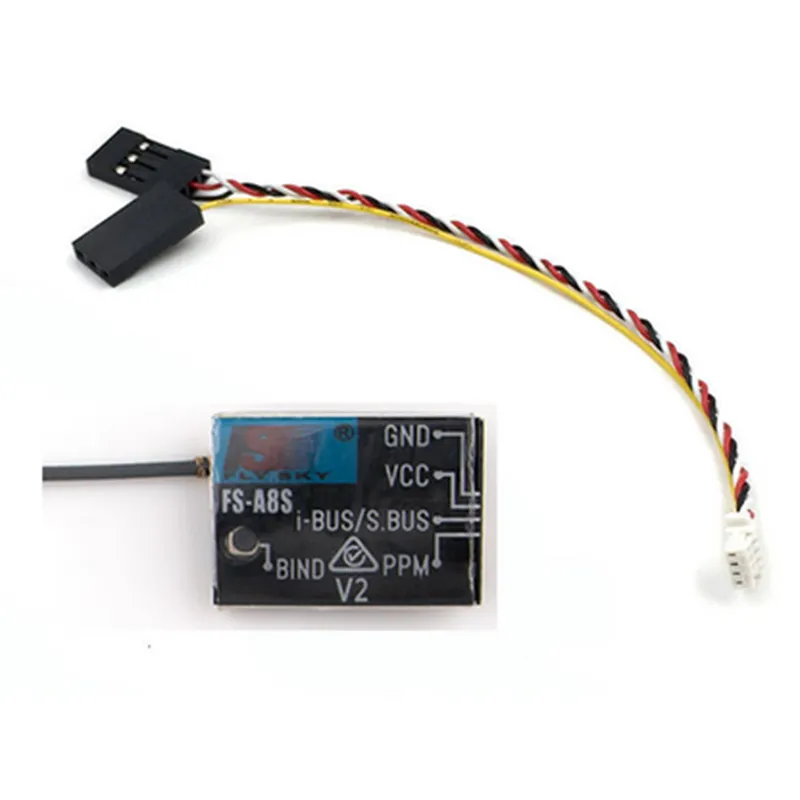
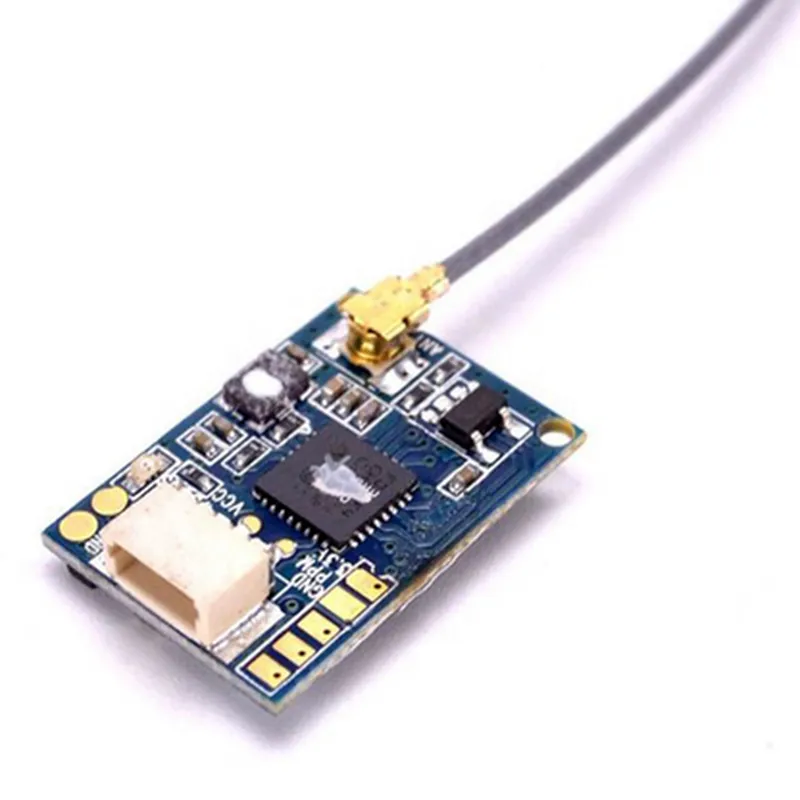
FlySky FS-A8S 2.4G 8CH Mini Receiver Module Rev 2

Buy Now on Stufin

Component Documentation

FlySky FS-A8S 2.4G 8CH Mini Receiver Module Rev 2

Overview

The FlySky FS-A8S 2.4G 8CH Mini Receiver Module Rev 2 is a compact and lightweight wireless receiver designed for remote control systems, robotics, and IoT applications. This module operates on the 2.4 GHz frequency band and supports up to 8 channels, making it an ideal choice for a wide range of projects.

Functionality

The FlySky FS-A8S receiver module receives radio frequency (RF) signals from a compatible transmitter and decodes them into digital signals, which are then transmitted to the connected microcontroller or device. This enables wireless control and communication between the transmitter and receiver.

Key Features

  • Frequency Band: 2.4 GHz ISM band
  • Number of Channels: 8 channels (CH1-CH8)
  • Operating Voltage: 4.5V to 6.5V
  • Current Consumption: <20mA (typical), <30mA (max)
  • Receiver Sensitivity: -95 dBm (typical)
  • Range: Up to 500 meters (depending on environment and antenna)
  • Antenna: Built-in PCB antenna (optional external antenna connection)
  • Dimensions: 24.5 mm x 18.5 mm x 6.5 mm (L x W x H)
  • Weight: Approximately 2 grams
  • Package: QFN-16 package

Interface and Connectivity

  • Signal Output: 8-channel digital outputs (VCC, GND, CH1-CH8)
  • Signal Level: 3.3V or 5V (configurable)

Additional Features

  • automatic frequency hopping (AFH): The receiver module supports AFH, which helps to minimize interference and ensures reliable transmission.
  • Error correction: The module incorporates error correction mechanisms to ensure data integrity and accuracy.
  • Low power consumption: The FlySky FS-A8S is designed to minimize power consumption, making it suitable for battery-powered devices.

Applications

  • RC models (airplanes, helicopters, drones, cars, boats)
  • Robotics (industrial, service, and autonomous robots)
  • IOT projects (wireless sensor networks, home automation, etc.)
  • Automation systems (industrial control, security systems, etc.)
The FlySky FS-A8S 2.4G 8CH Mini Receiver Module Rev 2 is suitable for a wide range of applications, including

Important Notes

  • Compatible Transmitter: The FlySky FS-A8S receiver module requires a compatible FlySky transmitter (e.g., FS-i6, FS-i10) to operate.
  • External Antenna: For optimal performance, an external antenna can be connected to the receiver module (optional).
  • Compliance: The module complies with CE, FCC, and RoHS regulations.

Conclusion

The FlySky FS-A8S 2.4G 8CH Mini Receiver Module Rev 2 is a reliable, compact, and feature-rich wireless receiver ideal for various IoT and robotics applications. Its low power consumption, high sensitivity, and automatic frequency hopping make it an attractive solution for designers and developers.

Pin Configuration

  • FlySky FS-A8S 2.4G 8CH Mini Receiver Module Rev 2 Documentation
  • Pinout Explanation
  • The FlySky FS-A8S 2.4G 8CH Mini Receiver Module Rev 2 has a total of 8 pins, each serving a specific purpose. Here's a detailed explanation of each pin:
  • Pin 1: VCC (Power Supply)
  • Purpose: Provides power to the receiver module.
  • Voltage Range: 3.5V to 6V
  • Recommended Power Source: 2S-3S LiPo battery or a regulated 5V power supply
  • Pin 2: GND (Ground)
  • Purpose: Provides a ground connection for the receiver module.
  • Connection: Connect to the negative terminal of the power source or a common ground point in the system.
  • Pin 3: CH1 (Channel 1 Signal)
  • Purpose: Outputs the signal corresponding to channel 1 of the receiver.
  • Signal Type: PWM (Pulse Width Modulation)
  • Connection: Connect to the input of a servo or an electronic speed controller (ESC) corresponding to channel 1.
  • Pin 4: CH2 (Channel 2 Signal)
  • Purpose: Outputs the signal corresponding to channel 2 of the receiver.
  • Signal Type: PWM (Pulse Width Modulation)
  • Connection: Connect to the input of a servo or an ESC corresponding to channel 2.
  • Pin 5: CH3 (Channel 3 Signal)
  • Purpose: Outputs the signal corresponding to channel 3 of the receiver.
  • Signal Type: PWM (Pulse Width Modulation)
  • Connection: Connect to the input of a servo or an ESC corresponding to channel 3.
  • Pin 6: CH4 (Channel 4 Signal)
  • Purpose: Outputs the signal corresponding to channel 4 of the receiver.
  • Signal Type: PWM (Pulse Width Modulation)
  • Connection: Connect to the input of a servo or an ESC corresponding to channel 4.
  • Pin 7: CH5 (Channel 5 Signal)
  • Purpose: Outputs the signal corresponding to channel 5 of the receiver.
  • Signal Type: PWM (Pulse Width Modulation)
  • Connection: Connect to the input of a servo or an ESC corresponding to channel 5.
  • Pin 8: CH6 (Channel 6 Signal)
  • Purpose: Outputs the signal corresponding to channel 6 of the receiver.
  • Signal Type: PWM (Pulse Width Modulation)
  • Connection: Connect to the input of a servo or an ESC corresponding to channel 6.
  • Connecting the Pins (Structural Connection Guide)
  • 1. Power Connection:
  • Connect the VCC pin (Pin 1) to a 3.5V to 6V power source (e.g., 2S-3S LiPo battery or a regulated 5V power supply).
  • Connect the GND pin (Pin 2) to the negative terminal of the power source or a common ground point in the system.
  • 2. Channel Connections:
  • Connect the CH1 pin (Pin 3) to the input of a servo or an ESC corresponding to channel 1.
  • Connect the CH2 pin (Pin 4) to the input of a servo or an ESC corresponding to channel 2.
  • Connect the CH3 pin (Pin 5) to the input of a servo or an ESC corresponding to channel 3.
  • Connect the CH4 pin (Pin 6) to the input of a servo or an ESC corresponding to channel 4.
  • Connect the CH5 pin (Pin 7) to the input of a servo or an ESC corresponding to channel 5.
  • Connect the CH6 pin (Pin 8) to the input of a servo or an ESC corresponding to channel 6.
  • Note: Make sure to connect the pins correctly to avoid any damage to the receiver module or the connected devices. It's recommended to use a breadboard or a PCB with a clear pinout diagram to ensure correct connections.

Code Examples

FlySky FS-A8S 2.4G 8CH Mini Receiver Module Rev 2 Documentation
Overview
The FlySky FS-A8S 2.4G 8CH Mini Receiver Module Rev 2 is a compact and lightweight receiver module designed for radio control systems. It operates at a frequency of 2.4 GHz and features 8 channels, making it suitable for a wide range of applications, including drones, robots, and other IoT projects.
Technical Specifications
Frequency: 2.4 GHz
 Channels: 8
 Receiver Sensitivity: -95 dBm
 Operating Voltage: 4.5-6.0 V
 Operating Current: 50-100 mA
 Dimension: 24 x 15 x 5 mm
 Weight: 2.5 g
Pinout
The FlySky FS-A8S receiver module has a 3-pin header for power and a 4-pin header for signal output.
| Pin | Function |
| --- | --- |
| VCC | Power Supply (4.5-6.0 V) |
| GND | Ground |
| SIGNAL | Signal Output (4-pin header) |
| CH1 | Channel 1 Output |
| CH2 | Channel 2 Output |
| ... | ... |
| CH8 | Channel 8 Output |
Code Examples
### Example 1: Arduino Sketch for Reading Channel Values
This example demonstrates how to read the channel values from the FlySky FS-A8S receiver module using an Arduino board.
```cpp
const int channelPins[] = {2, 3, 4, 5, 6, 7, 8, 9}; // Assign channel output pins to Arduino digital pins
void setup() {
  Serial.begin(9600);
}
void loop() {
  for (int i = 0; i < 8; i++) {
    int channelValue = pulseIn(channelPins[i], HIGH, 25000); // Read pulse width in microseconds
    Serial.print("Channel ");
    Serial.print(i + 1);
    Serial.print(": ");
    Serial.println(channelValue);
    delay(10);
  }
}
```
### Example 2: Raspberry Pi Python Script for Controlling a Robot
This example demonstrates how to use the FlySky FS-A8S receiver module to control a robot using a Raspberry Pi.
```python
import RPi.GPIO as GPIO
import time
# Set up GPIO mode
GPIO.setmode(GPIO.BCM)
# Define channel output pins on the Raspberry Pi
channel_pins = [17, 23, 24, 25, 5, 6, 12, 13]
# Set up channel pins as inputs
for pin in channel_pins:
    GPIO.setup(pin, GPIO.IN)
while True:
    # Read channel values
    channel_values = [GPIO.input(pin) for pin in channel_pins]
# Control the robot based on channel values
    if channel_values[0] == 1:  # Channel 1 (forward/reverse)
        print("Moving forward")
    elif channel_values[1] == 1:  # Channel 2 (left/right)
        print("Turning left")
    elif channel_values[2] == 1:  # Channel 3 (up/down)
        print("Moving up")
    else:
        print("Stopped")
time.sleep(0.1)
```
### Example 3: ESP32 MicroPython Script for Drone Control
This example demonstrates how to use the FlySky FS-A8S receiver module to control a drone using an ESP32 board with MicroPython.
```python
import machine
import time
# Define channel output pins on the ESP32
channel_pins = [18, 19, 21, 22, 23, 25, 26, 27]
# Set up channel pins as inputs
for pin in channel_pins:
    machine.Pin(pin, machine.Pin.IN)
while True:
    # Read channel values
    channel_values = [machine.Pin(pin).value() for pin in channel_pins]
# Control the drone based on channel values
    if channel_values[0] == 1:  # Channel 1 (roll)
        print("Rolling right")
    elif channel_values[1] == 1:  # Channel 2 (pitch)
        print("Pitching up")
    elif channel_values[2] == 1:  # Channel 3 (yaw)
        print("Yawing right")
    else:
        print("Stabilized")
time.sleep(0.1)
```
These examples demonstrate the basic usage of the FlySky FS-A8S 2.4G 8CH Mini Receiver Module Rev 2 in various IoT projects. You can modify the code to suit your specific application requirements.