

Stufin
Home Quick Cart Profile

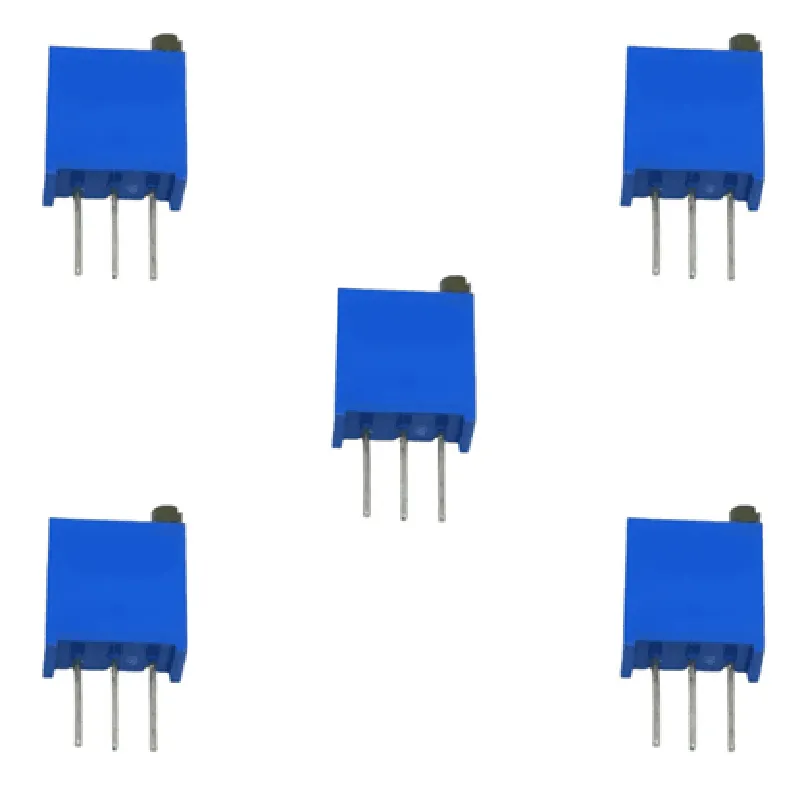
5K 3296W Trimpot(Pack of 5)

Buy Now on Stufin

Component Description

5K 3296W Trimpot (Pack of 5)

Overview

The 5K 3296W Trimpot is a type of potentiometer that is commonly used in various electronic circuits to provide variable resistance. This component is a pack of 5 trimmer potentiometers, offering convenience and cost-effectiveness for designers and engineers. The 5K 3296W Trimpot is a popular choice in the IoT industry due to its compact size, reliability, and ease of use.

Functionality

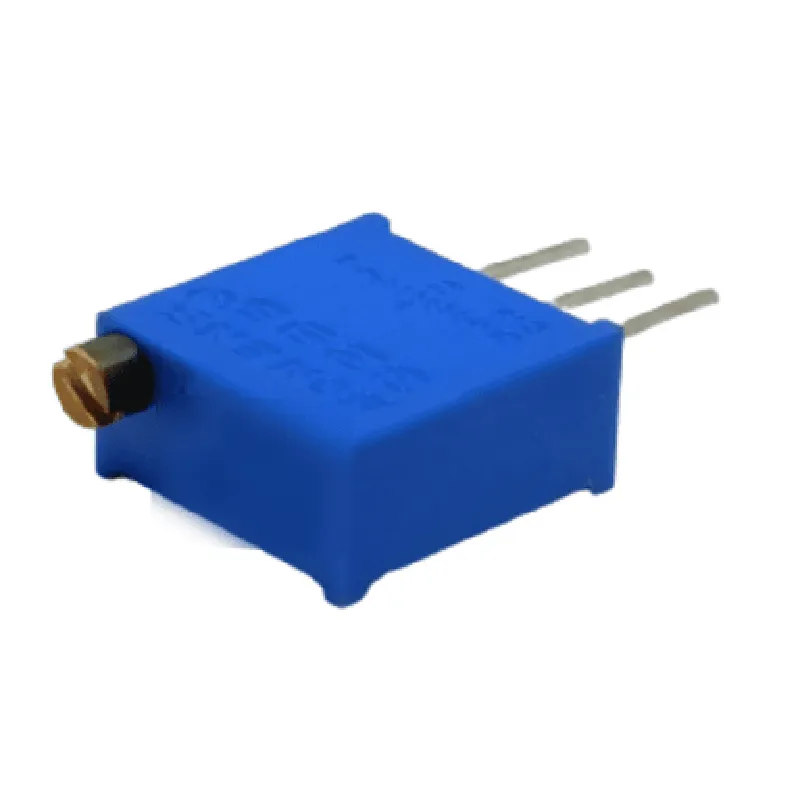
A trimpot is a three-terminal variable resistor that allows for precise adjustments of resistance values within a specific range. The 5K 3296W Trimpot operates as a voltage divider, where the input voltage is applied across the two outer terminals, and the output voltage is taken from the center terminal (wiper) and one of the outer terminals. By rotating the shaft, the wiper moves along the resistive track, changing the output voltage in relation to the input voltage.

The 5K 3296W Trimpot is designed to provide a variable resistance of 5 kilohms, with a power rating of 0.5 watts. This makes it suitable for a wide range of applications, from sensors and actuators to audio circuits and power supplies.

Key Features

  • Compact Size: The 5K 3296W Trimpot has a compact size of 9.5 mm x 6.5 mm x 5.5 mm, making it ideal for use in space-constrained designs.
  • Variable Resistance: The trimpot provides a variable resistance of 5 kilohms, allowing for precise adjustments of resistance values.
  • Power Rating: The component has a power rating of 0.5 watts, making it suitable for use in low-power applications.
  • Long-Life: The 5K 3296W Trimpot has a long-life expectancy, with a typical lifespan of 10,000 to 20,000 rotations.
  • Low Temperature Coefficient: The component has a low temperature coefficient, ensuring that its resistance value remains stable over a wide operating temperature range.
  • Pack of 5: The component is supplied in a pack of 5, providing convenience and cost-effectiveness for designers and engineers.
  • RoHS Compliant: The 5K 3296W Trimpot is RoHS (Restriction of Hazardous Substances) compliant, making it suitable for use in environmentally friendly designs.

Application Areas

  • Sensor Interfaces: The trimpot is used to adjust sensor sensitivity and output voltage in IoT sensor interfaces.
  • Actuator Control: The component is used to control actuator speed and direction in IoT applications.
  • Audio Circuits: The 5K 3296W Trimpot is used to adjust audio signal levels and frequencies in IoT audio circuits.
  • Power Supplies: The component is used to adjust output voltage and current in IoT power supply circuits.
The 5K 3296W Trimpot is commonly used in various IoT applications, including

Technical Specifications

| Parameter | Value |

| --- | --- |

| Resistance | 5 kilohms |

| Power Rating | 0.5 watts |

| Operating Temperature Range | -40C to 125C |

| Temperature Coefficient | 100 ppm/C |

| Insulation Resistance | 100 M |

| Dielectric Strength | 500 VAC |

| Rotation Life | 10,000 to 20,000 rotations |

Conclusion

The 5K 3296W Trimpot is a versatile and reliable component that provides precise variable resistance in a compact package. Its long-life expectancy, low temperature coefficient, and RoHS compliance make it an ideal choice for use in various IoT applications.

Pin Configuration

  • 5K 3296W Trimpot (Pack of 5) - Pinout and Connection Guide
  • The 5K 3296W Trimpot is a 5k trimming potentiometer, a type of variable resistor commonly used in electronic circuits. It features three terminals and a rotating shaft that allows for precise resistance adjustment. Here's a detailed explanation of each pin and how to connect them:
  • Pinout:
  • 1. CCW (Counter-Clockwise) Terminal:
  • Pin 1: The CCW terminal is the leftmost pin when facing the trimpot with the shaft pointing upwards.
  • Function: This pin is connected to one end of the resistive element.
  • Connection: Typically connected to the reference voltage (e.g., VCC) or a fixed voltage source.
  • 2. Wiper Terminal:
  • Pin 2: The wiper terminal is the middle pin.
  • Function: This pin is connected to the movable wiper contact that slides along the resistive element.
  • Connection: Typically connected to the output pin of a device or circuit, such as an amplifier, filter, or sensor.
  • 3. CW (Clockwise) Terminal:
  • Pin 3: The CW terminal is the rightmost pin when facing the trimpot with the shaft pointing upwards.
  • Function: This pin is connected to the other end of the resistive element.
  • Connection: Typically connected to ground (GND) or a reference point in the circuit.
  • Connection Structure:
  • To connect the 5K 3296W Trimpot, follow this structure:
  • Connect Pin 1 (CCW) to the reference voltage (VCC) or a fixed voltage source.
  • Connect Pin 2 (Wiper) to the output pin of the device or circuit that requires a variable resistance.
  • Connect Pin 3 (CW) to ground (GND) or a reference point in the circuit.
  • Example Circuit:
  • Here's a simple example circuit:
  • VCC (5V) Pin 1 (CCW)
  • Pin 2 (Wiper) R_OUT (e.g., an output pin of an amplifier or sensor)
  • Pin 3 (CW) GND
  • When the trimpot is adjusted, the resistance between the wiper terminal (Pin 2) and the CCW terminal (Pin 1) changes, allowing for a variable voltage output at R_OUT.
  • Important Notes:
  • The trimpot's shaft should be rotated clockwise to increase the resistance and counterclockwise to decrease the resistance.
  • The trimpot's value (5k in this case) represents the maximum resistance between the CCW and CW terminals when the wiper is at either end of its travel.
  • Always handle the trimpot with care to avoid mechanical damage or electrical shock.

Code Examples

Component Documentation: 5K 3296W Trimpot (Pack of 5)
Overview
The 5K 3296W Trimpot is a precision potentiometer, commonly used in electronic circuits to provide variable voltage division or signal attenuation. This trimmer potentiometer has a resistance of 5 k and comes in a pack of 5. It features a compact design, making it suitable for use in a wide range of IoT applications, from robotics to home automation systems.
Technical Specifications
Resistance: 5 k
 Power Rating: 0.5 W
 Tolerance: 10%
 Operating Temperature: -40C to 125C
 Size: 9 mm (L) x 4 mm (W) x 3 mm (H)
 Package: Pack of 5
Code Examples
### Example 1: Arduino Voltage Divider
In this example, we'll use the 5K 3296W Trimpot to create a voltage divider circuit to adjust the output voltage of a 9V battery. We'll connect the potentiometer to an Arduino board to read the output voltage and display it on the serial monitor.
Components:
Arduino Board (e.g., Arduino Uno)
 5K 3296W Trimpot (1 piece)
 9V Battery
 Breadboard and jumper wires
Code:
```c
const int potPin = A0;  // Potentiometer connected to analog pin A0
void setup() {
  Serial.begin(9600);
}
void loop() {
  int sensorValue = analogRead(potPin);
  float voltage = (sensorValue  5.0) / 1023.0;
  Serial.print("Voltage: ");
  Serial.print(voltage, 2);
  Serial.println(" V");
  delay(500);
}
```
Explanation:
In this example, we connect the potentiometer to the analog input pin A0 of the Arduino board. We read the analog value using `analogRead()` and convert it to a voltage value using the formula `voltage = (sensorValue  5.0) / 1023.0`. Finally, we print the output voltage to the serial monitor using `Serial.print()`.
### Example 2: Raspberry Pi Signal Attenuation
In this example, we'll use the 5K 3296W Trimpot to attenuate a signal from a sensor connected to a Raspberry Pi. We'll connect the potentiometer to the Raspberry Pi's GPIO pins to control the signal level.
Components:
Raspberry Pi (e.g., Raspberry Pi 4)
 5K 3296W Trimpot (1 piece)
 Sensor (e.g., Light Dependent Resistor (LDR))
 Breadboard and jumper wires
Code:
```python
import RPi.GPIO as GPIO
import time
GPIO.setmode(GPIO.BCM)
# Set up GPIO pins for potentiometer and sensor
pot_pin = 17
sensor_pin = 23
GPIO.setup(pot_pin, GPIO.IN)
GPIO.setup(sensor_pin, GPIO.IN)
while True:
    # Read potentiometer value
    pot_value = GPIO.input(pot_pin)
# Attenuate signal from sensor using potentiometer value
    sensor_voltage = GPIO.input(sensor_pin)  (pot_value / 255.0)
# Print attenuated signal value
    print("Attenuated Signal: {:.2f} V".format(sensor_voltage))
time.sleep(0.5)
```
Explanation:
In this example, we connect the potentiometer to a GPIO input pin (e.g., pin 17) and the sensor to another GPIO input pin (e.g., pin 23). We read the potentiometer value using `GPIO.input()` and attenuate the signal from the sensor using the formula `sensor_voltage = GPIO.input(sensor_pin)  (pot_value / 255.0)`. Finally, we print the attenuated signal value to the console using `print()`.
Note: These examples are for illustrative purposes only and may require modification to suit your specific IoT application. Ensure proper connections and safety precautions when working with electronic components.