DTMF Decoder - GL


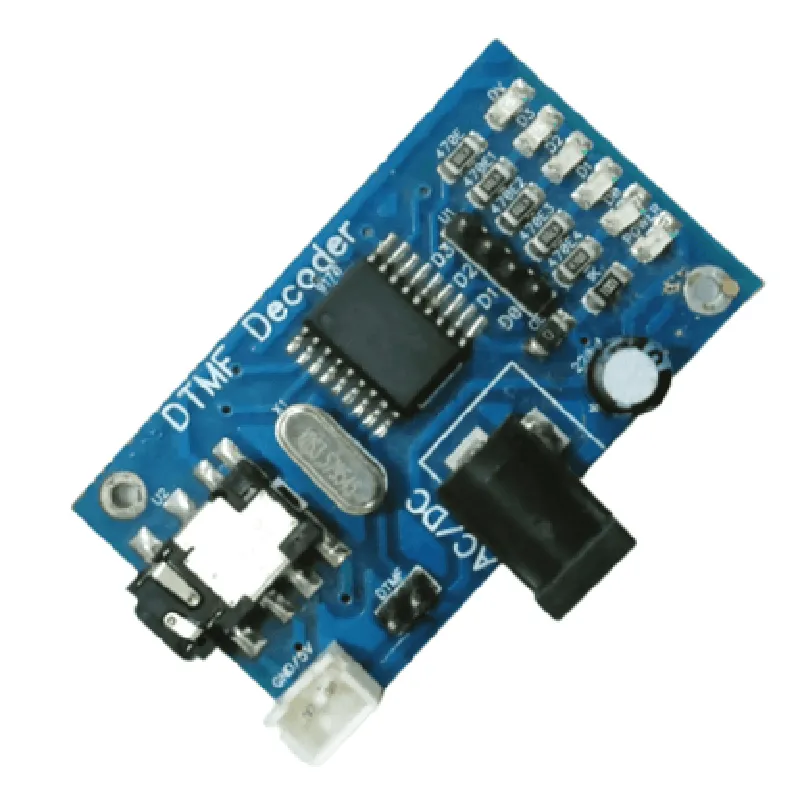
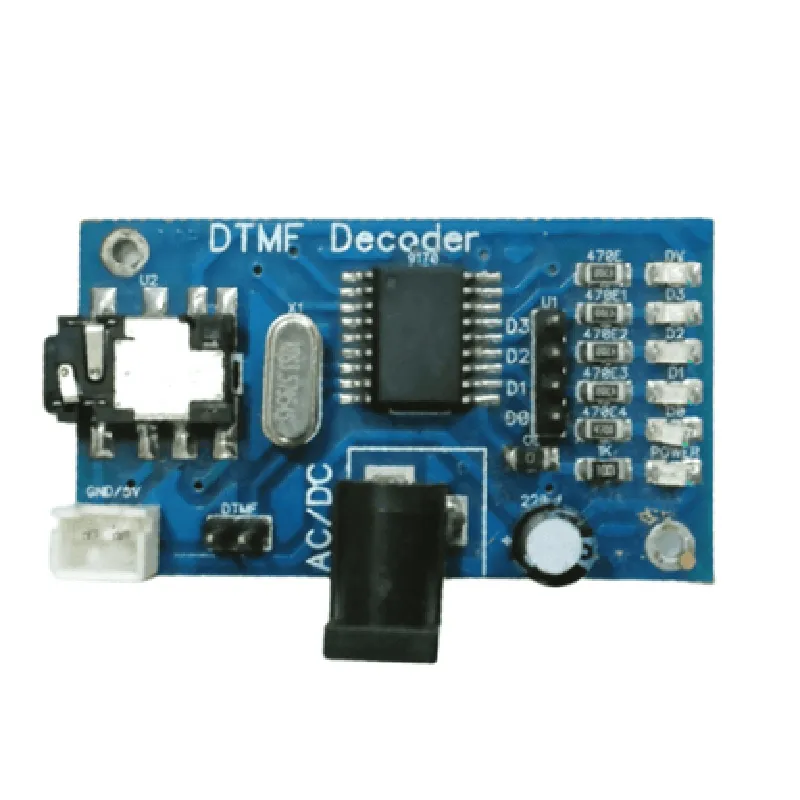
DTMF Decoder - GL
The DTMF Decoder - GL is a compact, low-power Dual-Tone Multi-Frequency (DTMF) decoding module designed for various Internet of Things (IoT) applications. This module is capable of detecting and decoding DTMF tones, commonly used in telecommunications, voice response systems, and other interactive voice applications.
The DTMF Decoder - GL module receives an analog audio signal containing DTMF tones and decodes them into a digital output. The module includes a high-quality audio amplifier and filter, which Condition the input signal before decoding. The GL module uses a proprietary algorithm to accurately detect and decode the DTMF tones, ensuring reliable operation even in noisy environments.
### Electrical Characteristics
3.3V to 5.5V
10mA (typical)
2k (typical)
CMOS compatible
### Performance Characteristics
Detects and decodes 16 DTMF tones (0-9, , #, A, B, C, D)
-30 dBm (typical)
40 ms (typical)
>99% at -20 dBm signal level
### Interface and Connectivity
Single-ended input for DTMF tone signal
4-bit digital output (Q0-Q3) for decoded DTMF tone
Active-low reset (RST) and valid tone detected (VT) indicators
### Physical Characteristics
SMD (Surface Mount Device)
14-pin SOP (Small Outline Package), 10.16 mm x 5.08 mm x 1.27 mm
approximately 0.5 grams
### Operating Environment
-40C to +85C
-55C to +125C
5% to 95% relative humidity (non-condensing)
| The DTMF Decoder - GL module is suitable for various IoT applications, including |
Interactive Voice Response (IVR) systems
Telephone and telephony systems
Remote control systems
Voice-controlled devices
Automotive and industrial control systems
Comprehensive documentation, including datasheets, application notes, and sample code, is available for the DTMF Decoder - GL module. Additionally, dedicated technical support is provided for customers requiring assistance with integration or customization.
DTMF Decoder - GL Component DocumentationOverviewThe DTMF Decoder - GL is a versatile and efficient component designed to decode Dual-Tone Multi-Frequency (DTMF) signals, commonly used in telecommunication systems. This component is particularly useful in IoT applications where tone-based input is required, such as in remote control systems, automated attendant consoles, and voice response systems.FeaturesDecodes DTMF signals from an analog input
Supports 16 DTMF tone frequencies (0-9, , #, A-D)
Provides a digital output of the decoded tone
Operates at a wide range of input frequencies (300-3400 Hz)
Glitch-free and noise-resistant designPinoutThe DTMF Decoder - GL component has the following pinout:VCC: Power supply (3.3V or 5V)
GND: Ground
IN: Analog input for DTMF signal
OUT: Digital output of decoded tone (active low)Code Examples### Example 1: Basic DTMF Decoding using ArduinoThis example demonstrates how to use the DTMF Decoder - GL component with an Arduino board to decode DTMF tones and print the corresponding digits to the serial monitor.```c++
const int inPin = A0; // Analog input pin for DTMF signal
const int outPin = 2; // Digital output pin for decoded tonevoid setup() {
pinMode(outPin, INPUT);
Serial.begin(9600);
}void loop() {
int tone = digitalRead(outPin);
if (tone != 1) {
Serial.print("DTMF tone detected: ");
switch (tone) {
case 0: Serial.println("0"); break;
case 1: Serial.println("1"); break;
case 2: Serial.println("2"); break;
...
case 15: Serial.println("D"); break;
default: Serial.println("Invalid tone");
}
}
delay(50);
}
```### Example 2: DTMF-based Remote Control using Raspberry Pi and PythonThis example shows how to use the DTMF Decoder - GL component with a Raspberry Pi to create a simple remote control system using Python.```python
import RPi.GPIO as GPIO
import timeGPIO.setmode(GPIO.BCM)
inPin = 18 # Analog input pin for DTMF signal
GPIO.setup(inPin, GPIO.IN)while True:
tone = GPIO.input(inPin)
if tone == 0:
print("DTMF tone detected: ", end='')
time.sleep(0.1) # Debounce delay
if tone == 0:
switch tone:
case 0: print("0"); break
case 1: print("1"); break
case 2: print("2"); break
...
case 15: print("D"); break
default: print("Invalid tone")
time.sleep(0.5) # Delay between tone detection
```Note: In both examples, the DTMF signal is connected to the analog input pin (IN) of the DTMF Decoder - GL component. The digital output pin (OUT) is connected to a digital input pin on the microcontroller (Arduino or Raspberry Pi).