20K 3296W Trimpot (Pack of 5)


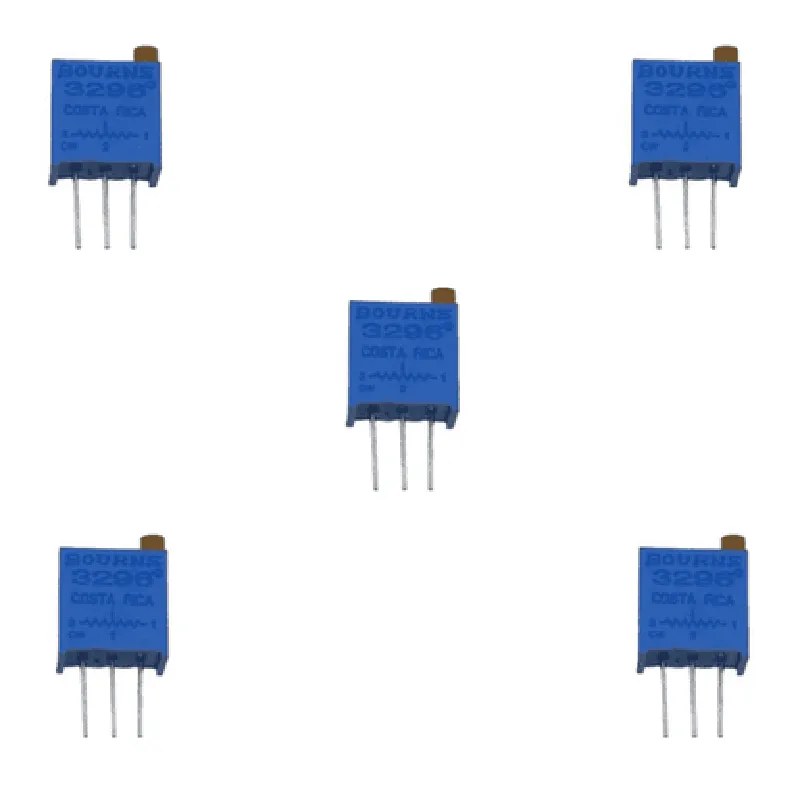
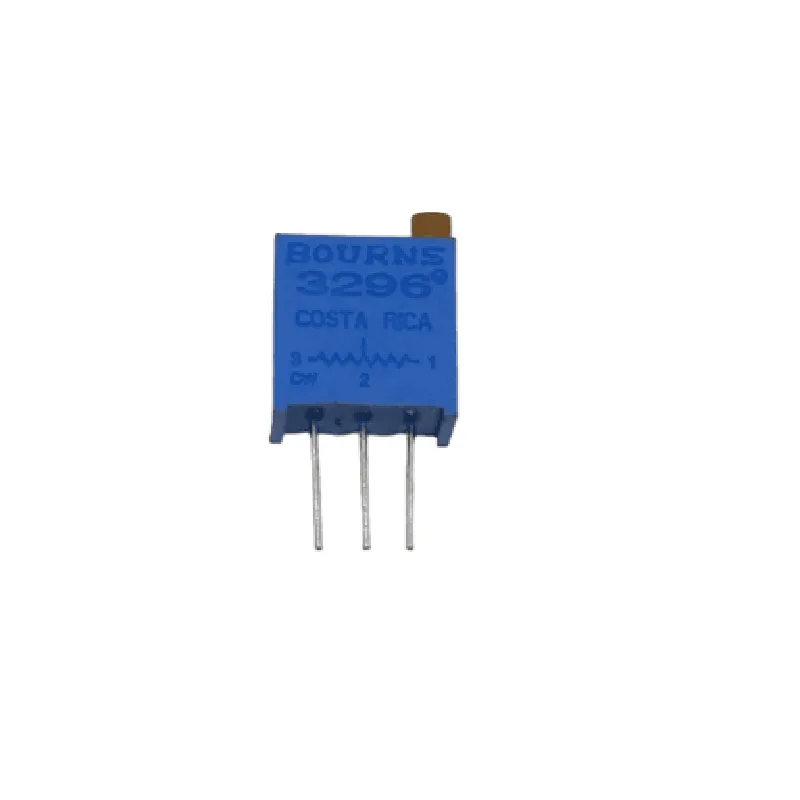
20K 3296W Trimpot (Pack of 5)
The 20K 3296W Trimpot is a type of variable resistor, also known as a trimpot or trimmer potentiometer, designed for precision adjustment of electrical circuits. This component is packaged in a set of 5, offering convenience and cost-effectiveness for electronics enthusiasts and professionals. The 20K 3296W Trimpot is a popular choice for various applications, including audio equipment, instrumentation, and industrial control systems.
The primary function of the 20K 3296W Trimpot is to provide a variable resistance value between its three terminals. This allows the user to fine-tune the voltage or current in a circuit, enabling precise adjustments to achieve the desired performance or functionality.
The trimpot exhibits good linearity, ensuring a smooth and consistent change in resistance value with rotation.
The component provides a high-resolution adjustment, allowing for precise fine-tuning of circuit parameters.
The 20K 3296W Trimpot demonstrates excellent stability, maintaining its set resistance value even under varying environmental conditions.
| The 20K 3296W Trimpot is suitable for a wide range of applications, including |
Audio equipment calibration
Instrumentation and measurement systems
Industrial control systems
Robotics and automation
Experimental and prototype development
For more information on the 20K 3296W Trimpot, including datasheets, application notes, and technical support, please refer to the manufacturer's documentation or contact their customer support team.
The 20K 3296W Trimpot is covered under a warranty that varies depending on the manufacturer and supplier. Please contact the supplier or manufacturer for specific warranty details and support information.
Component Documentation: 20K 3296W Trimpot (Pack of 5)OverviewThe 20K 3296W Trimpot is a variable resistor, also known as a trimpot or trimmer potentiometer, used to adjust and fine-tune electronic circuits. This component is a three-terminal device with a rotating shaft that allows for precise resistance adjustments. The 20K Ohm trimpot is a popular choice for various IoT applications, including sensor calibration, voltage dividers, and impedance matching.SpecificationsResistance: 20K Ohm
Power rating: 0.5W
Package: Through-hole, radial lead
Operating temperature: -40C to +125C
Dimensions: 9.5 x 5.5 x 5.5mmPinoutThe 20K 3296W Trimpot has three pins:Pin 1: Clockwise terminal (CW)
Pin 2: Center terminal (CT)
Pin 3: Counterclockwise terminal (CCW)Code Examples### Example 1: Voltage Divider Circuit with Trimpot (Arduino)In this example, we will use the 20K 3296W Trimpot to create a voltage divider circuit that outputs a variable voltage signal to an analog input pin on an Arduino board.Circuit:Connect Pin 1 (CW) to 5V
Connect Pin 2 (CT) to A0 (analog input pin) on the Arduino board
Connect Pin 3 (CCW) to GNDCode:
```c
const int sensorPin = A0; // analog input pinvoid setup() {
Serial.begin(9600);
}void loop() {
int sensorValue = analogRead(sensorPin);
float voltage = sensorValue (5.0 / 1023.0);
Serial.print("Voltage: ");
Serial.print(voltage);
Serial.println(" V");
delay(100);
}
```
### Example 2: Trimpot-controlled LED Dimmer (Raspberry Pi)In this example, we will use the 20K 3296W Trimpot to control the brightness of an LED connected to a Raspberry Pi's GPIO pin.Circuit:Connect Pin 1 (CW) to 3.3V
Connect Pin 2 (CT) to a 1K Ohm resistor, then to GPIO 17 (PWM output)
Connect Pin 3 (CCW) to GND
Connect the LED to GPIO 17 and GND (through a 1K Ohm resistor)Code:
```python
import RPi.GPIO as GPIO
import timeGPIO.setmode(GPIO.BCM)
GPIO.setup(17, GPIO.OUT)try:
while True:
trim_pot_value = GPIO.input(17) # read trimpot value
brightness = int(trim_pot_value (255.0 / 1023.0))
GPIO.PWM(17, 50).start(brightness) # set PWM duty cycle
time.sleep(0.01)
except KeyboardInterrupt:
GPIO.cleanup()
```
Note: These examples are for illustrative purposes only and may require modifications based on the specific requirements of your project. Ensure that you use proper resistor values and follow safety guidelines when working with electrical circuits.