Stufin
Home Quick Cart Profile

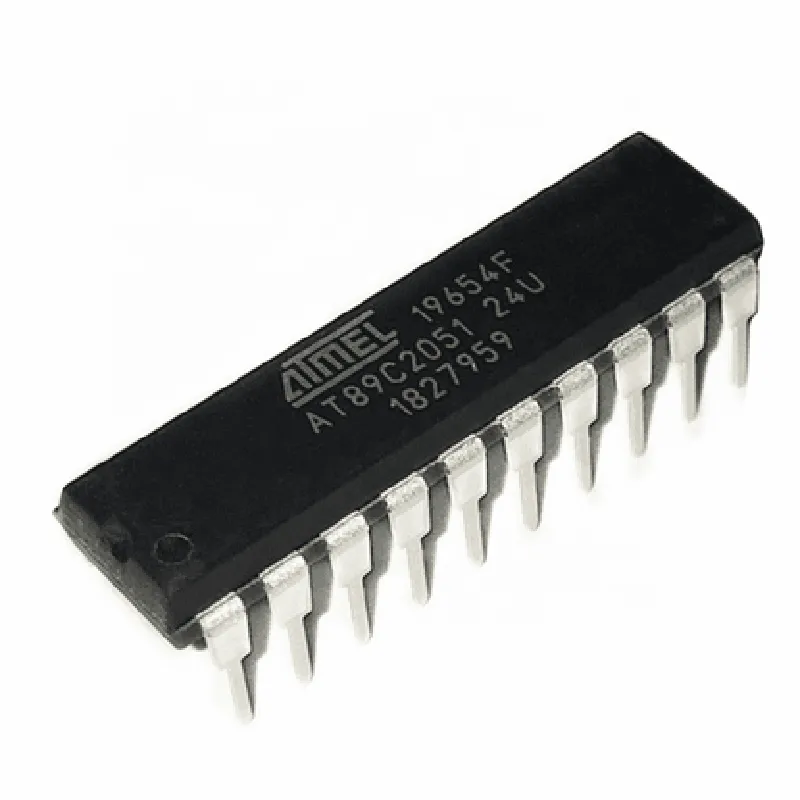
ATMEL 89C2051 IC

Buy Now on Stufin

Flash Memory

The device features 2KB of in-system reprogrammable Flash memory, allowing for easy and flexible programming and updates.


SRAM and EEPROM

The 89C2051 includes 128 bytes of SRAM (Static Random Access Memory) for data storage and 512 bytes of EEPROM (Electrically Erasable Programmable Read-Only Memory) for non-volatile data storage.

Clock Speed

The device operates at a maximum clock speed of 24 MHz, providing a high-performance processing capability.

I/O PortsThe 89C2051 features 15 programmable I/O lines, including 12 bi-directional I/O ports and 3 output-only ports.

Serial Communication

The device supports asynchronous serial communication through its built-in UART (Universal Asynchronous Receiver-Transmitter) interface.

Interrupts

The 89C2051 has 11 interrupt vectors, allowing for efficient handling of interrupts and events.

Power Consumption

The device operates at a low power consumption of 15 mA at 4 MHz.

Industrial Control

The device can be used in industrial control applications, such as motor control, lighting control, and process control.

Automotive

The 89C2051 is suitable for automotive applications, including dashboard control, body control, and infotainment systems.

Consumer Electronics

The device can be used in consumer electronics, such as TV remote controls, audio systems, and gaming consoles.

Key Performance Characteristics

Processing Speed

The 89C2051 can execute 1 million instructions per second (MIPS) at 24 MHz.

Memory

The 89C2051 features 2KB of Flash memory, 128 bytes of SRAM, and 512 bytes of EEPROM.

Package and Pinout

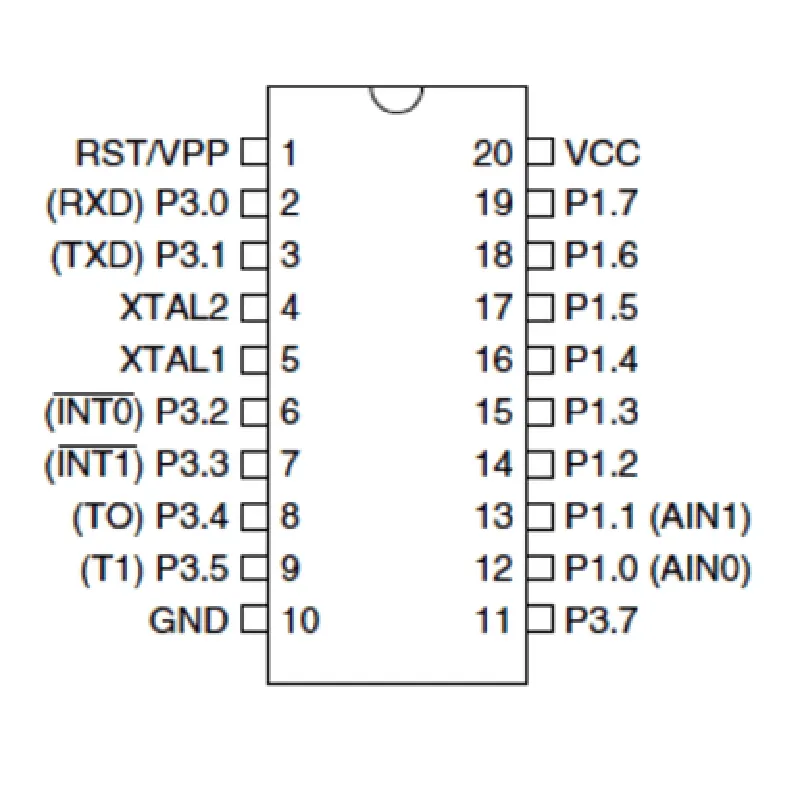
The ATMEL 89C2051 is available in a 20-pin DIP (Dual In-Line Package) or a 20-pin SOIC (Small Outline Integrated Circuit) package. The pinout is as follows

VCC

Power supply pin

GND

Ground pin

Reset

Reset input pin

XTAL1Crystal oscillator pin
XTAL2Crystal oscillator pin

CLKI

Clock input pin

CLKO

Clock output pin

PORTA

8-bit bi-directional I/O port

PORTB

4-bit bi-directional I/O port

PORTC

3-bit output-only port

RXD

UART receive data input pin

TXD

UART transmit data output pin

Conclusion

The ATMEL 89C2051 is a versatile and powerful microcontroller that offers a range of features and capabilities, making it suitable for a wide range of applications. Its low power consumption, high processing speed, and flexible programming capabilities make it an ideal choice for designers and developers.

Pin Configuration

  • ATMEL 89C2051 IC Documentation
  • Overview:
  • The ATMEL 89C2051 is an 8-bit microcontroller with 2KB of flash memory, 128 bytes of RAM, and 512 bytes of EEPROM. It is a popular choice for various IoT projects due to its low power consumption, compact size, and ease of use.
  • Pin Description:
  • The ATMEL 89C2051 IC has 20 pins, which are explained below:
  • Pin 1: VCC
  • Function: Power supply pin
  • Description: Connect to a 5V power source.
  • Notes: Ensure a stable 5V power supply to avoid any malfunction or damage to the IC.
  • Pin 2: GND
  • Function: Ground pin
  • Description: Connect to the ground of the circuit.
  • Notes: Ensure a good ground connection to prevent noise and interference.
  • Pin 3: P1.0 (Port 1 Bit 0)
  • Function: Bi-directional I/O port
  • Description: Can be used as an input or output pin.
  • Notes: This pin can be used for general-purpose I/O operations.
  • Pin 4: P1.1 (Port 1 Bit 1)
  • Function: Bi-directional I/O port
  • Description: Can be used as an input or output pin.
  • Notes: This pin can be used for general-purpose I/O operations.
  • Pin 5: P1.2 (Port 1 Bit 2)
  • Function: Bi-directional I/O port
  • Description: Can be used as an input or output pin.
  • Notes: This pin can be used for general-purpose I/O operations.
  • Pin 6: P1.3 (Port 1 Bit 3)
  • Function: Bi-directional I/O port
  • Description: Can be used as an input or output pin.
  • Notes: This pin can be used for general-purpose I/O operations.
  • Pin 7: P1.4 (Port 1 Bit 4)
  • Function: Bi-directional I/O port
  • Description: Can be used as an input or output pin.
  • Notes: This pin can be used for general-purpose I/O operations.
  • Pin 8: P1.5 (Port 1 Bit 5)
  • Function: Bi-directional I/O port
  • Description: Can be used as an input or output pin.
  • Notes: This pin can be used for general-purpose I/O operations.
  • Pin 9: P1.6 (Port 1 Bit 6)
  • Function: Bi-directional I/O port
  • Description: Can be used as an input or output pin.
  • Notes: This pin can be used for general-purpose I/O operations.
  • Pin 10: P1.7 (Port 1 Bit 7)
  • Function: Bi-directional I/O port
  • Description: Can be used as an input or output pin.
  • Notes: This pin can be used for general-purpose I/O operations.
  • Pin 11: RST (Reset)
  • Function: Reset input
  • Description: Active-low reset input. Connect to a pull-up resistor and a reset button (optional).
  • Notes: The reset pin is used to reset the microcontroller.
  • Pin 12: XTAL1 (Crystal Oscillator Pin 1)
  • Function: Crystal oscillator pin
  • Description: Connect to a crystal oscillator (optional) or a clock source.
  • Notes: The XTAL1 pin is used to connect a crystal oscillator, which provides a clock signal to the microcontroller.
  • Pin 13: XTAL2 (Crystal Oscillator Pin 2)
  • Function: Crystal oscillator pin
  • Description: Connect to a crystal oscillator (optional) or a clock source.
  • Notes: The XTAL2 pin is used to connect a crystal oscillator, which provides a clock signal to the microcontroller.
  • Pin 14: ALE (Address Latch Enable)
  • Function: Address latch enable output
  • Description: Used for latching the low-order address byte during bus cycles.
  • Notes: The ALE pin is used to latch the low-order address byte during bus cycles.
  • Pin 15: P2.0 (Port 2 Bit 0)
  • Function: Bi-directional I/O port
  • Description: Can be used as an input or output pin.
  • Notes: This pin can be used for general-purpose I/O operations.
  • Pin 16: P2.1 (Port 2 Bit 1)
  • Function: Bi-directional I/O port
  • Description: Can be used as an input or output pin.
  • Notes: This pin can be used for general-purpose I/O operations.
  • Pin 17: P2.2 (Port 2 Bit 2)
  • Function: Bi-directional I/O port
  • Description: Can be used as an input or output pin.
  • Notes: This pin can be used for general-purpose I/O operations.
  • Pin 18: P2.3 (Port 2 Bit 3)
  • Function: Bi-directional I/O port
  • Description: Can be used as an input or output pin.
  • Notes: This pin can be used for general-purpose I/O operations.
  • Pin 19: P2.4 (Port 2 Bit 4)
  • Function: Bi-directional I/O port
  • Description: Can be used as an input or output pin.
  • Notes: This pin can be used for general-purpose I/O operations.
  • Pin 20: P2.5 (Port 2 Bit 5)
  • Function: Bi-directional I/O port
  • Description: Can be used as an input or output pin.
  • Notes: This pin can be used for general-purpose I/O operations.
  • Connection Structure:
  • When connecting the ATMEL 89C2051 IC, ensure that:
  • VCC (Pin 1) is connected to a 5V power source.
  • GND (Pin 2) is connected to the ground of the circuit.
  • The XTAL1 (Pin 12) and XTAL2 (Pin 13) pins are connected to a crystal oscillator (if used) or a clock source.
  • The RST (Pin 11) pin is connected to a pull-up resistor and a reset button (optional).
  • The I/O ports (P1.0-P1.7, P2.0-P2.5) are connected to the desired peripherals, sensors, or actuators.
  • Ensure that the power supply is stable and the ground connection is good to avoid any noise or interference.
  • Important Notes:
  • The ATMEL 89C2051 IC is a 5V device, and excessive voltage can damage the IC.
  • The IC should be handled with care to avoid static electricity damage.
  • Ensure that the XTAL1 and XTAL2 pins are connected to a crystal oscillator or a clock source, if required.
  • The RST pin should be pulled high to prevent accidental resets.
  • By following this documentation and understanding the pinouts and connections, you can effectively use the ATMEL 89C2051 IC in your IoT projects.

Code Examples

ATMEL 89C2051 IC Documentation
Overview
The ATMEL 89C2051 is an 8-bit microcontroller (MCU) from the Atmel AVR family, which is widely used in various embedded systems and Internet of Things (IoT) applications. This microcontroller features 2KB of flash memory, 128 bytes of RAM, and 512 bytes of EEPROM. It operates at a clock frequency of up to 24 MHz and has 15 programmable I/O lines.
Pinouts and Features
The ATMEL 89C2051 IC has a 20-pin DIP package with the following pinouts:
| Pin | Function |
| --- | --- |
| 1-8 | Port A (PA0-PA7) - I/O lines |
| 9-13 | Port B (PB0-PB4) - I/O lines |
| 14-15 | VCC and GND - Power supply |
| 16 | XTAL1 - Crystal oscillator input |
| 17 | XTAL2 - Crystal oscillator output |
| 18 | RST - Reset input |
| 19-20 | SCK and MISO - SPI interface |
Code Examples
Here are three code examples that demonstrate how to use the ATMEL 89C2051 IC in different contexts:
Example 1: Blinking LED Using Timer/Counter
In this example, we will use the Timer/Counter module to blink an LED connected to Port A, Pin 0 (PA0).
```c
#include <avr/io.h>
#include <avr/interrupt.h>
#define F_CPU 1000000UL // 1 MHz clock frequency
#define LED_PIN PA0
int main(void) {
    // Initialize Port A as output
    DDRA |= (1 << LED_PIN);
// Initialize Timer/Counter0
    TCCR0 = (1 << CS01) | (1 << CS00); // Prescaler = 64
    OCR0 = 249; // Set timer value for 1 Hz
// Enable global interrupts
    sei();
while (1) {
        // Toggle LED state
        PORTA ^= (1 << LED_PIN);
    }
}
ISR(TIMER0_COMP_vect) {
    // Timer/Counter0 interrupt handler
    PORTA ^= (1 << LED_PIN); // Toggle LED state
}
```
Example 2: SPI Communication with an External EEPROM
In this example, we will use the SPI interface to read and write data to an external EEPROM (e.g., AT24C02) connected to the SCK, MISO, and MOSI pins.
```c
#include <avr/io.h>
#include <avr/sleep.h>
#define F_CPU 1000000UL // 1 MHz clock frequency
#define EEPROM_SELECT PB0 // Chip select pin for EEPROM
void spi_init(void) {
    DDRB |= (1 << SCK) | (1 << MOSI) | (1 << EEPROM_SELECT);
    SPCR = (1 << SPE) | (1 << MSTR) | (1 << SPR1) | (1 << SPR0);
}
void spi_write(uint8_t data) {
    SPDR = data;
    while (!(SPSR & (1 << SPIF)));
}
uint8_t spi_read(void) {
    SPDR = 0xFF;
    while (!(SPSR & (1 << SPIF)));
    return SPDR;
}
int main(void) {
    spi_init();
// Write data to EEPROM
    PORTB &= ~(1 << EEPROM_SELECT);
    spi_write(0x00); // Write command
    spi_write(0x01); // Address
    spi_write(0x02); // Data
    PORTB |= (1 << EEPROM_SELECT);
// Read data from EEPROM
    PORTB &= ~(1 << EEPROM_SELECT);
    spi_write(0x03); // Read command
    spi_write(0x01); // Address
    uint8_t data = spi_read();
    PORTB |= (1 << EEPROM_SELECT);
return 0;
}
```
Example 3: UART Communication with a Serial Terminal
In this example, we will use the UART interface to send and receive data to/from a serial terminal (e.g., HyperTerminal) connected to the microcontroller's Tx and Rx pins.
```c
#include <avr/io.h>
#include <avr/interrupt.h>
#define F_CPU 1000000UL // 1 MHz clock frequency
#define UART_BAUD_RATE 9600
void uart_init(void) {
    UBRR = 12; // Set baud rate
    UCSR |= (1 << RXEN) | (1 << TXEN);
    UCSR |= (1 << RXCIE);
}
void uart_send(char data) {
    while (!(UCSR & (1 << UDRE)));
    UDR = data;
}
char uart_receive(void) {
    while (!(UCSR & (1 << RXC)));
    return UDR;
}
ISR(USART_RXC_vect) {
    char data = uart_receive();
    uart_send(data); // Echo back received data
}
int main(void) {
    uart_init();
while (1) {
        // Receive and process data from serial terminal
    }
}
```
These code examples demonstrate the basic usage of the ATMEL 89C2051 IC in different contexts, showcasing its capabilities and versatility in IoT applications.