

Stufin
Home Quick Cart Profile

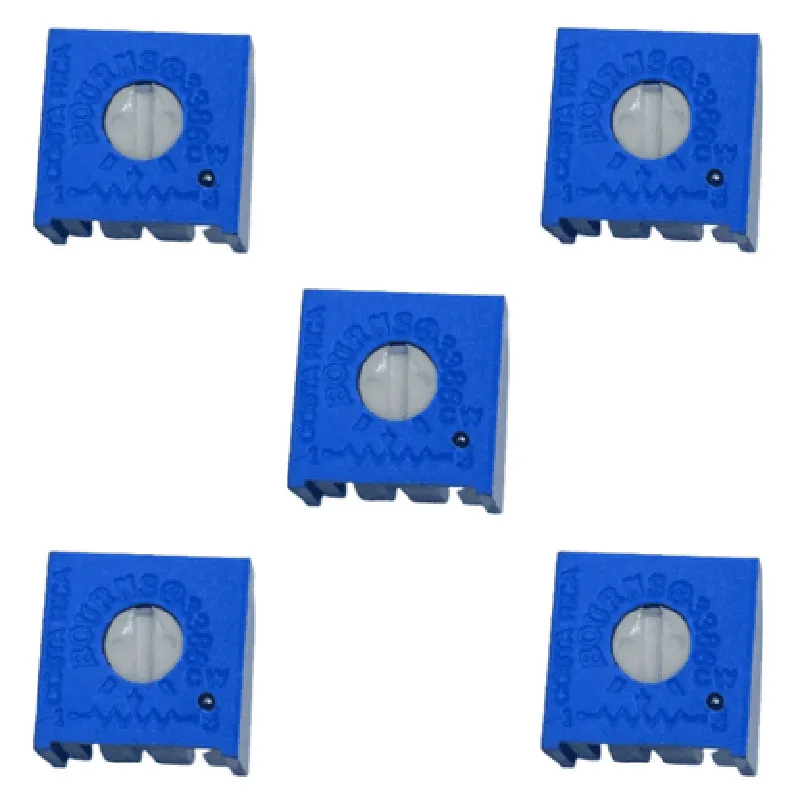
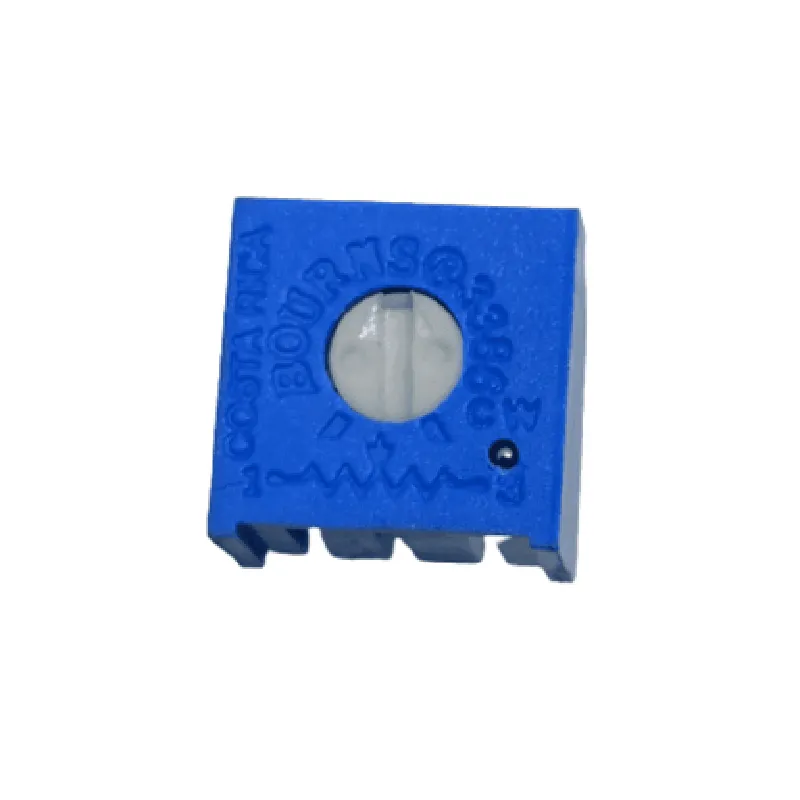
1M 3386P Trimpot(Pack of 5)

Buy Now on Stufin

Component Documentation

1M 3386P Trimpot (Pack of 5)

Overview

The 1M 3386P Trimpot is a high-quality, precision rotary potentiometer designed for precise voltage division and signal attenuation applications. This component is available in a pack of 5, making it an excellent choice for prototyping, development, and production projects.

Functionality

The 1M 3386P Trimpot is a variable resistor that allows for precise adjustments of electrical resistance. It functions as a three-terminal device, with one terminal connected to a fixed resistance, one terminal connected to a movable wiper, and the third terminal connected to the remaining resistance. By rotating the shaft, the wiper moves along the resistive element, dividing the input voltage between the two outer terminals. This allows the user to set a specific output voltage, making it an essential component in various applications.

Key Features

  • High Precision: The 1M 3386P Trimpot offers high precision and accuracy, with a rotation angle of 300 and a resistance tolerance of 20%.
  • Compact Design: The component features a compact design, measuring only 9.5 mm in diameter and 22.5 mm in length, making it ideal for space-constrained applications.
  • Rotary Shaft: The shaft is designed for smooth rotation, allowing for precise adjustments and easy operation.
  • Long-Life Cycle: The 1M 3386P Trimpot is built to last, with a long-life cycle and a minimum of 100,000 rotations guaranteed.
  • High-Quality Materials: The component is constructed from high-quality materials, ensuring reliable operation in various environmental conditions.
  • Various Applications: The 1M 3386P Trimpot is suitable for a wide range of applications, including audio equipment, medical devices, industrial control systems, and more.
  • Pack of 5: The component is available in a pack of 5, making it an excellent choice for projects that require multiple potentiometers.

Electrical Characteristics

Resistance

1 M

Tolerance

20%

Power Rating

0.5 W

Operating Temperature Range

-20C to +70C

Insulation Resistance

100 M (min)

Dielectric Strength

500 Vrms (min)

Physical Characteristics

Diameter

9.5 mm

Length

22.5 mm

Shaft Diameter

2.5 mm

Rotation Angle

300

Weight

10 g (approx.)

Packaging and Dimensions

The 1M 3386P Trimpot is packaged in a compact, resealable bag containing 5 pieces. Each component is carefully wrapped to prevent damage during shipping and storage.

Conclusion

The 1M 3386P Trimpot (Pack of 5) is a high-quality, precision rotary potentiometer designed for precise voltage division and signal attenuation applications. Its compact design, high precision, and long-life cycle make it an excellent choice for various projects, from prototyping to production.

Pin Configuration

  • 1M 3386P Trimpot (Pack of 5) Documentation
  • Overview
  • The 1M 3386P Trimpot is a type of potentiometer, a variable resistor, commonly used in electronic circuits to adjust voltage, impedance, or signal levels. This trimmer potentiometer is a compact, axial-lead device with a resistance value of 1M ohms.
  • Pinout
  • The 1M 3386P Trimpot has three pins, which are explained below:
  • Pin 1: Counter Clockwise (CCW) Terminal
  • Function: Connects to the low-end (0%) of the resistance range
  • Description: This pin is the counter-clockwise terminal of the potentiometer, which is connected to the low-end of the resistance range (0% of the total resistance value).
  • Pin 2: Wiper Terminal
  • Function: Connects to the moving contact (wiper) of the potentiometer
  • Description: This pin is the wiper terminal, which is connected to the moving contact of the potentiometer. The wiper terminal is connected to the output of the potentiometer, and its position determines the resistance ratio between the CCW and CW terminals.
  • Pin 3: Clockwise (CW) Terminal
  • Function: Connects to the high-end (100%) of the resistance range
  • Description: This pin is the clockwise terminal of the potentiometer, which is connected to the high-end of the resistance range (100% of the total resistance value).
  • Connection Structure
  • To connect the 1M 3386P Trimpot, follow these steps:
  • 1. CCW Terminal (Pin 1): Connect the CCW terminal to a fixed voltage source (e.g., Vcc or GND) or a signal ground.
  • 2. Wiper Terminal (Pin 2): Connect the wiper terminal to the output of your circuit, which requires a variable resistance or voltage divider.
  • 3. CW Terminal (Pin 3): Connect the CW terminal to the other fixed voltage source (e.g., Vcc or GND) or a signal ground.
  • Important Notes
  • The potentiometer's resistance value is 1M ohms, so ensure that your circuit is designed to accommodate this value.
  • When adjusting the trimmer potentiometer, turn the knob clockwise to increase the resistance or counter-clockwise to decrease the resistance.
  • Use a screwdriver or a trimmer tool to adjust the potentiometer's position.
  • Ensure proper soldering and handling to avoid damaging the component.
  • By following this documentation, you can successfully connect and utilize the 1M 3386P Trimpot in your electronic projects.

Code Examples

Component Documentation: 1M 3386P Trimpot (Pack of 5)
Overview
The 1M 3386P Trimpot is a high-quality, adjustable potentiometer designed for precision voltage division and signal control applications. This component is part of a pack of 5, offering flexibility and convenience for a wide range of IoT projects. The 1M 3386P Trimpot features a compact design, making it ideal for use in compact devices, robots, drones, and other space-constrained systems.
Technical Specifications
Resistance: 1Mohm
 Power Rating: 0.5W
 Tolerance: 20%
 Linearity: 10%
 Operating Temperature: -40C to +125C
 Dimensions: 9.5 mm x 3.8 mm x 6.3 mm
Pinout
The 1M 3386P Trimpot has three pins:
Pin 1 (CCW): Counter-Clockwise terminal
 Pin 2 (Wiper): Moving contact, adjustable via the trimmer screw
 Pin 3 (CW): Clockwise terminal
Example 1: Voltage Divider Circuit
In this example, we'll use the 1M 3386P Trimpot to create a simple voltage divider circuit to regulate the output voltage of a power supply.
Circuit Diagram
```
 Vin --->[R1]--->| Trimpot |----->[R2]---> GND
           |           |           |
           |  Pin 1    |  Pin 2    |  Pin 3
           |  (CCW)     |  (Wiper)   |  (CW)
           |           |           |
           +-----------+-----------+
```
Code Example (Arduino)
```c
const int vin = 5;  // Input voltage (5V)
const int r1 = 1000;  // Fixed resistor (1kohm)
const int trimpotPin = A0;  // Trimpot wiper pin connected to analog input 0
void setup() {
  pinMode(trimpotPin, INPUT);
  Serial.begin(9600);
}
void loop() {
  int trimpotValue = analogRead(trimpotPin);
  float outputVoltage = (trimpotValue / 1023.0)  vin;
  Serial.print("Output Voltage: ");
  Serial.print(outputVoltage);
  Serial.println(" V");
  delay(500);
}
```
Example 2: Signal Attenuation Circuit
In this example, we'll use the 1M 3386P Trimpot to attenuate an audio signal.
Circuit Diagram
```
 Audio In --->[R1]--->| Trimpot |----->[R2]---> Audio Out
           |           |           |
           |  Pin 1    |  Pin 2    |  Pin 3
           |  (CCW)     |  (Wiper)   |  (CW)
           |           |           |
           +-----------+-----------+
```
Code Example (Python)
```python
import pyaudio
import numpy as np
# PyAudio setup
p = pyaudio.PyAudio()
stream = p.open(format=pyaudio.paInt16, channels=1, rate=44100, input=True, frames_per_buffer=1024)
while True:
    # Read audio data
    data = np.fromstring(stream.read(1024), dtype=np.int16)
    
    # Apply signal attenuation using the trimpot
    trimpotValue = 0.5  # Adjust this value to change the attenuation level
    attenuatedData = data  trimpotValue
    
    # Write attenuated data to the output
    stream.write(attenuatedData.tobytes())
```
These examples demonstrate the versatility of the 1M 3386P Trimpot in various IoT applications, including voltage regulation and signal attenuation. By adjusting the trimpot's wiper position, you can fine-tune the output voltage or signal level to meet the specific requirements of your project.