3.5-digit LCD display with 4000 counts


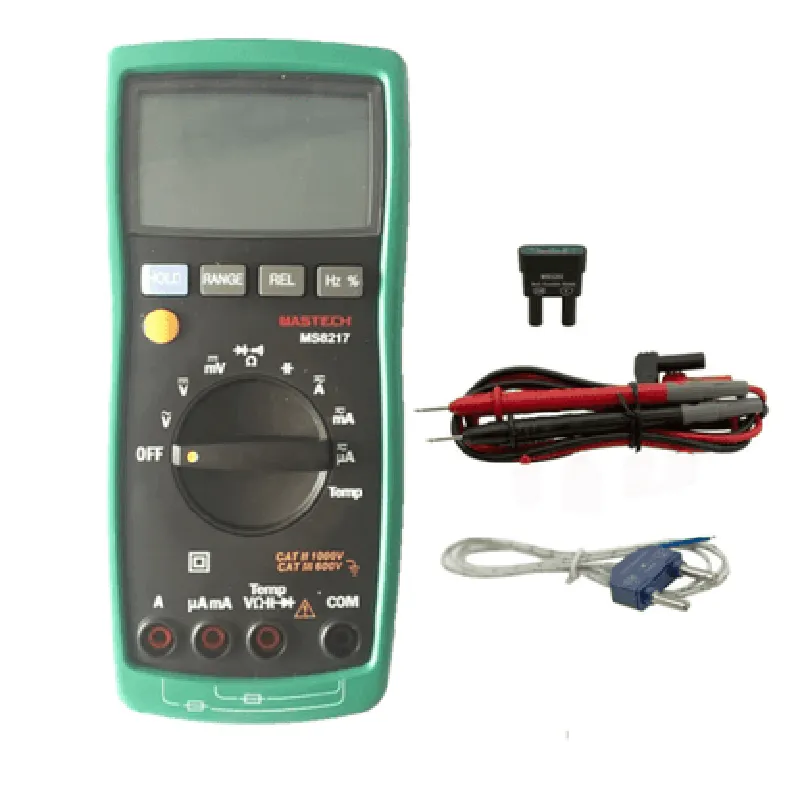
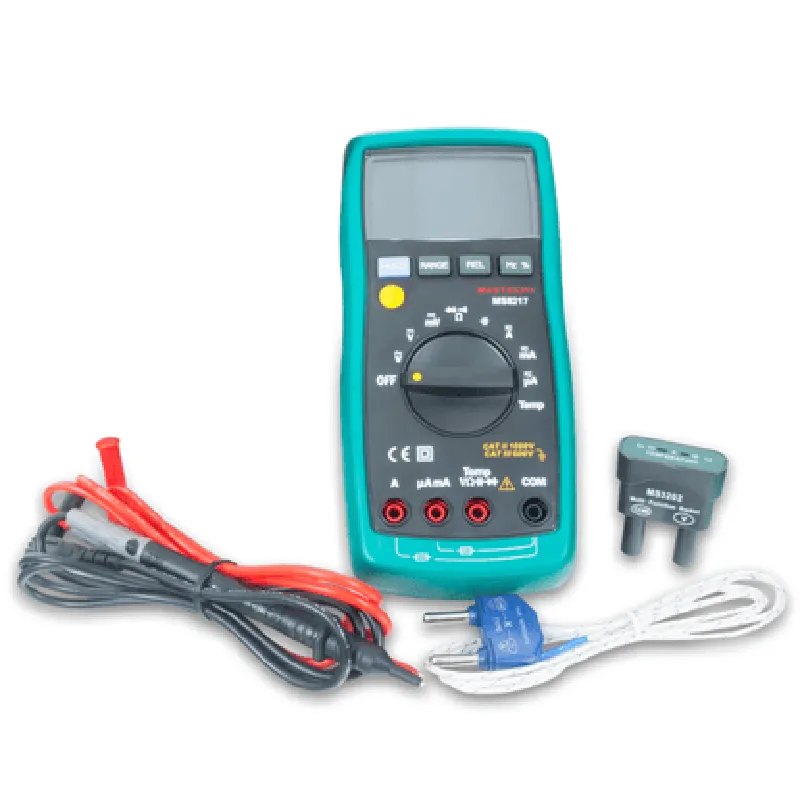
3.5-digit LCD display with 4000 counts
9V battery (included)
0C to 40C (32F to 104F)
-20C to 60C (-4F to 140F)
122 x 67 x 35 mm (4.8 x 2.6 x 1.4 in)
Approximately 250g (8.8 oz)
Applications
| The Mastech MS8217 Digital Multimeter Meter is suitable for a wide range of applications, including |
Electrical and electronics engineering
Industrial maintenance and troubleshooting
Automotive systems diagnosis
HVAC systems installation and repair
Laboratory testing and measurement
Educational purposes
Conclusion
The Mastech MS8217 Digital Multimeter Meter is a reliable and accurate testing device that offers a range of features and functions, making it an ideal choice for professionals and hobbyists alike. Its compact design, high accuracy, and versatility make it a valuable tool for anyone working with electrical and electronic systems.
Mastech MS8217 Digital Multimeter Meter DocumentationThe Mastech MS8217 is a digital multimeter designed for measuring various electrical parameters such as voltage, current, resistance, and continuity. This document provides an overview of the component's features, specifications, and code examples to demonstrate its usage in different contexts.Features and SpecificationsMeasures voltage (AC/DC), current (AC/DC), resistance, continuity, and diode test
Auto-ranging and manual ranging modes
Data hold function for easy reading
Large 3.5-digit LCD display with backlight
Maximum measurement ranges:
+ Voltage: 1000V AC/DC
+ Current: 10A AC/DC
+ Resistance: 40M
+ Continuity: beeper sounds if resistance is less than 30
Powered by a 9V battery (not included)Code ExamplesExample 1: Basic Measurement using ArduinoIn this example, we will use the Mastech MS8217 to measure the voltage of a 9V battery and display it on an Arduino Serial Monitor.Hardware Requirements:Mastech MS8217 Digital Multimeter Meter
Arduino Board (e.g., Arduino Uno)
Breadboard and jumper wiresSoftware Requirements:Arduino IDE (version 1.8.x or later)Code:
```cpp
const int multimeterPin = A0; // Connect the multimeter's voltage output to Arduino's analog input A0void setup() {
Serial.begin(9600);
}void loop() {
int reading = analogRead(multimeterPin);
float voltage = reading (5.0 / 1023.0); // Convert analog reading to voltage (assuming 5V reference)
Serial.print("Voltage: ");
Serial.print(voltage);
Serial.println(" V");
delay(1000);
}
```
Example 2: Interfacing with Raspberry Pi for AutomationIn this example, we will use the Mastech MS8217 to measure the current flowing through a load connected to a Raspberry Pi's GPIO pins.Hardware Requirements:Mastech MS8217 Digital Multimeter Meter
Raspberry Pi (e.g., Raspberry Pi 4)
Breadboard and jumper wires
Load (e.g., LED, resistor)Software Requirements:Raspbian OS (latest version)
Python 3.xCode:
```python
import RPi.GPIO as GPIO
import time# Set up GPIO pins for output
GPIO.setmode(GPIO.BCM)
GPIO.setup(17, GPIO.OUT) # Load connected to GPIO 17# Set up multimeter on GPIO 18 (analog input)
multimeter_pin = 18while True:
# Measure current using the multimeter
current_reading = GPIO.input(multimeter_pin)
current_amps = current_reading (5.0 / 1023.0) / 100 # Convert analog reading to current (assuming 5V reference and 100mA full scale)# Control the load based on the measured current
if current_amps > 50:
GPIO.output(17, GPIO.HIGH) # Turn on the load if current exceeds 50mA
else:
GPIO.output(17, GPIO.LOW) # Turn off the load if current is below 50mAtime.sleep(1) # Take readings every second
```
Please note that these examples are for illustration purposes only and may require modifications to suit your specific use case. Always ensure proper connections and safety precautions when working with electrical components.