M5 Stack SERVO2 Module 16 Channels - 13.2 (PCA9685)


M5 Stack SERVO2 Module 16 Channels - 13.2 (PCA9685)
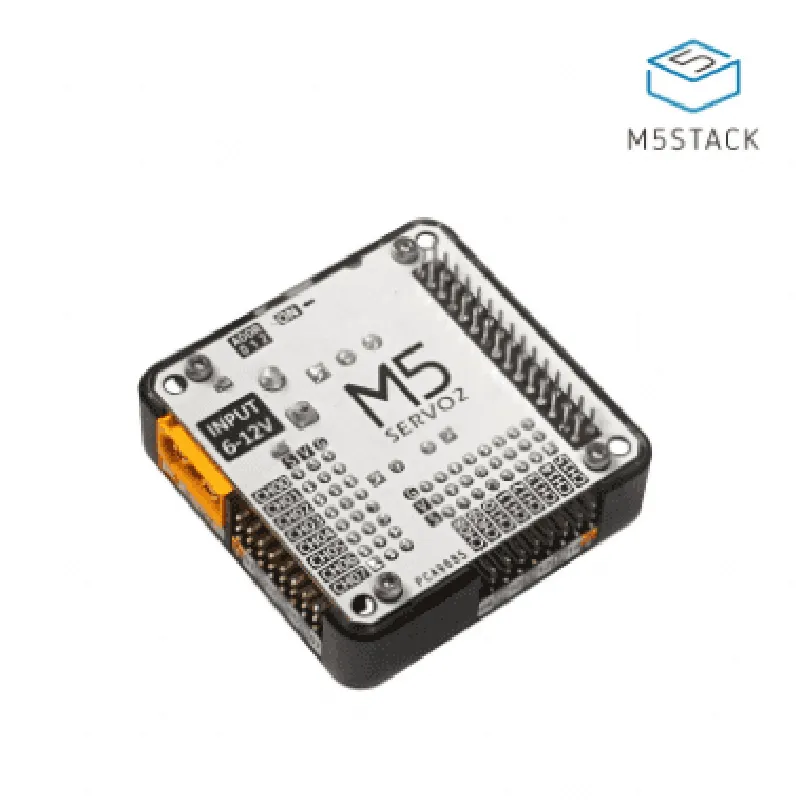
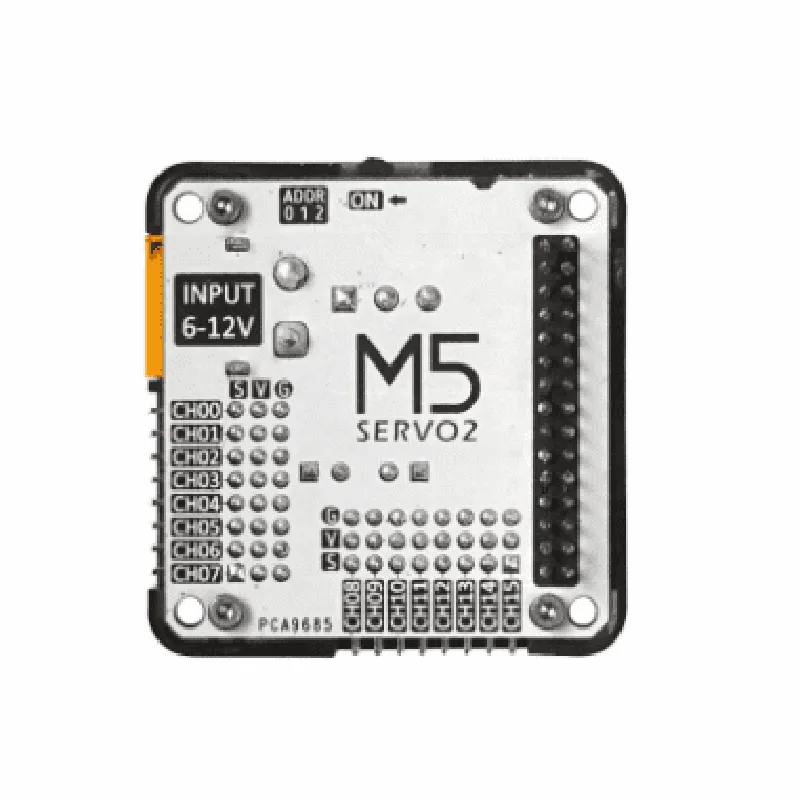
The M5 Stack SERVO2 Module is a 16-channel PWM servo driver module based on the PCA9685 chip. It is designed to provide a comprehensive solution for controlling multiple servo motors in IoT and robotics applications.
The SERVO2 Module is capable of controlling up to 16 servo motors independently, each with its own PWM signal. The module can be easily integrated with popular microcontrollers such as Arduino, ESP32, and ESP8266 to create complex robotic systems, automated machinery, and IoT projects.
The module is built around the PCA9685 chip, a 16-channel, 12-bit PWM Fm+ I2C-bus servo driver. This chip provides a high degree of precision and flexibility in servo motor control.
The module has 16 individual PWM output channels, each capable of driving a servo motor. This allows for the control of multiple servo motors simultaneously, making it ideal for complex robotic systems.
The SERVO2 Module communicates with the microcontroller through the I2C protocol, allowing for easy integration with popular development boards.
The module offers 12-bit PWM resolution, providing a high degree of precision in servo motor control.
The module operates at a voltage range of 2.3V to 5.5V, making it compatible with a wide range of microcontrollers and power supplies.
The module has a built-in LED indicator that displays the I2C communication status, providing a visual feedback during debugging and troubleshooting.
The M5 Stack SERVO2 Module is designed to be compact and space-efficient, making it perfect for IoT and robotics projects where space is limited.
The module is easy to use and requires minimal setup, thanks to its simple I2C communication protocol and easy-to-use APIs.
The SERVO2 Module is compatible with the M5 Stack series of development boards, providing a seamless integration experience.
PCA9685 chip
16-channel PWM output
12-bit PWM resolution
I2C communication protocol
2.3V to 5.5V
Built-in LED indicator
Compact design
Compatible with M5 Stack series
Robotics and automation
IoT projects
Automated machinery
CNC machines
3D printing
Drone and UAV projects
Robotics engineers
IoT developers
Hobbyists and makers
Students and researchers
By providing a comprehensive overview of the M5 Stack SERVO2 Module, this documentation aims to facilitate a deeper understanding of its functionality and key features, allowing users to unlock its full potential in IoT and robotics applications.
M5 Stack SERVO2 Module 16 Channels - 13.2 (PCS9685) DocumentationOverviewThe M5 Stack SERVO2 Module 16 Channels - 13.2 (PCS9685) is a high-performance servo motor controller module designed for IoT and robotics applications. It features 16 channels, allowing for the control of multiple servo motors simultaneously. The module is based on the PCS9685 chip, providing a high degree of precision and reliability.Technical SpecificationsOperating Voltage: 5V
Operating Current: 10mA (max)
Communication Protocol: I2C
Address Range: 0x40 - 0x7F (7-bit)
PWM Frequency: 50Hz
Resolution: 12-bitPinoutThe M5 Stack SERVO2 Module has the following pins:VCC: 5V power supply
GND: Ground
SCL: I2C clock
SDA: I2C data
INT: Interrupt output (optional)Code ExamplesExample 1: Basic Servo Control (Arduino)
```c++
#include <Wire.h>// Define the I2C address of the SERVO2 module
#define SERVO2_ADDRESS 0x40void setup() {
Wire.begin();
}void loop() {
// Set the servo motor to channel 0
Wire.beginTransmission(SERVO2_ADDRESS);
Wire.write(0x00); // Channel 0
Wire.write(0x1F); // Pulse width (0-4095)
Wire.endTransmission();delay(1000);// Set the servo motor to channel 1
Wire.beginTransmission(SERVO2_ADDRESS);
Wire.write(0x01); // Channel 1
Wire.write(0x3F); // Pulse width (0-4095)
Wire.endTransmission();delay(1000);
}
```
This example demonstrates basic servo motor control using the I2C protocol. The code sets the pulse width of the servo motor connected to channel 0 and channel 1 to different values, causing the motor to rotate to corresponding angles.Example 2: Servo Sweep (MicroPython)
```python
import machine
import utime# Define the I2C object
i2c = machine.I2C(scl=machine.Pin(22), sda=machine.Pin(21))# Define the I2C address of the SERVO2 module
SERVO2_ADDRESS = 0x40while True:
for channel in range(16):
for pulse_width in range(0, 4095, 50):
i2c.writeto(SERVO2_ADDRESS, bytearray([channel, pulse_width]))
utime.sleep_ms(10)
```
This example demonstrates a servo sweep using MicroPython. The code iterates over each of the 16 channels, setting the pulse width of the servo motor connected to each channel to a range of values, causing the motor to rotate smoothly from 0 to 180.Note: These examples are provided as a starting point and may require modification to suit specific use cases. It is recommended to consult the datasheet and technical documentation for the PCS9685 chip and servo motors being used for more detailed information.