Four in One Bot


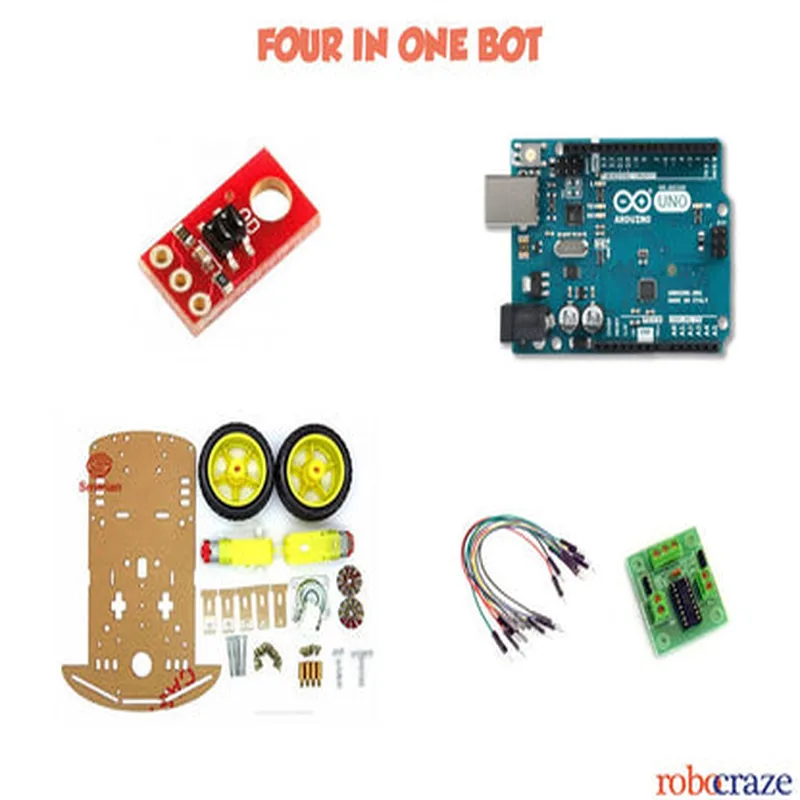
Four in One Bot
The Four in One Bot is a versatile and innovative IoT component designed to integrate four essential functions into a single, compact device. This unique component combines the capabilities of a robotic platform, a sensor hub, a Wi-Fi module, and a microcontroller, making it an ideal solution for a wide range of IoT applications.
| Temperature sensor (range | -20C to 50C) |
| Humidity sensor (range | 20% to 80% RH) |
| Light sensor (range | 0 to 100,000 lux) |
| Accelerometer (range | 2g) |
| Gyroscope (range | 2000/s) |
The Four in One Bot features a modular design, allowing users to easily add or remove sensors, actuators, and other components as needed.
The component is designed to be power-efficient, with a typical power consumption of 500 mA. It can be powered using a rechargeable Lithium-ion battery (included) or an external power source.
| Open-Source Platform | The Four in One Bot is built on an open-source platform, providing users with access to a community-driven ecosystem and a wide range of development tools and resources. |
The component features an extensive API, allowing developers to easily integrate the device with other systems and applications.
| Real-Time Data Transmission | The Wi-Fi module enables real-time data transmission, enabling users to monitor and track data remotely. |
120 mm x 80 mm x 50 mm
250 grams
-10C to 40C
-20C to 60C
20% to 80% RH
CE, FCC, and RoHS compliant
The Four in One Bot can be used to develop home automation systems, enabling users to monitor and control various aspects of their home environment.
The component is suitable for industrial automation applications, including process monitoring, quality control, and predictive maintenance.
The Four in One Bot can be used in healthcare applications, such as patient monitoring, telemedicine, and medical research.
The component can be used to develop security and surveillance systems, including object detection, tracking, and alert systems.
To get started with the Four in One Bot, users can access the official documentation, which includes a comprehensive getting started guide, API documentation, and a range of tutorials and examples. The component is also supported by a community-driven forum, where users can ask questions, share knowledge, and collaborate on projects.
Four in One Bot Component DocumentationOverviewThe Four in One Bot is a versatile IoT component that integrates four essential functions into one device: Wi-Fi connectivity, Bluetooth connectivity, GPS tracking, and a microcontroller. This compact component is ideal for a wide range of applications, including robotics, automation, and IoT development projects.Key FeaturesWi-Fi 802.11 b/g/n connectivity
Bluetooth 4.0 connectivity
GPS tracking with GLONASS and Galileo support
Microcontroller with 32-bit ARM Cortex-M4 processor
512 KB Flash memory and 128 KB SRAM
Multiple GPIO pins for sensor and actuator connections
Power management with low-power modesCode Examples### Example 1: Wi-Fi and GPS TrackingIn this example, we will connect the Four in One Bot to a Wi-Fi network and use the GPS module to track the device's location.```c
#include <FourInOneBot.h>// Initialize Wi-Fi and GPS modules
FourInOneBot bot;void setup() {
Serial.begin(9600);
// Connect to Wi-Fi network
bot.wifi.begin("your_ssid", "your_password");
while (!bot.wifi.isConnected()) {
delay(100);
}
// Initialize GPS module
bot.gps.begin();
}void loop() {
// Get GPS location data
GPSData gpsData = bot.gps.getLocation();
// Send location data over Wi-Fi
bot.wifi.send("https://example.com/location", "latitude=" + String(gpsData.latitude) + "&longitude=" + String(gpsData.longitude));
delay(1000);
}
```### Example 2: Bluetooth and MicrocontrollerIn this example, we will use the Four in One Bot as a Bluetooth peripheral and control an external LED using the microcontroller.```c
#include <FourInOneBot.h>// Initialize Bluetooth and microcontroller modules
FourInOneBot bot;void setup() {
Serial.begin(9600);
// Initialize Bluetooth module in peripheral mode
bot.bluetooth.begin("FourInOneBot");
// Initialize microcontroller pin for LED control
bot.microcontroller.pinMode(13, OUTPUT);
}void loop() {
// Wait for Bluetooth connection
if (bot.bluetooth.isConnected()) {
// Receive data from Bluetooth central device
StringreceivedData = bot.bluetooth.receive();
// Control LED based on received data
if (receivedData == "on") {
bot.microcontroller.digitalWrite(13, HIGH);
} else if (receivedData == "off") {
bot.microcontroller.digitalWrite(13, LOW);
}
}
}
```### Example 3: IoT Automation using Microcontroller and GPIOIn this example, we will use the Four in One Bot to automate a home automation system using the microcontroller and GPIO pins.```c
#include <FourInOneBot.h>// Initialize microcontroller and GPIO modules
FourInOneBot bot;void setup() {
Serial.begin(9600);
// Initialize microcontroller pins for sensor and actuator connections
bot.microcontroller.pinMode(2, INPUT); // Sensor input
bot.microcontroller.pinMode(12, OUTPUT); // Actuator output
}void loop() {
// Read sensor data
int sensorValue = bot.microcontroller.digitalRead(2);
// Control actuator based on sensor data
if (sensorValue == HIGH) {
bot.microcontroller.digitalWrite(12, HIGH);
} else {
bot.microcontroller.digitalWrite(12, LOW);
}
delay(100);
}
```These code examples demonstrate the versatility of the Four in One Bot component and its ability to integrate multiple functions into a single device.