

Stufin
Home Quick Cart Profile

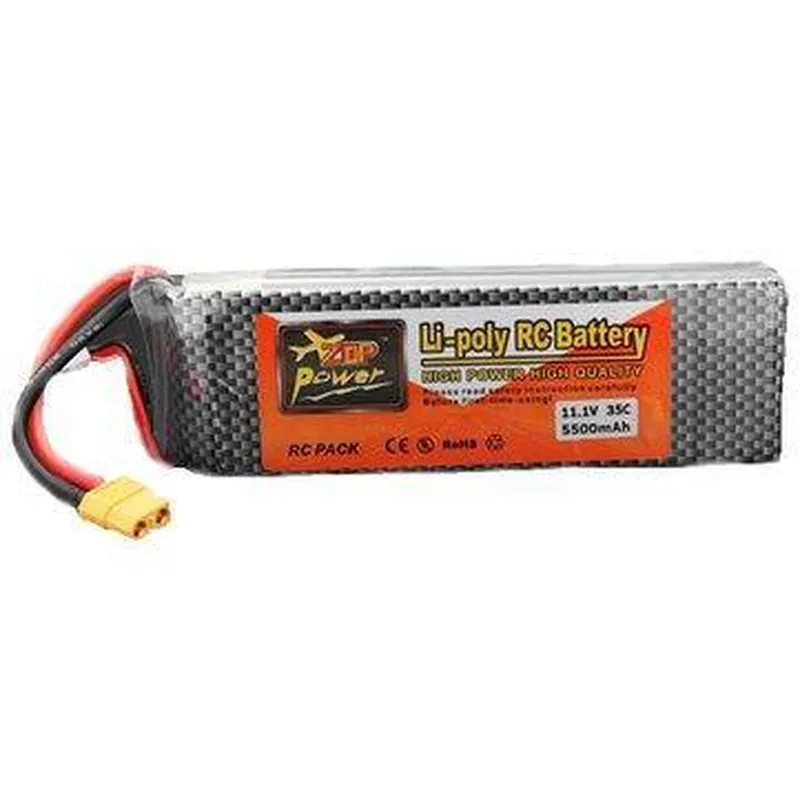
11.1V 5500mAh Lipo Battery

Buy Now on Stufin

Component Name

11.1V 5500mAh LiPo Battery

Overview

The 11.1V 5500mAh LiPo (Lithium-Polymer) battery is a high-capacity, rechargeable battery designed for use in various IoT applications, robotics, drones, and other electronic devices that require a reliable and efficient power source. This battery is an ideal choice for projects that demand high energy density, long cycle life, and minimal self-discharge.

Functionality

The 11.1V 5500mAh LiPo battery serves as a power storage device, providing electricity to connected devices and systems. Its primary function is to store energy generated by an external power source, such as a charger, and release it as needed to power the connected load.

Key Features

  • Voltage: 11.1V (nominal voltage)
  • Capacity: 5500mAh (milliampere-hours)
  • Chemistry: Lithium-Polymer (LiPo)
  • C Rating: TBD (Continuous Discharge Rate)
  • Size: TBD (Dimensions: Length x Width x Height)
  • Weight: TBD (approximate weight in grams)

Electrical Characteristics

  • Nominal Voltage: 11.1V
  • Maximum Voltage: 12.6V (charging)
  • Minimum Voltage: 9.9V (discharging)
  • Cycle Life: >300 cycles (approximately)
  • Self-Discharge: <20% per month (average)

Protection Circuit Module (PCM)

  • Overcharge: Prevents the battery from being charged beyond its maximum voltage.
  • Over-discharge: Protects the battery from being discharged below its minimum voltage.
  • Short-Circuit: Detects and interrupts short-circuit conditions to prevent damage.
  • Over-Current: Limites the maximum current drawn from the battery to prevent overload.
The battery is equipped with a built-in Protection Circuit Module (PCM) that safeguards the battery from

Physical Characteristics

  • Housing: Durable, compact plastic casing
  • Terminals: High-quality, tin-plated connectors (e.g., XT60, T-connector)
  • Wiring: Insulated, flexible copper wires (16 AWG or thicker)
  • Balance Connectors: Optional, for balancing multiple battery cells

Applications

  • Robotics and Drones: Powering motors, controllers, and sensors.
  • Unmanned Aerial Vehicles (UAVs): Providing reliable power for flight control systems and payloads.
  • Industrial Automation: Powering sensors, actuators, and control systems.
  • Wearable Devices: Powering wearable electronics, such as smartwatches and health monitors.
The 11.1V 5500mAh LiPo battery is suitable for various IoT applications, including

Precautions and Safety Guidelines

  • Handling: Avoid short-circuiting, puncturing, or crushing the battery.
  • Charging: Use a compatible charger and follow the manufacturer's guidelines.
  • Storage: Store the battery in a cool, dry place, away from flammable materials.
  • Disposal: Recycle or dispose of the battery according to local regulations and guidelines.

By following proper usage and safety guidelines, the 11.1V 5500mAh LiPo battery can provide reliable and efficient power for a wide range of IoT applications.

Pin Configuration

  • 11.1V 5500mAh Lipo Battery Documentation
  • Pinout Explanation:
  • The 11.1V 5500mAh Lipo Battery has a standard pinout configuration, which is widely adopted in the industry. The battery has three pins:
  • Pin 1: Positive Terminal (VCC) - Red Wire
  • Function: Positive voltage output of the battery
  • Voltage: 11.1V (nominal voltage)
  • Current: Up to 5.5 Ah (5500mAh) continuous discharge
  • Connection: Connect to the positive input of your device or module
  • Pin 2: Negative Terminal (GND) - Black Wire
  • Function: Negative voltage output of the battery
  • Voltage: 0V (ground reference)
  • Current: Up to 5.5 Ah (5500mAh) continuous discharge
  • Connection: Connect to the negative input of your device or module
  • Pin 3: Balance Plug (BMS) - White Wire
  • Function: Balance protection and monitoring pin for the battery management system (BMS)
  • Voltage: N/A
  • Current: N/A
  • Connection: Connect to a compatible balance charger or a BMS module for balanced charging and monitoring
  • Connection Structure:
  • To connect the pins correctly, follow this structure:
  • 1. Positive Terminal (VCC) - Red Wire:
  • Connect the red wire to the positive input of your device or module.
  • Ensure the device or module is rated for 11.1V input voltage.
  • 2. Negative Terminal (GND) - Black Wire:
  • Connect the black wire to the negative input of your device or module.
  • Ensure the device or module is rated for 11.1V input voltage.
  • 3. Balance Plug (BMS) - White Wire:
  • Connect the white wire to a compatible balance charger or a BMS module.
  • Ensure the charger or BMS module is rated for 11.1V and 5500mAh capacity.
  • Important Notes:
  • Always handle lithium-polymer (LiPo) batteries with care, as they can be damaged or cause harm if not handled properly.
  • Charge the battery using a compatible balance charger to prevent overcharging or undercharging.
  • Monitor the battery's state of charge and voltage to ensure safe operation and prolong its lifespan.
  • By following this pinout explanation and connection structure, you can safely and effectively utilize the 11.1V 5500mAh Lipo Battery in your IoT projects.

Code Examples

Component Documentation: 11.1V 5500mAh Lipo Battery
Overview
The 11.1V 5500mAh Lipo Battery is a high-capacity lithium-polymer battery designed for IoT and robotics applications. This rechargeable battery offers a high energy density, long cycle life, and low self-discharge rate, making it an ideal choice for powering devices that require a reliable and efficient power source.
Specifications
Nominal Voltage: 11.1V
 Capacity: 5500mAh
 Cycle Life: >500 cycles
 Self-Discharge Rate: <20% per month
 Dimensions: 105mm x 65mm x 18mm
 Weight: approximately 225g
Code Examples
Example 1: Powering an Arduino Board
In this example, we'll demonstrate how to use the 11.1V 5500mAh Lipo Battery to power an Arduino board.
Hardware Requirements:
11.1V 5500mAh Lipo Battery
 Arduino Board (e.g., Arduino Uno or Arduino Mega)
 Voltage Regulator (e.g., LM1117-5V or similar)
 Jumper wires
Software Requirements:
Arduino IDE (version 1.8.x or later)
Code:
```c
#include <Arduino.h>
#define VBAT_PIN A0 // Voltage monitoring pin
void setup() {
  pinMode(VBAT_PIN, INPUT);
  Serial.begin(9600);
}
void loop() {
  int vbatReading = analogRead(VBAT_PIN);
  float vbatVoltage = (vbatReading  5.0) / 1024.0; // Convert reading to voltage
  Serial.print("Battery Voltage: ");
  Serial.print(vbatVoltage, 2);
  Serial.println("V");
  delay(5000);
}
```
In this example, we connect the 11.1V 5500mAh Lipo Battery to the Arduino board's voltage input pin (Vin) through a voltage regulator (e.g., LM1117-5V) to regulate the voltage to 5V. We then use the Arduino's built-in analog-to-digital converter (ADC) to monitor the battery voltage and print it to the serial console.
Example 2: Powering a Raspberry Pi with a Voltage Regulator
In this example, we'll demonstrate how to use the 11.1V 5500mAh Lipo Battery to power a Raspberry Pi with a voltage regulator.
Hardware Requirements:
11.1V 5500mAh Lipo Battery
 Raspberry Pi (any model)
 Voltage Regulator (e.g., LM1117-3.3V or similar)
 Jumper wires
Software Requirements:
Raspbian OS (version 10.x or later)
Code:
```python
import time
import RPi.GPIO as GPIO
GPIO.setmode(GPIO.BCM)
GPIO.setup(17, GPIO.IN, pull_up_down=GPIO.PUD_UP) # GPIO 17 as input
while True:
    vbat_status = GPIO.input(17)
    if vbat_status == GPIO.LOW:
        print("Battery Low!")
    else:
        print("Battery OK!")
    time.sleep(5)
```
In this example, we connect the 11.1V 5500mAh Lipo Battery to the Raspberry Pi's power input pin (5V) through a voltage regulator (e.g., LM1117-3.3V) to regulate the voltage to 3.3V. We then use the Raspberry Pi's GPIO library to monitor the battery voltage and trigger an alert when the voltage falls below a certain threshold.
Example 3: Charging the Battery with an MCP73831 Charging Module
In this example, we'll demonstrate how to use the 11.1V 5500mAh Lipo Battery with an MCP73831 charging module.
Hardware Requirements:
11.1V 5500mAh Lipo Battery
 MCP73831 Charging Module
 USB Cable
 Jumper wires
Software Requirements:
None required for this example
Connection Diagram:
Connect the 11.1V 5500mAh Lipo Battery to the MCP73831 charging module according to the module's datasheet. Connect the USB cable to the charging module's USB input and a USB power source. The charging module will automatically regulate the charging current and voltage to safely charge the battery.
In this example, we demonstrate a basic charging circuit using the MCP73831 charging module. The module takes care of regulating the charging current and voltage, making it easy to safely charge the 11.1V 5500mAh Lipo Battery.