11.1V 2200mAh 25C LiPo Battery


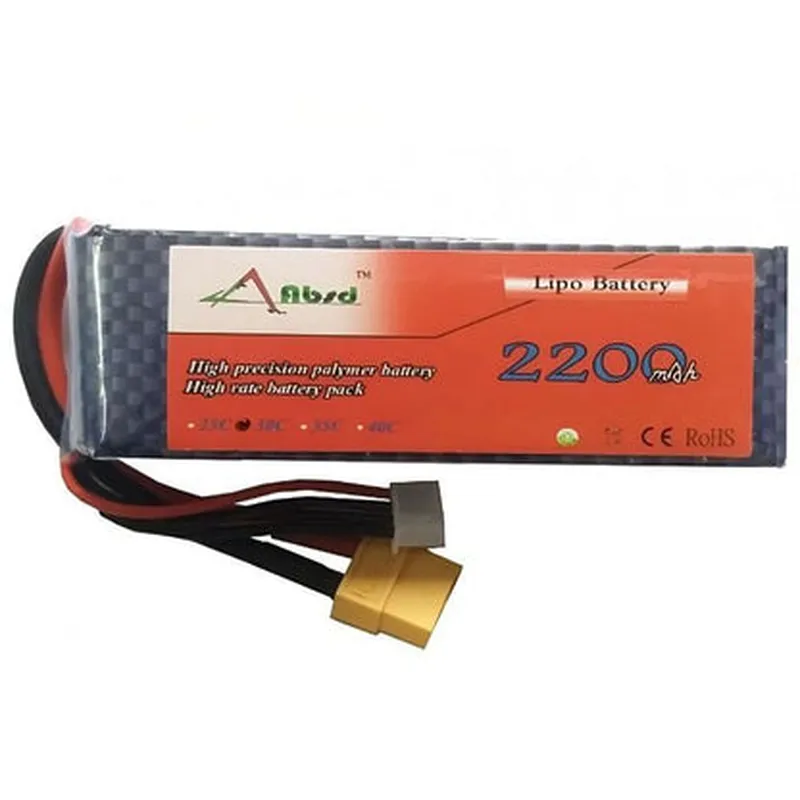

11.1V 2200mAh 25C LiPo Battery
The 11.1V 2200mAh 25C LiPo Battery is a high-performance rechargeable lithium-ion polymer battery designed for use in various IoT applications, robotics, drones, and other devices that require reliable and efficient power supply.
The primary function of the 11.1V 2200mAh 25C LiPo Battery is to store electrical energy and provide a stable voltage output to devices. It is a rechargeable battery, meaning it can be charged and discharged multiple times, making it an ideal choice for applications where power efficiency and reliability are crucial.
11.1V (nominal voltage)
2200mAh (milliampere-hours) - the battery's ability to store electrical energy
25C - the battery's ability to supply current, where 1C is equivalent to 2200mA. A 25C rating means the battery can supply up to 55,000mA (2200mAh x 25C) of current.
Lithium-Ion Polymer (LiPo) - a type of rechargeable battery known for its high energy density, long cycle life, and relatively low self-discharge rate.
[Insert dimensions, e.g., 105mm x 35mm x 25mm]
[Insert weight, e.g., 220g]
[Insert connector type, e.g., JST-XH or T-connector]
The battery can be charged and discharged for up to 300-500 cycles, depending on operating conditions and charging/discharging methodology.
| Self-Discharge Rate | The battery will retain up to 90% of its capacity after 3 months of storage at room temperature (20C/68F). |
-20C to 45C (-4F to 113F) - the recommended temperature range for optimal performance and safety.
| Internal Protection Circuit (IPC) | The battery contains an internal protection circuit that prevents overcharge, over-discharge, and short-circuit conditions, thereby ensuring safe operation. |
The battery is designed to prevent thermal runaway, a condition that can lead to overheating or fire.
| The 11.1V 2200mAh 25C LiPo Battery is suitable for various IoT applications, including |
Robotics and automation systems
Drones and UAVs
Remote monitoring and sensing systems
Wearable devices and IoT wearables
Autonomous vehicles and robotics platforms
Handle the battery with care to avoid mechanical damage or electrical shock.
Follow proper charging and discharging procedures to ensure safe and efficient operation.
Store the battery in a cool, dry place away from flammable materials.
Recycle the battery responsibly at the end of its life cycle.
11.1V 2200mAh 25c LiPo Battery DocumentationOverviewThe 11.1V 2200mAh 25c LiPo Battery is a high-performance lithium-polymer battery designed for various IoT applications, including drones, robots, and other devices that require high energy density and reliable power supply. This battery offers a capacity of 2200mAh, a voltage of 11.1V, and a discharge rate of 25C.SpecificationsVoltage: 11.1V
Capacity: 2200mAh
Discharge Rate: 25C
Weight: 160g
Dimensions: 65mm x 35mm x 25mmCode Examples### Example 1: Using the LiPo Battery with an Arduino BoardIn this example, we will demonstrate how to connect the 11.1V 2200mAh 25c LiPo Battery to an Arduino board and monitor its voltage level using the Arduino's built-in analog-to-digital converter (ADC).Hardware ConnectionConnect the positive terminal of the LiPo Battery to the VIN pin on the Arduino board.
Connect the negative terminal of the LiPo Battery to the GND pin on the Arduino board.
Connect a voltage divider circuit (e.g., 2k and 1k resistors) to the analog input pin (A0) on the Arduino board to measure the battery voltage.Arduino Code
```cpp
const int batteryPin = A0; // Select the input pin for the battery voltage measurementvoid setup() {
Serial.begin(9600);
}void loop() {
int batteryValue = analogRead(batteryPin);
float batteryVoltage = (batteryValue 5.0) / 1024.0; // Convert the ADC value to voltage
Serial.print("Battery Voltage: ");
Serial.print(batteryVoltage);
Serial.println(" V");
delay(1000);
}
```
This code reads the analog value from the voltage divider circuit, converts it to a voltage value, and prints it to the serial console.### Example 2: Using the LiPo Battery with a Raspberry Pi to Power a DroneIn this example, we will demonstrate how to use the 11.1V 2200mAh 25c LiPo Battery to power a drone's control system, which is built around a Raspberry Pi single-board computer.Hardware ConnectionConnect the positive terminal of the LiPo Battery to the power input pin on the Raspberry Pi (e.g., pin 2 on the GPIO header).
Connect the negative terminal of the LiPo Battery to the power ground pin on the Raspberry Pi (e.g., pin 6 on the GPIO header).
Connect the necessary peripherals (e.g., motors, sensors, and communication modules) to the Raspberry Pi.Python Code
```python
import time
import RPi.GPIO as GPIO# Define the GPIO pins for the motor control signals
motor_pins = [17, 23, 24, 25]# Set up the GPIO pins as outputs
GPIO.setmode(GPIO.BCM)
for pin in motor_pins:
GPIO.setup(pin, GPIO.OUT)try:
while True:
# Read the battery voltage using an ADC module (not shown in this example)
battery_voltage = 11.1 # Assume a constant voltage for simplicity# Control the motors based on the battery voltage and other factors
if battery_voltage > 10.5:
# Throttle up the motors
for pin in motor_pins:
GPIO.output(pin, GPIO.HIGH)
else:
# Throttle down the motors
for pin in motor_pins:
GPIO.output(pin, GPIO.LOW)
time.sleep(0.1)
except KeyboardInterrupt:
GPIO.cleanup()
```
This code demonstrates a simple motor control scheme that adjusts the motor speed based on the battery voltage level. Note that this is a simplified example and may not represent a real-world drone control system.Remember to always follow proper safety precautions when working with lithium-polymer batteries and high-power devices.