3mm DIP Diffused Blue LED (Pack of 10)


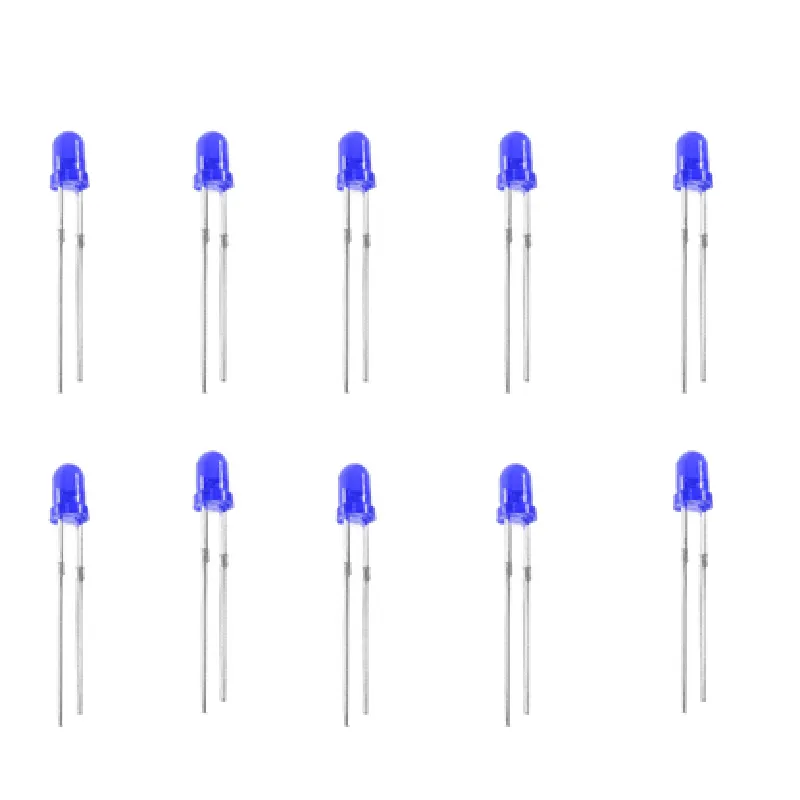
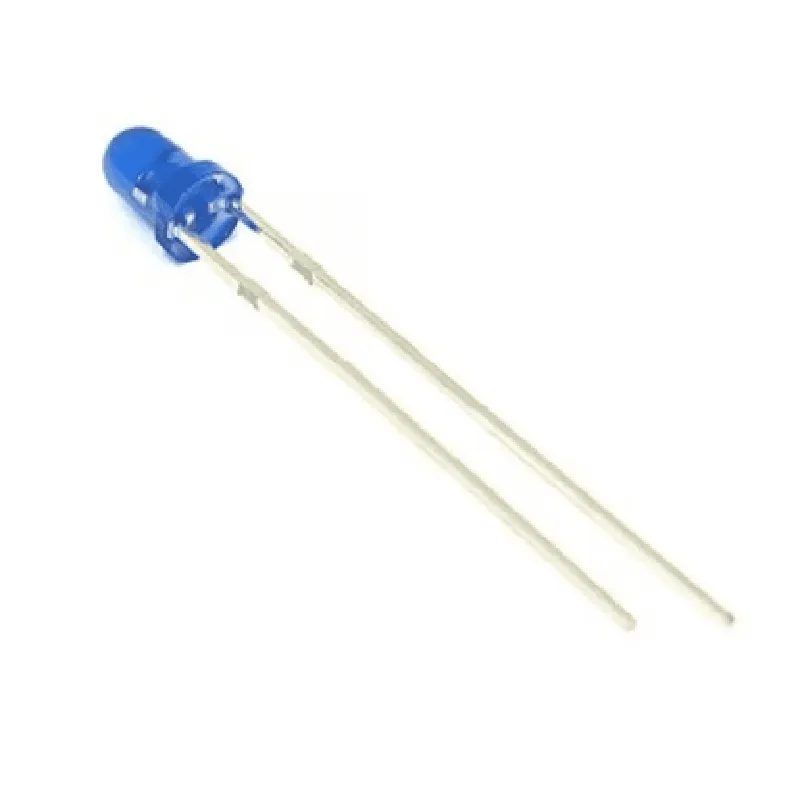
3mm DIP Diffused Blue LED (Pack of 10)
The 3mm DIP Diffused Blue LED is a light-emitting diode component designed to emit a blue color light with a diffused lens. This LED is a discrete semiconductor device that converts electrical energy into visible light. The component comes in a pack of 10, making it an ideal choice for various electronic projects, prototypes, and production runs.
The primary function of the 3mm DIP Diffused Blue LED is to emit a blue light when an electric current passes through it. The LED is polarized, meaning it has a positive leg (anode) and a negative leg (cathode). When connected to a power source, the LED will illuminate when the positive leg is connected to the positive terminal of the power source and the negative leg is connected to the negative terminal.
| Forward Voltage (Vf) | 1.8-2.5 volts |
| Forward Current (If) | 10-20 milliamps |
| Reverse Voltage (Vr) | 5 volts |
450-495 nanometers
100-200 mcd
3mm
4.5mm
2.54mm
15mm
-30C to 80C
-40C to 100C
| The 3mm DIP Diffused Blue LED is suitable for a wide range of applications, including |
Electronic projects and prototypes
Indicator lights for devices and appliances
Backlighting for LCD displays
Decorative lighting and ambiance creation
IoT and automation projects
By incorporating the 3mm DIP Diffused Blue LED into your design, you can add a reliable, efficient, and visually appealing light source that enhances the overall functionality and aesthetic appeal of your project.
3mm DIP Diffused Blue LED (Pack of 10) DocumentationOverviewThe 3mm DIP Diffused Blue LED is a versatile and widely used component in various IoT and electronics projects. This LED emits a bright blue light when energized and is suitable for indicators, status lights, and other applications where a blue light is required.PinoutThe LED has a standard 3mm DIP (Dual In-Line Package) with two legs: Anode (Positive) and Cathode (Negative).| Leg | Function |
| --- | --- |
| Anode | Positive |
| Cathode | Negative |Electrical Characteristics| Parameter | Value |
| --- | --- |
| Forward Voltage (Vf) | 3.2V - 3.8V |
| Forward Current (If) | 20mA |
| Luminous Intensity | 400-600 mcd |
| Wavelength | 460-470 nm (Blue) |Code Examples### Example 1: Simple LED Connection with a Microcontroller (Arduino)In this example, we will connect the LED to digital pin 13 of an Arduino Uno board and toggle it on and off using a simple program.Hardware Requirements:Arduino Uno board
3mm DIP Diffused Blue LED
1k resistor
Breadboard and jumper wiresSoftware Requirements:Arduino IDECode:
```cpp
const int ledPin = 13; // Digital pin 13void setup() {
pinMode(ledPin, OUTPUT);
}void loop() {
digitalWrite(ledPin, HIGH); // Turn LED on
delay(1000); // Wait for 1 second
digitalWrite(ledPin, LOW); // Turn LED off
delay(1000); // Wait for 1 second
}
```
Note: Make sure to connect the LED's anode to digital pin 13 and the cathode to GND through a 1k resistor to limit the current.### Example 2: LED Blinking with a Raspberry Pi (Python)In this example, we will connect the LED to GPIO pin 17 of a Raspberry Pi and blink it using a Python script.Hardware Requirements:Raspberry Pi board
3mm DIP Diffused Blue LED
1k resistor
Breadboard and jumper wiresSoftware Requirements:Raspbian OS
Python 3.xCode:
```python
import RPi.GPIO as GPIO
import timeGPIO.setmode(GPIO.BCM)
GPIO.setup(17, GPIO.OUT)while True:
GPIO.output(17, GPIO.HIGH) # Turn LED on
time.sleep(1) # Wait for 1 second
GPIO.output(17, GPIO.LOW) # Turn LED off
time.sleep(1) # Wait for 1 second
```
Note: Make sure to connect the LED's anode to GPIO pin 17 and the cathode to GND through a 1k resistor to limit the current.By following these examples, you can easily integrate the 3mm DIP Diffused Blue LED into your IoT projects and create interactive and visual effects.