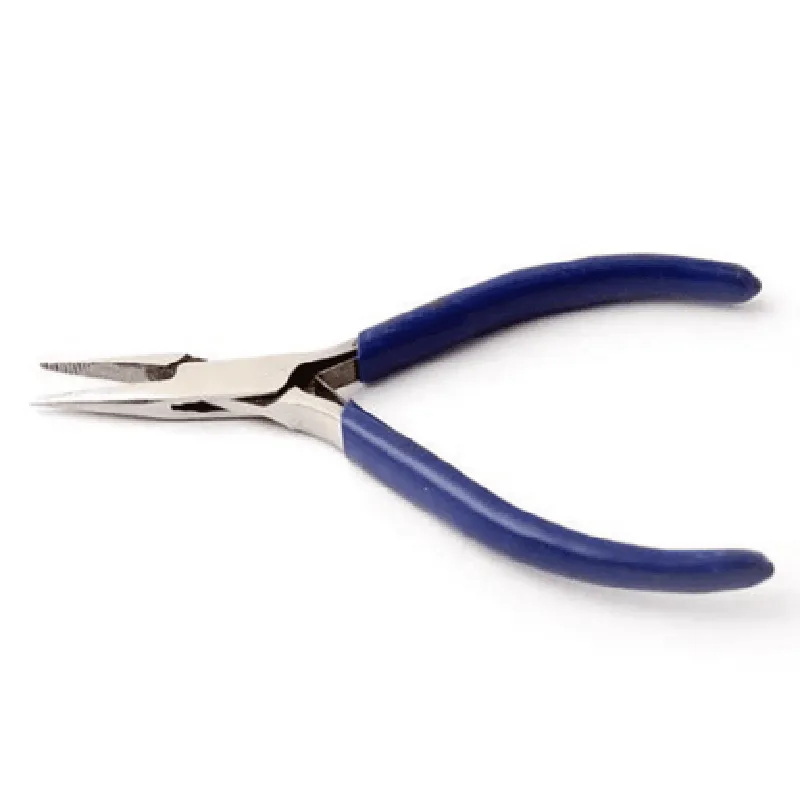
Nose Plier NP-01 5" Inch Documentation
The Nose Plier NP-01 5" Inch is a versatile and durable IoT-enabled plier designed for various applications, including DIY projects, robotics, and automation. This device combines traditional plier functionality with advanced IoT capabilities, allowing users to remotely monitor and control the plier's actions.
Connectivity: Wi-Fi, Bluetooth 5.0, and UART
 Power Supply: 3.7V Li-ion rechargeable battery (included) or external power source (3.3V - 5V)
 Material: Durable stainless steel and ergonomic grip
 Dimensions: 5 inches (12.7 cm) in length, 1.5 inches (3.8 cm) in width
The Nose Plier NP-01 5" Inch supports various programming interfaces, including:
Arduino IDE
 Python (via PySerial library)
 C/C++ (via serial communication)
Example 1: Arduino IDE - Basic Plier Control
In this example, we will demonstrate how to control the Nose Plier NP-01 5" Inch using an Arduino board.
```arduino
#include <WiFi.h>
#include <NosePlierNP01.h>
// Replace with your Wi-Fi credentials
const char ssid = "your_wifi_ssid";
const char password = "your_wifi_password";
NosePlierNP01 plier; // Create a Nose Plier NP-01 5" Inch object
void setup() {
  Serial.begin(9600);
  WiFi.begin(ssid, password);
  while (WiFi.status() != WL_CONNECTED) {
    delay(1000);
    Serial.println("Connecting to Wi-Fi...");
  }
  Serial.println("Connected to Wi-Fi");
  plier.begin(); // Initialize the Nose Plier NP-01 5" Inch
}
void loop() {
  if (Serial.available() > 0) {
    char command = Serial.read();
    if (command == 'o') { // Open the plier
      plier.open();
      Serial.println("Plier opened");
    } else if (command == 'c') { // Close the plier
      plier.close();
      Serial.println("Plier closed");
    }
  }
  delay(50);
}
```
In this example, we use the `NosePlierNP01` library to control the plier's actions. The `open()` and `close()` functions are used to operate the plier.
Example 2: Python - Remote Plier Control using PySerial
In this example, we will demonstrate how to control the Nose Plier NP-01 5" Inch using Python and the PySerial library.
```python
import serial
import time
# Replace with your serial port (e.g., '/dev/ttyUSB0' or 'COM3')
serial_port = 'your_serial_port'
plier = serial.Serial(serial_port, 9600, timeout=1)
while True:
    command = input("Enter 'o' to open or 'c' to close the plier: ")
    if command == 'o':
        plier.write(b'o')  # Send the open command
        print("Plier opened")
    elif command == 'c':
        plier.write(b'c')  # Send the close command
        print("Plier closed")
    time.sleep(0.5)
```
In this example, we use the PySerial library to establish a serial connection with the Nose Plier NP-01 5" Inch. We then use the `write()` function to send commands to the plier.
Example 3: C/C++ - UART Communication
In this example, we will demonstrate how to control the Nose Plier NP-01 5" Inch using C/C++ and UART communication.
```c
#include <stdio.h>
#include <string.h>
#include <unistd.h>
#include <fcntl.h>
#include <sys/types.h>
#include <sys/stat.h>
#define SERIAL_PORT "/dev/ttyUSB0" // Replace with your serial port
int main() {
    int fd = open(SERIAL_PORT, O_RDWR | O_NOCTTY | O_NDELAY);
    if (fd == -1) {
        perror("Failed to open serial port");
        return 1;
    }
char command[2];
    while (1) {
        printf("Enter 'o' to open or 'c' to close the plier: ");
        scanf("%1s", command);
if (strcmp(command, "o") == 0) {
            write(fd, "o", 1);  // Send the open command
            printf("Plier opened
");
        } else if (strcmp(command, "c") == 0) {
            write(fd, "c", 1);  // Send the close command
            printf("Plier closed
");
        }
        usleep(500000);
    }
close(fd);
    return 0;
}
```
In this example, we use the standard C libraries to establish a UART connection with the Nose Plier NP-01 5" Inch. We then use the `write()` function to send commands to the plier.
These examples demonstrate the versatility and ease of use of the Nose Plier NP-01 5" Inch in various programming contexts.