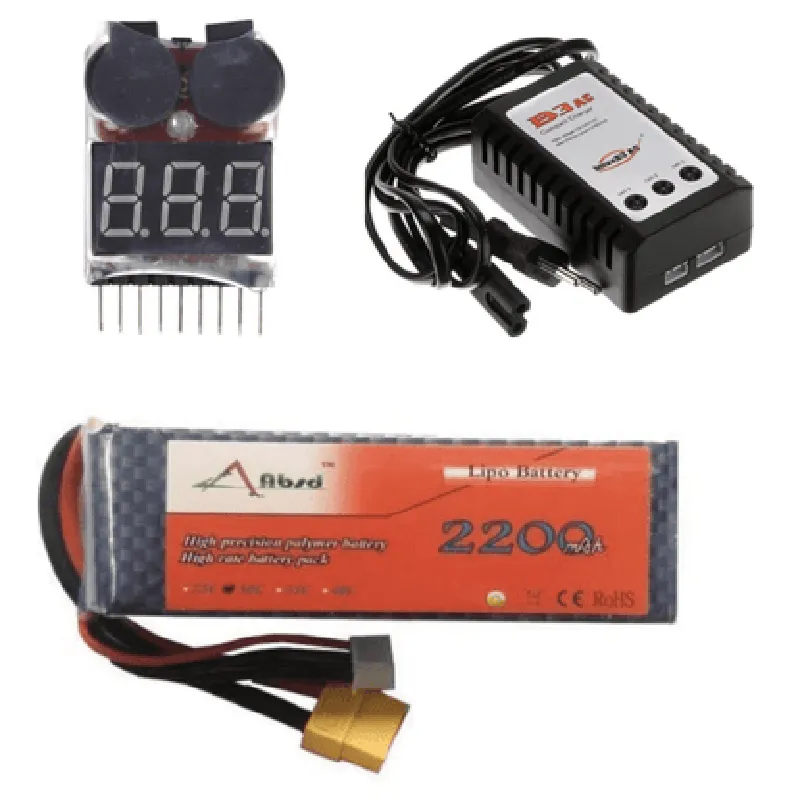
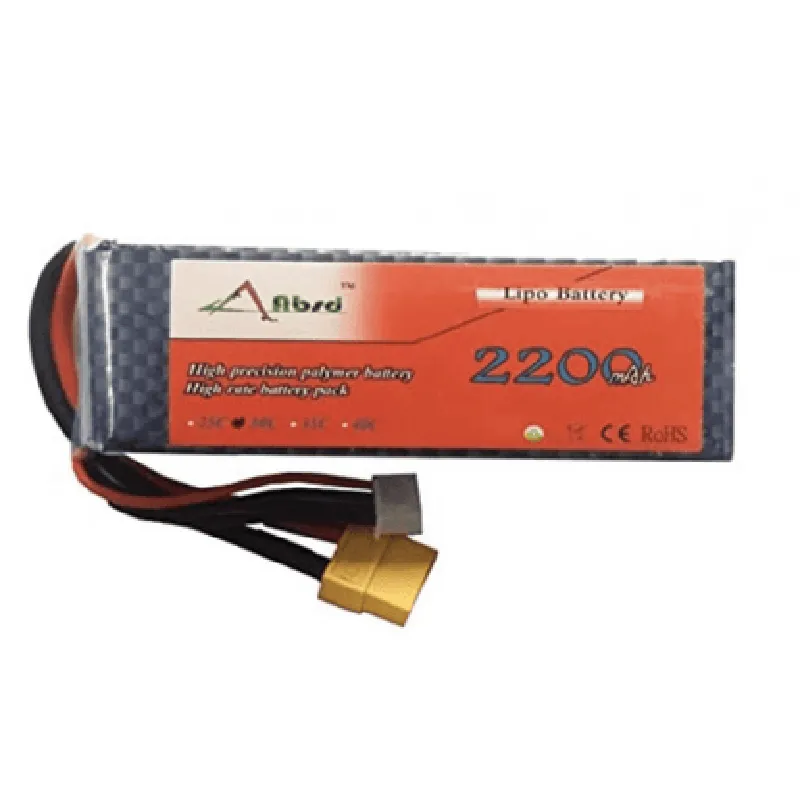
Component Documentation: 11.1V 25C 2200mAh ABS D Lipo Battery with B3AC Lipo Battery Charger and QP38 1-8S Li-Po Battery Voltage Tester
The 11.1V 25C 2200mAh ABS D Lipo Battery is a high-performance lithium-polymer battery designed for demanding applications. It comes bundled with a B3AC Lipo Battery Charger and a QP38 1-8S Li-Po Battery Voltage Tester, providing a comprehensive power solution for IoT projects. This documentation provides an overview of the component, its specifications, and code examples to help developers integrate it into their projects.
Battery:
	+ Voltage: 11.1V
	+ Capacity: 2200mAh
	+ Rating: 25C
	+ Chemistry: Lithium-Polymer (Li-Po)
	+ Dimensions: 73mm x 34mm x 24mm
 Charger:
	+ Model: B3AC
	+ Input: 100-240V AC, 50-60Hz
	+ Output: 12.6V, 5A
	+ Charging Method: Balance Charging
 Voltage Tester:
	+ Model: QP38
	+ Supported Cells: 1-8S Li-Po
	+ Measurement Range: 0-12V
	+ Accuracy: 0.01V
Here are three code examples demonstrating how to use the 11.1V 25C 2200mAh ABS D Lipo Battery with the B3AC Lipo Battery Charger and QP38 1-8S Li-Po Battery Voltage Tester:
Example 1: Arduino-Based Voltage Monitoring
This example uses an Arduino board to read the voltage of the Li-Po battery using the QP38 voltage tester.
```c
const int voltagePin = A0; // Analog input pin connected to QP38 voltage tester
void setup() {
  Serial.begin(9600);
}
void loop() {
  int voltageReading = analogRead(voltagePin);
  float voltage = voltageReading  (12.6 / 1023.0); // Convert analog reading to voltage
  Serial.print("Battery Voltage: ");
  Serial.print(voltage);
  Serial.println(" V");
  delay(1000);
}
```
Example 2: Charging Status Indicator using Raspberry Pi
This example uses a Raspberry Pi to monitor the charging status of the Li-Po battery using the B3AC charger.
```python
import RPi.GPIO as GPIO
# Define pins for charger status LEDs
chargingPin = 17
fullPin = 23
GPIO.setmode(GPIO.BCM)
GPIO.setup(chargingPin, GPIO.IN)
GPIO.setup(fullPin, GPIO.IN)
while True:
  if GPIO.input(chargingPin) == GPIO.HIGH:
    print("Battery is charging...")
  elif GPIO.input(fullPin) == GPIO.HIGH:
    print("Battery is fully charged!")
  else:
    print("Battery is not charging.")
  time.sleep(1)
```
Example 3: Power Management using ESP32
This example uses an ESP32 board to monitor the battery voltage and implement power management strategies.
```c
#include <WiFi.h>
const int voltagePin = 32; // Analog input pin connected to QP38 voltage tester
void setup() {
  Serial.begin(115200);
  pinMode(voltagePin, INPUT);
}
void loop() {
  int voltageReading = analogRead(voltagePin);
  float voltage = voltageReading  (12.6 / 4095.0); // Convert analog reading to voltage
if (voltage < 10.0) {
    Serial.println("Low battery! Entering power-saving mode.");
    // Implement power-saving strategies, such as reducing CPU frequency or disabling peripherals
  } else {
    Serial.println("Battery voltage is within safe range.");
  }
  delay(1000);
}
```
These examples demonstrate how to use the 11.1V 25C 2200mAh ABS D Lipo Battery with the B3AC Lipo Battery Charger and QP38 1-8S Li-Po Battery Voltage Tester in various IoT applications.