Stufin
Home Quick Cart Profile

5mm to 5mm Flexible Couplings


Buy Now on Stufin

Component Name

5mm to 5mm Flexible Couplings
Description

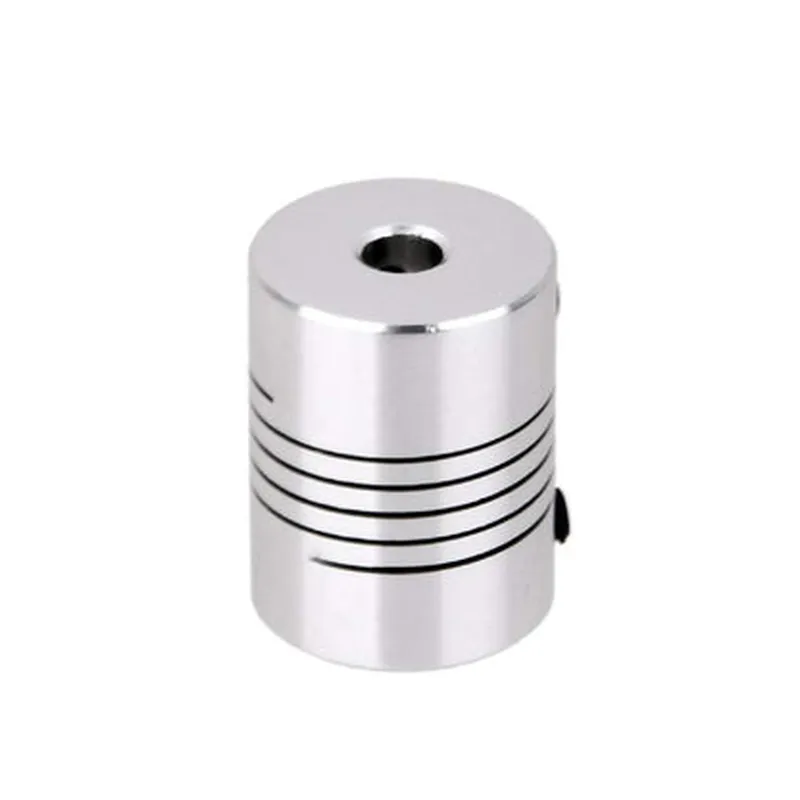
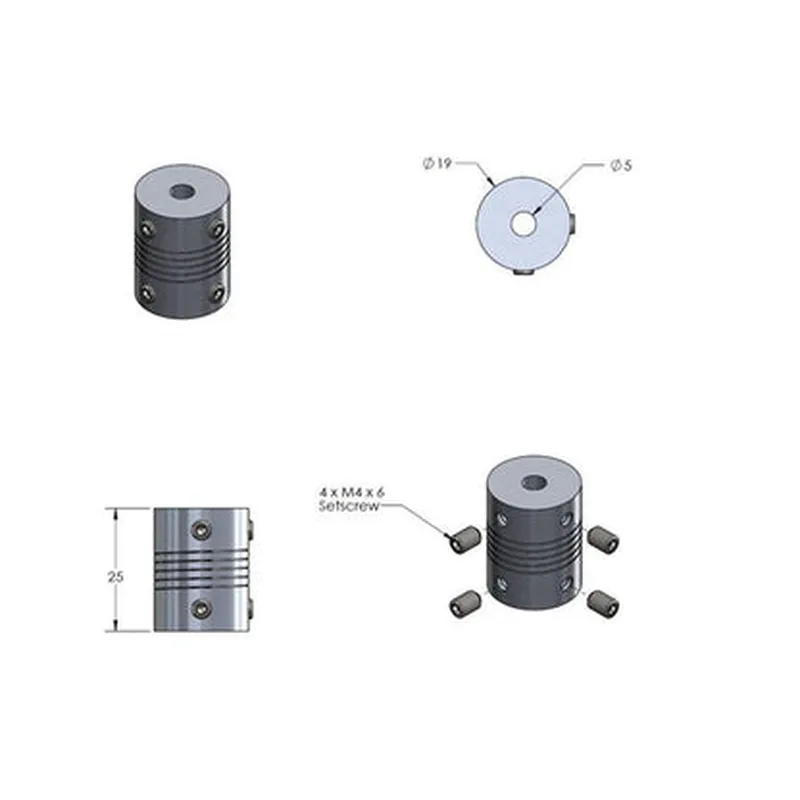
The 5mm to 5mm Flexible Couplings are mechanical components designed to connect and decouple two shafts or rods with a 5mm diameter, allowing for flexible movement and rotation while maintaining a stable connection. These couplings are commonly used in robotics, mechanical engineering, and IoT applications where precise movement and flexibility are crucial.
Functionality

  • Connect and decouple two 5mm shafts or rods, enabling the transfer of rotational motion and torque between them.
  • Absorb vibrations and shocks, reducing the impact of external disturbances on the connected components.
  • Compensate for misalignment, allowing for slight deviations in the axis of rotation between the connected shafts.
The primary function of the 5mm to 5mm Flexible Couplings is to

Key Features

  • Flexible Design: The couplings feature a flexible, elastomeric material that enables smooth, vibration-free motion and absorbs shocks.
  • High Torque Capacity: The couplings are designed to handle high torque loads, making them suitable for demanding applications.
  • Corrosion-Resistant: The materials used in the couplings are resistant to corrosion, ensuring a long lifespan in various environments.
  • Compact Size: The 5mm to 5mm Flexible Couplings have a compact design, making them ideal for use in space-constrained applications.
  • Easy Installation: The couplings are simple to install, with no need for special tools or expertise.
  • Low Backlash: The couplings exhibit low backlash, ensuring precise movement and minimizing the risk of oscillation or vibration.
  • High-Speed Capability: The couplings can operate at high speeds, making them suitable for applications requiring rapid motion.

Shaft Diameter

5mm

Material

Elastomeric material (e.g., silicone or rubber)

Torque Capacity

Up to 10 Nm (dependent on the specific model)

Operating Temperature

-20C to 80C (-4F to 176F)

Vibration Damping

Up to 10 Hz

Misalignment Compensation

Up to 2

Applications

  • Robotics and Automation
  • Mechanical Engineering
  • IoT Devices (e.g., robotic arms, conveyor systems)
  • Industrial Machinery
  • Motion Control Systems

Conclusion

The 5mm to 5mm Flexible Couplings are versatile, high-performance components that provide a reliable and flexible connection between two shafts or rods. Their unique combination of features makes them an ideal choice for various IoT and industrial applications where precise movement, flexibility, and vibration dampening are essential.

Pin Configuration

  • 5mm to 5mm Flexible Couplings Documentation
  • Overview
  • The 5mm to 5mm Flexible Couplings are a type of connector used in IoT devices and robotics to establish a secure and flexible connection between two 5mm diameter shafts. These couplings are designed to provide a reliable and flexible connection, allowing for some degree of misalignment and vibration between the connected components.
  • Pin Structure
  • The 5mm to 5mm Flexible Couplings have a simple and straightforward pin structure, with a total of two pins. Here is a breakdown of each pin:
  • Pin 1:
  • Function: 5mm Shaft Connection
  • Description: This pin is used to connect to one of the 5mm diameter shafts.
  • Type: Male thread
  • Size: 5mm diameter
  • Material: Typically made of a durable material such as stainless steel or aluminum
  • Pin 2:
  • Function: 5mm Shaft Connection
  • Description: This pin is used to connect to the other 5mm diameter shaft.
  • Type: Male thread
  • Size: 5mm diameter
  • Material: Typically made of a durable material such as stainless steel or aluminum
  • Connecting the Pins
  • To connect the pins, follow these steps:
  • 1. Align the shafts: Ensure the two 5mm diameter shafts are aligned properly, taking into account any potential misalignment or vibration.
  • 2. Thread the pins: Screw the pins onto the respective shafts, making sure they are securely fastened.
  • 3. Connect the couplings: Bring the two pins together, ensuring they are properly aligned and seated within the flexible coupling.
  • 4. Secure the connection: Use the appropriate torque or tightening mechanism to secure the connection, ensuring it can withstand the intended load and environmental conditions.
  • Tips and Considerations
  • Tightening: Ensure the pins are tightened evenly and securely to prevent vibration or loosening over time.
  • Misalignment: The flexible coupling is designed to accommodate some degree of misalignment, but excessive misalignment may affect the connection's reliability.
  • Environmental factors: Consider the operating environment and potential exposure to dust, moisture, or extreme temperatures when selecting the flexible coupling material and tightening mechanism.
  • Shaft size: Verify the shaft diameter is 5mm to ensure proper compatibility with the flexible coupling.
  • By following these guidelines and connecting the pins correctly, the 5mm to 5mm Flexible Couplings will provide a reliable and flexible connection between the two shafts, ensuring the successful operation of your IoT device or robotic system.

Code Examples

Component Documentation: 5mm to 5mm Flexible Couplings
Overview
The 5mm to 5mm Flexible Couplings are flexible, misalignment-compensating connectors designed to connect two shafts or rods with a 5mm diameter. They provide a reliable and flexible connection between rotating shafts, allowing for axial, radial, and angular misalignment. These couplings are commonly used in robotics, CNC machines, and other applications where precise motion control is required.
Technical Specifications
Material: Aluminum alloy or Stainless Steel
 Shaft diameter: 5mm
 Length: 10mm (standard), 15mm, 20mm, 25mm (optional)
 Torque rating: Up to 10 Nm
 Operating temperature: -20C to 80C
 Misalignment capacity: Up to 3 angular, 1.5mm axial, and 0.5mm radial
Usage Examples
### Example 1: Connecting two stepper motors for synchronized movement
In this example, we will demonstrate how to use the 5mm to 5mm Flexible Couplings to connect two stepper motors for synchronized movement in a 3D printing application.
Hardware Requirements
2 x Stepper motors with 5mm shafts
 1 x 5mm to 5mm Flexible Coupling
 1 x Arduino Board (e.g., Arduino Uno)
 1 x Stepper motor driver (e.g., A4988)
Code Example (Arduino)
```c
#include <Stepper.h>
// Define stepper motors and coupling
Stepper motor1(200, 2, 3); // Stepper motor 1, 200 steps/rev, pins 2 and 3
Stepper motor2(200, 4, 5); // Stepper motor 2, 200 steps/rev, pins 4 and 5
FlexibleCoupling coupling; // 5mm to 5mm Flexible Coupling
void setup() {
  // Initialize stepper motors
  motor1.setSpeed(100); // Set speed to 100 rpm
  motor2.setSpeed(100); // Set speed to 100 rpm
}
void loop() {
  // Synchronized movement
  motor1.step(100); // Move motor 1 100 steps
  motor2.step(100); // Move motor 2 100 steps
  delay(10); // Wait 10ms
}
```
Example 2: Connecting a DC motor to a encoder for speed measurement
In this example, we will demonstrate how to use the 5mm to 5mm Flexible Couplings to connect a DC motor to an encoder for speed measurement in a robotics application.
Hardware Requirements
1 x DC motor with 5mm shaft
 1 x Encoder (e.g., optical or magnetic)
 1 x 5mm to 5mm Flexible Coupling
 1 x Microcontroller (e.g., ESP32)
Code Example (ESP32)
```c
#include <WiFi.h>
#include <Encoder.h>
// Define DC motor, encoder, and coupling
DCMotor motor(9); // DC motor on pin 9
Encoder encoder(2, 3); // Encoder on pins 2 and 3
FlexibleCoupling coupling; // 5mm to 5mm Flexible Coupling
void setup() {
  // Initialize encoder
  encoder.begin();
}
void loop() {
  // Read encoder values
  int speed = encoder.read();
  Serial.println("Speed: " + String(speed) + " rpm");
  delay(10); // Wait 10ms
}
```
Please note that the provided code examples are simplified and may require modifications to suit specific application requirements. Additionally, ensure proper installation, alignment, and maintenance of the Flexible Couplings to ensure reliable operation.