Stufin
Home Quick Cart Profile

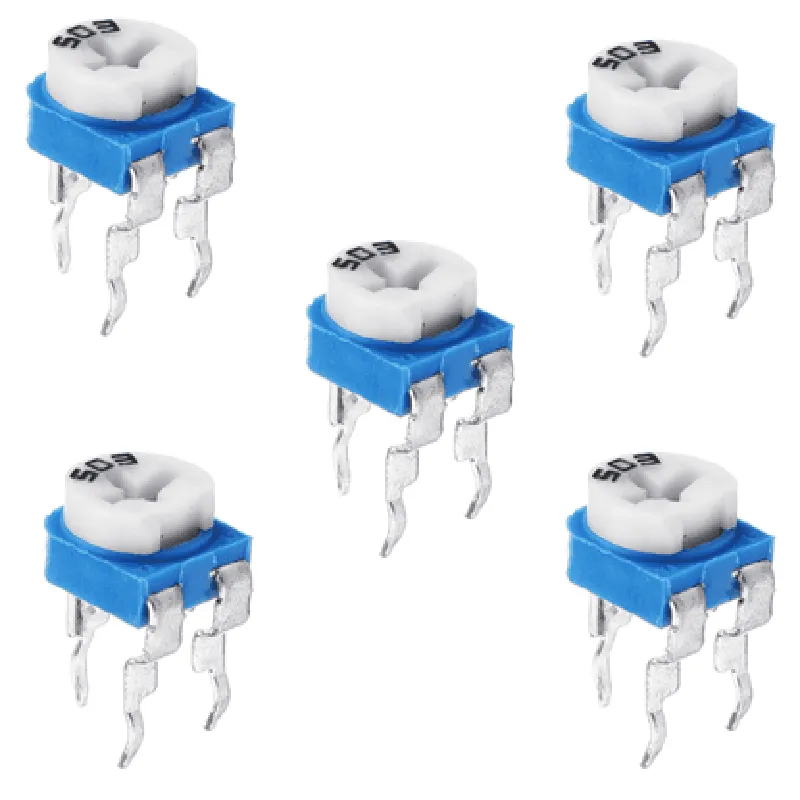
50K Cermet(Pack of 5)

Buy Now on Stufin

Component Name

50K Cermet (Pack of 5)


Description

The 50K Cermet (Pack of 5) is a set of five thermistor elements, each with a resistance value of 50 kilohms at a temperature of 25C. These ceramic-metal composite thermistors, also known as Cermet thermistors, are designed to measure temperature with high accuracy and stability.
Functionality

The primary function of the 50K Cermet thermistors is to convert temperature changes into corresponding electrical resistance changes. This allows them to be used in various applications such as temperature measurement, control, and compensation in electronic circuits.

Key Features

  • High Accuracy: The 50K Cermet thermistors have a high accuracy of 1% or better, making them suitable for precision temperature measurement applications.
  • Stable Resistance-Temperature Characteristic: The thermistors exhibit a stable and linear resistance-temperature characteristic, ensuring reliable and consistent performance over a wide temperature range.
  • Low Thermal Shock: The ceramic-metal composite structure of the thermistors provides excellent thermal shock resistance, allowing them to withstand rapid temperature changes without compromising their performance.
  • Small Size: The thermistors have a compact size, making them ideal for use in space-constrained applications or where miniature sensors are required.
  • Wide Operating Temperature Range: The 50K Cermet thermistors can operate over a wide temperature range of -50C to 150C, making them suitable for a variety of industrial, commercial, and consumer applications.
  • Fast Response Time: The thermistors have a fast response time, typically in the order of milliseconds, allowing them to quickly respond to temperature changes.
  • Low Power Consumption: The thermistors have a low power consumption, making them suitable for battery-powered or energy-efficient applications.
  • Pack of 5: The 50K Cermet thermistors are supplied in a pack of five, providing a convenient and cost-effective solution for designs that require multiple temperature sensors.

Technical Specifications

Resistance at 25C (R25)50 kilohms 1%

Temperature Range

-50C to 150C

Accuracy

1% or better

Tolerance

1%

Thermal Shock Resistance

Excellent

Response Time

Milliseconds

Power Consumption

Low

Operating Voltage

Up to 1 V

Storage Temperature

-50C to 150C

Applications

The 50K Cermet thermistors are suitable for a wide range of applications, including

Temperature measurement and control in industrial automation

HVAC systems

Medical devices

Automotive systems

Consumer electronics

Industrial sensors and transducers

Precautions and Handling

Handle the thermistors with care to avoid mechanical shock or damage.

Avoid exposing the thermistors to high voltages or currents.

Use a suitable thermal interface material to ensure good thermal contact between the thermistor and the heat source.

Follow proper soldering and assembly techniques to prevent damage to the thermistors.

By providing a comprehensive overview of the 50K Cermet thermistors, this documentation aims to help engineers, designers, and hobbyists understand the capabilities and limitations of these components, enabling them to make informed decisions when selecting temperature sensors for their projects.

Pin Configuration

  • 50K Cermet (Pack of 5) Component Documentation

  • Overview
  • The 50K Cermet is a thermistor-based temperature sensor component, commonly used in Internet of Things (IoT) applications for precise temperature measurement. This documentation outlines the pin descriptions, connection guidelines, and usage notes for the 50K Cermet component.
  • Pin Descriptions
  • The 50K Cermet component has two pins, labeled as follows:
  • ### Pin 1: Signal Pin (S)
  • Function: Output signal pin, providing a resistance-based temperature reading.
  • Description: This pin carries the temperature-dependent resistance value, which varies according to the temperature changes.
  • ### Pin 2: Ground Pin (G)
  • Function: Ground reference pin, providing a stable voltage reference.
  • Description: This pin is connected to the ground of the circuit, serving as a return path for the signal pin.
  • Connection Guidelines
  • To connect the 50K Cermet component, follow these steps:
  • 1. Signal Pin (S) Connection:
  • Connect the signal pin (S) to a suitable analog-to-digital converter (ADC) input or an analog input of a microcontroller (e.g., Arduino, Raspberry Pi).
  • Ensure the ADC input or microcontroller analog input is configured to read the resistance-based temperature signal.
  • 2. Ground Pin (G) Connection:
  • Connect the ground pin (G) to the ground of the circuit (e.g., GND pin on the microcontroller or breadboard).
  • Verify that the ground connection is stable and not prone to noise or interference.
  • Important Notes
  • Power Supply: The 50K Cermet component does not require an external power supply. It operates based on the resistance changes due to temperature variations.
  • Temperature Range: The 50K Cermet component is designed to operate within a specific temperature range (typically -20C to 150C). Ensure the temperature range is within the component's specifications for accurate readings.
  • Noise Immunity: To minimize noise and interference, use a shielded cable or twisted pair wiring for the signal connection. Additionally, ensure the circuit is well-grounded and follows proper electromagnetic compatibility (EMC) practices.
  • By following these guidelines, you can effectively connect and utilize the 50K Cermet component in your IoT applications for accurate temperature measurement.

Code Examples

Component Documentation: 50K Cermet (Pack of 5)
The 50K Cermet is a high-precision thermistor component designed for accurate temperature measurement in a wide range of applications. This component is available in a pack of 5, making it ideal for projects that require multiple temperature sensors.
Component Specifications:
Resistance: 50k at 25C
 Accuracy: 1% at 25C
 Temperature Range: -50C to 150C
 Response Time: 10 seconds
 Operating Voltage: 3.3V to 5V
Code Examples:
### Example 1: Basic Temperature Measurement with Arduino
In this example, we will use the 50K Cermet thermistor to measure the temperature using an Arduino board.
```cpp
const int thermistorPin = A0;  // Analog input pin for the thermistor
void setup() {
  Serial.begin(9600);
}
void loop() {
  int sensorValue = analogRead(thermistorPin);
  float voltage = sensorValue  5.0 / 1023.0;
  float temperature = (voltage - 0.5) / 0.01;  // Calculate temperature using the Steinhart-Hart equation
  Serial.print("Temperature: ");
  Serial.print(temperature);
  Serial.println(" C");
  delay(1000);
}
```
### Example 2: Raspberry Pi (Python) with ADC Conversion
In this example, we will use the 50K Cermet thermistor with a Raspberry Pi and an ADC (Analog-to-Digital Converter) module to measure the temperature.
```python
import time
import Adafruit_ADS1x15
# Create an ADS1115 ADC instance
adc = Adafruit_ADS1x15.ADS1115()
# Set the gain to 1 (default)
gain = 1
while True:
    # Read the ADC value from channel 0
    adc_value = adc.read_adc(0, gain)
# Calculate the voltage from the ADC value
    voltage = adc_value  3.3 / 32767.0
# Calculate the temperature using the Steinhart-Hart equation
    temperature = (voltage - 0.5) / 0.01
    print("Temperature: {:.2f} C".format(temperature))
    time.sleep(1)
```
### Example 3: ESP32 (MicroPython) with Built-in ADC
In this example, we will use the 50K Cermet thermistor with an ESP32 board and its built-in ADC to measure the temperature.
```python
import machine
import time
# Create an ADC instance
adc = machine.ADC(machine.Pin(32))  # Pin 32 is an analog input on the ESP32
while True:
    # Read the ADC value
    adc_value = adc.read_u16()
# Calculate the voltage from the ADC value
    voltage = adc_value  3.3 / 65535.0
# Calculate the temperature using the Steinhart-Hart equation
    temperature = (voltage - 0.5) / 0.01
    print("Temperature: {:.2f} C".format(temperature))
    time.sleep(1)
```
These examples demonstrate how to use the 50K Cermet thermistor with various microcontrollers and programming languages. The Steinhart-Hart equation is used to convert the voltage reading from the thermistor to a temperature value.