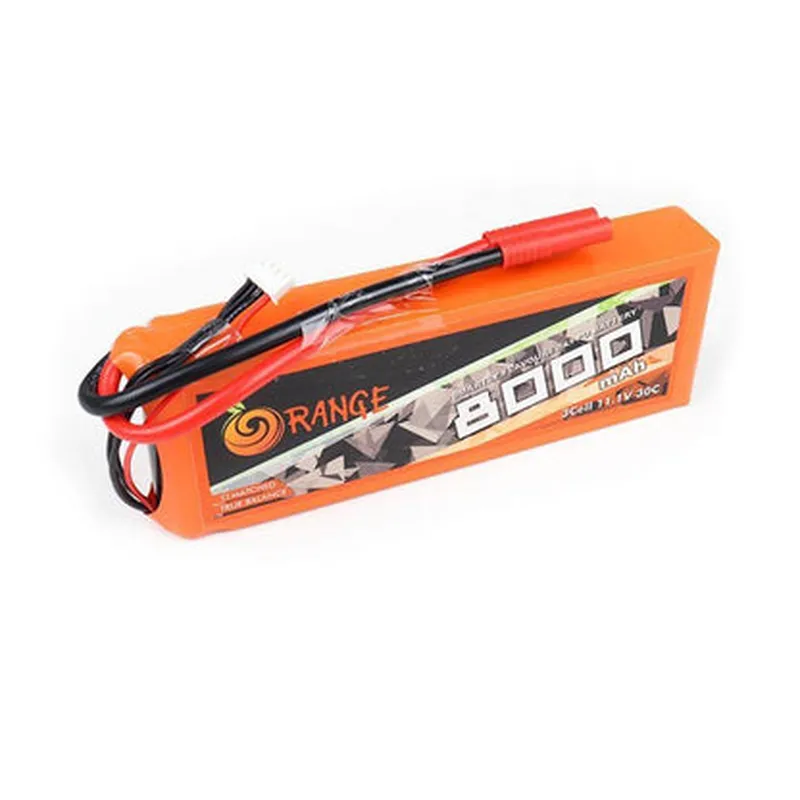
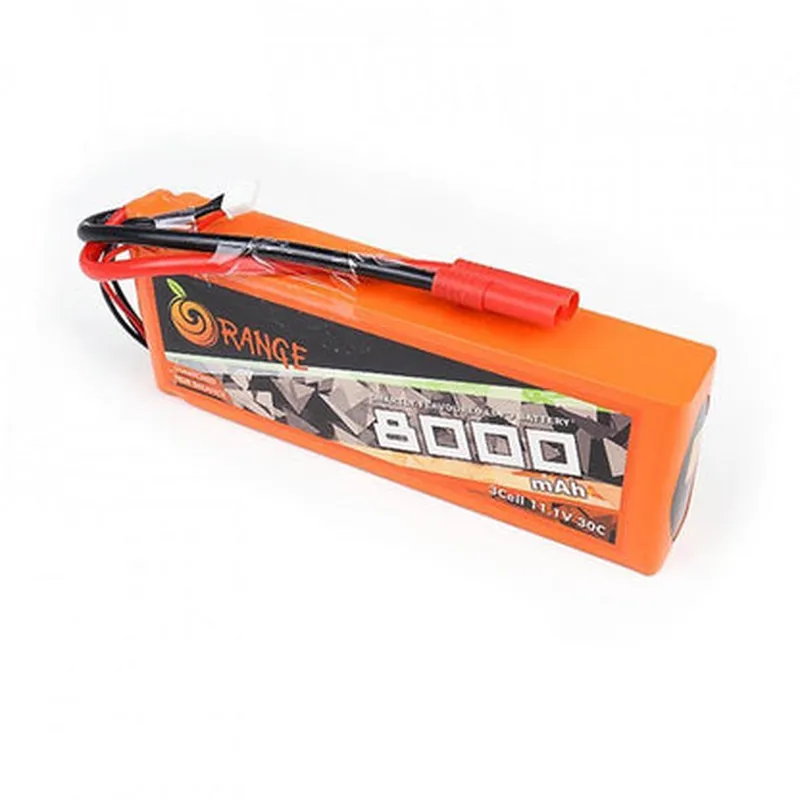
Component Documentation: 11.1 V 8000mAh Orange Lithium Polymer Battery
The 11.1V 8000mAh Orange Lithium Polymer Battery is a high-capacity, rechargeable battery designed for use in various IoT applications. This battery features a compact design, high energy density, and a long cycle life, making it an ideal choice for powering IoT devices, robots, drones, and other battery-powered systems.
Voltage: 11.1V
 Capacity: 8000mAh
 Chemistry: Lithium Polymer (Li-Poly)
 Dimensions: 144mm x 69mm x 20mm (L x W x H)
 Weight: approximately 240g
 Operating Temperature: -20C to 45C
 Charging Temperature: 0C to 45C
 Cycle Life: > 300 cycles
The battery has a standard JST-XH 2-pin connector for charging and discharging. The positive terminal is marked with a "+" sign, and the negative terminal is marked with a "-" sign.
### Example 1: Arduino-based Battery Monitoring System
This example demonstrates how to use the 11.1V 8000mAh Orange Lithium Polymer Battery with an Arduino board to monitor the battery voltage and capacity.
```c++
const int batteryPin = A0; // Analog input pin for battery voltage measurement
void setup() {
  Serial.begin(9600);
}
void loop() {
  int sensorValue = analogRead(batteryPin);
  float voltage = sensorValue  (11.1 / 1023.0);
  float capacity = (voltage / 11.1)  100;

  Serial.print("Battery Voltage: ");
  Serial.print(voltage);
  Serial.println(" V");

  Serial.print("Battery Capacity: ");
  Serial.print(capacity);
  Serial.println(" %");

  delay(1000);
}
```
### Example 2: Raspberry Pi-based Drone Power System
This example demonstrates how to use the 11.1V 8000mAh Orange Lithium Polymer Battery to power a Raspberry Pi-based drone system.
```python
import RPi.GPIO as GPIO
import time
# Initialize the GPIO pins for the battery monitoring
GPIO.setmode(GPIO.BCM)
GPIO.setup(17, GPIO.IN, pull_up_down=GPIO.PUD_UP)  # Battery voltage monitoring pin
while True:
    # Read the battery voltage
    voltage = GPIO.input(17)
    if voltage:
        print("Battery voltage is above 10.5V")
    else:
        print("Battery voltage is below 10.5V")

    time.sleep(1)
```
Note: In this example, the Raspberry Pi is powered directly from the battery, and the GPIO pin 17 is used to monitor the battery voltage. The voltage threshold for the low-battery warning is set to 10.5V.
### Example 3: ESP32-based IoT Node Power Supply
This example demonstrates how to use the 11.1V 8000mAh Orange Lithium Polymer Battery to power an ESP32-based IoT node.
// Initialize the ESP32 ADC pin for battery voltage measurement
const int adcPin = 32;
void setup() {
  Serial.begin(115200);
  WiFi.begin("your_wifi_ssid", "your_wifi_password");
}
void loop() {
  int adcValue = analogRead(adcPin);
  float voltage = (adcValue  11.1) / 4095.0;

  Serial.print("Battery Voltage: ");
  Serial.print(voltage);
  Serial.println(" V");

  // Send the battery voltage data to the cloud or a remote server
  // ...

  delay(1000);
}
```
Note: In this example, the ESP32 is powered directly from the battery, and the ADC pin 32 is used to measure the battery voltage.