

Stufin
Home Quick Cart Profile

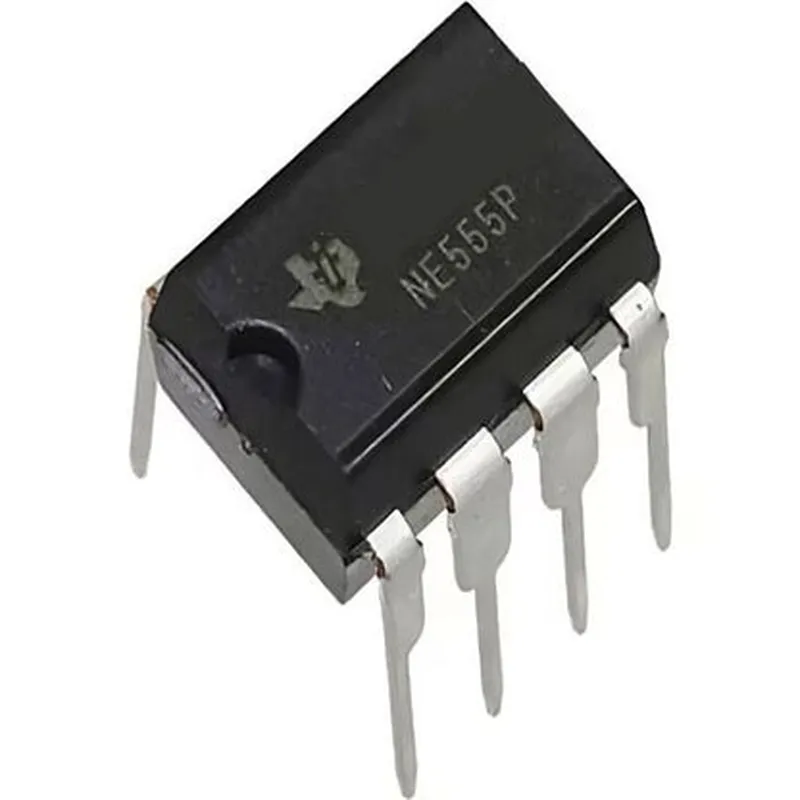
555 Timer IC

Buy Now on Stufin

Component Name

555 Timer IC

Description

The 555 Timer IC is a widely used and versatile integrated circuit (IC) that operates as a timer, oscillator, or flip-flop device. It is a crucial component in various electronic circuits, particularly in applications requiring timing, pulse generation, and oscillation. The 555 Timer IC is an 8-pin device that provides a precise timing interval, making it an essential component in many Internet of Things (IoT) projects, robots, and embedded systems.

Functionality

  • Monostable Mode (One-Shot Mode): In this mode, the 555 Timer IC generates a single pulse of a predetermined duration in response to a trigger signal. The pulse width is determined by the values of the external resistors and capacitors connected to the IC.
  • Astable Mode: In this mode, the 555 Timer IC functions as an oscillator, generating a continuous train of rectangular pulses at a frequency determined by the values of the external resistors and capacitors.
  • Bistable Mode (Flip-Flop Mode): In this mode, the 555 Timer IC operates as a flip-flop, toggling between two states (0 and 1) in response to trigger signals.
The 555 Timer IC can operate in three primary modes

Key Features

  • Supply Voltage: The 555 Timer IC operates with a supply voltage range of 4.5V to 15V, making it suitable for a wide range of applications.
  • Output Current: The IC can source or sink up to 200mA of current, allowing it to drive small loads directly.
  • Output Voltage: The output voltage is typically 1.5V to 2V less than the supply voltage, depending on the operating mode.
  • Frequency Range: The 555 Timer IC can generate frequencies from a few Hz to several hundred kHz, depending on the component values and operating mode.
  • Trigger Input: The IC has a trigger input (pin 2) that allows external triggering of the timer or oscillator.
  • Reset Input: The IC has a reset input (pin 4) that can be used to reset the timer or oscillator.
  • Timing Capacitor: The IC has a built-in internal capacitor (approximately 10nF) that can be used in conjunction with external resistors to set the timing intervals.
  • Low Power Consumption: The 555 Timer IC has a low quiescent current of around 3mA to 6mA, making it suitable for battery-powered devices.

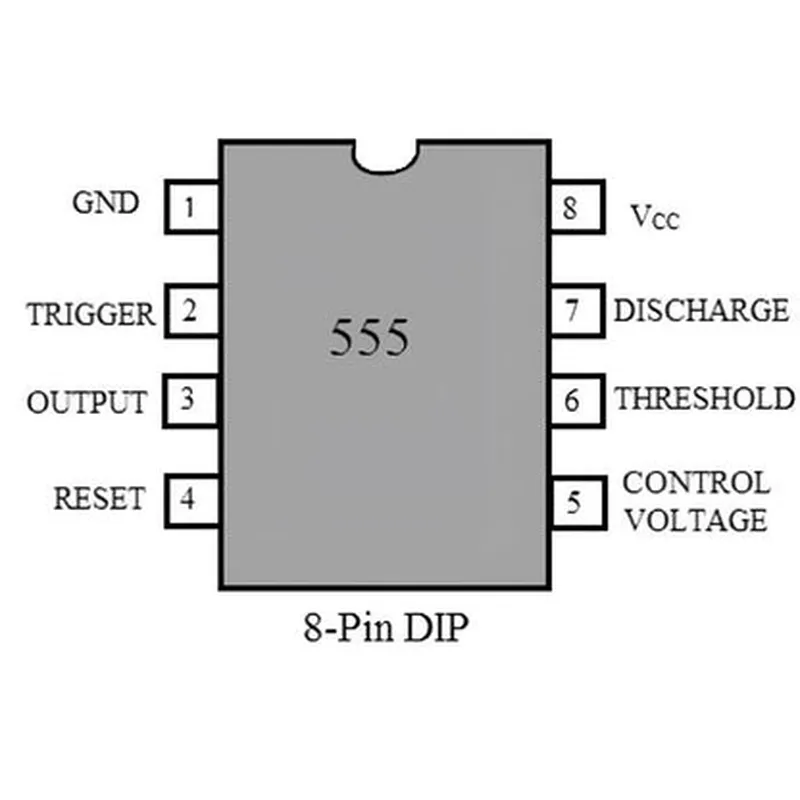
Pinout

  • GND (Ground): Pin 1
  • TRIGGER: Pin 2
  • OUTPUT: Pin 3
  • RESET: Pin 4
  • CONTROL VOLTAGE: Pin 5
  • THRESHOLD: Pin 6
  • DISCHARGE: Pin 7
  • VCC (Supply Voltage): Pin 8
The 555 Timer IC has an 8-pin package with the following pinout

Applications

  • Timing Circuits: For generating precise timing intervals in electronic systems.
  • Oscillator Circuits: For generating clock signals or oscillations in electronic systems.
  • Pulse Generation: For generating pulses in electronic systems.
  • Robotics: For controlling motors, LEDs, and other devices in robotics projects.
  • IoT Projects: For timing and oscillation requirements in IoT projects.
The 555 Timer IC is widely used in various applications, including

Conclusion

The 555 Timer IC is a versatile and widely used component in electronic circuits, offering a range of timing, oscillation, and pulse generation capabilities. Its low power consumption, flexibility, and ease of use make it an essential component in many IoT projects, robots, and embedded systems.

Pin Configuration

  • 555 Timer IC Documentation
  • The 555 Timer IC is a popular and versatile integrated circuit (IC) used in a wide range of electronic circuits, particularly in timing and oscillator applications. The 555 Timer IC has 8 pins, each with a specific function. Below is a detailed explanation of each pin and how to connect them:
  • Pin 1: Ground (GND)
  • Function: Provides a common reference point for the IC's internal circuits.
  • Connection: Connect to the negative terminal of the power supply (0V) or the ground plane of the circuit board.
  • Pin 2: Trigger (TRIG)
  • Function: Initiates the timer's operation when the voltage on this pin falls below 1/3 of the supply voltage.
  • Connection: Typically connected to a switch, a logic gate, or a pulse generator to trigger the timer.
  • Pin 3: Output (OUT)
  • Function: Provides the output signal of the timer, which can be used to drive external circuits or components.
  • Connection: Connect to the input of the external circuit or component that requires the timer's output signal.
  • Pin 4: Reset (RST)
  • Function: Resets the timer to its initial state when the voltage on this pin is low (less than 0.5V).
  • Connection: Typically connected to a push-button switch or a logic gate to reset the timer.
  • Pin 5: Control Voltage (CV)
  • Function: Allows the timer's output frequency to be adjusted by connecting a voltage divider network between the supply voltage and ground.
  • Connection: Connect a voltage divider network (typically two resistors) between the supply voltage and ground, with the midpoint connected to this pin.
  • Pin 6: Threshold (THRES)
  • Function: Determines the upper threshold voltage of the timer's internal comparator.
  • Connection: Typically connected to the junction of two resistors that form a voltage divider network between the supply voltage and ground.
  • Pin 7: Discharge (DISCH)
  • Function: Provides a discharge path for the timer's internal capacitor when the output is low.
  • Connection: Connect to the capacitor that forms the timing component with Pin 2 (Trigger).
  • Pin 8: Supply Voltage (VCC)
  • Function: Provides the power supply voltage to the IC.
  • Connection: Connect to the positive terminal of the power supply (typically +5V to +15V).
  • Connection Structure:
  • Here's a typical connection structure for a basic 555 Timer IC circuit:
  • Pin 1 (GND) to Ground
  • Pin 2 (TRIG) to Trigger input (switch, logic gate, or pulse generator)
  • Pin 3 (OUT) to Output circuit or component
  • Pin 4 (RST) to Reset input (push-button switch or logic gate)
  • Pin 5 (CV) to Voltage divider network (two resistors between VCC and GND)
  • Pin 6 (THRES) to Voltage divider network (two resistors between VCC and GND)
  • Pin 7 (DISCH) to Timing capacitor
  • Pin 8 (VCC) to Positive power supply terminal
  • Note: The specific connection details may vary depending on the specific application and circuit requirements. It's essential to consult the datasheet and application notes for the 555 Timer IC to ensure correct usage and optimal performance.

Code Examples

555 Timer IC Documentation
Overview
The 555 Timer IC is a highly versatile and widely used integrated circuit (IC) in various electronic circuits. It is a type of timer IC that can operate in three modes: monostable, bistable, and astable. The 555 Timer IC is commonly used in digital and analog circuits for applications such as timing, pulse generation, and oscillation.
Pin Configuration
The 555 Timer IC has 8 pins:
1. VCC (Supply Voltage)
2. GND (Ground)
3. Trigger (Input)
4. Reset (Input)
5. Control Voltage (Input)
6. Threshold (Input)
7. Discharge (Output)
8. Output (Output)
Code Examples
### Example 1: Monostable Mode (One-Shot Timer)
In this example, we will create a simple one-shot timer using the 555 Timer IC in monostable mode.
Circuit Diagram
Connect VCC to a 5V power supply
 Connect GND to ground
 Connect Trigger (pin 3) to a push-button switch
 Connect Output (pin 6) to an LED
 Connect a 1k resistor between VCC and the trigger pin
 Connect a 10F capacitor between the trigger pin and GND
Arduino Code
```c
void setup() {
  pinMode(6, OUTPUT); // Output pin
}
void loop() {
  digitalWrite(6, HIGH); // Initial output state
  if (digitalRead(3) == LOW) { // Trigger pin is grounded
    delay(1000); // Wait for 1 second
    digitalWrite(6, LOW); // Output goes low
  }
}
```
Explanation
When the push-button switch is pressed, the trigger pin is grounded, and the 555 Timer IC generates a single pulse at the output pin, turning the LED on for 1 second.
### Example 2: Astable Mode (Oscillator)
In this example, we will create a simple oscillator using the 555 Timer IC in astable mode.
Circuit Diagram
Connect VCC to a 5V power supply
 Connect GND to ground
 Connect Threshold (pin 6) to a 1k resistor
 Connect the resistor to a 10F capacitor
 Connect the capacitor to GND
 Connect Output (pin 3) to an LED
 Connect a 1k resistor between Output and VCC
Arduino Code
```c
void setup() {
  pinMode(3, OUTPUT); // Output pin
}
void loop() {
  analogWrite(3, 128); // Output a 50% duty cycle signal
}
```
Explanation
The 555 Timer IC oscillates at a frequency determined by the values of the resistors and capacitors, generating a square wave at the output pin. The LED will blink at the same frequency.
Note: These examples are simplified and are meant to demonstrate the basic usage of the 555 Timer IC. In a real-world scenario, you would need to consider additional components, such as resistors, capacitors, and power supply decoupling, to ensure stable operation.
I hope this helps! Let me know if you have any questions or need further clarification.