Stufin
Home Quick Cart Profile

CD4011 - Quad 2-Input NAND Gate IC


Buy Now on Stufin

Component Name

CD4011 - Quad 2-Input NAND Gate IC
Description

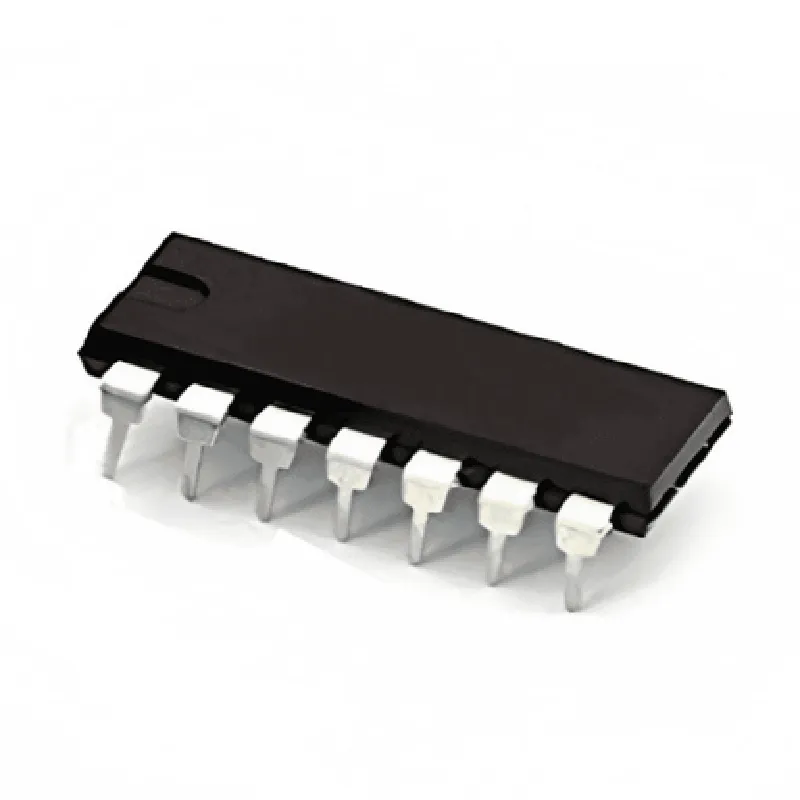
The CD4011 is a quad 2-input NAND gate integrated circuit (IC) belonging to the 4000 series of CMOS logic gates. It is a widely used component in digital electronic circuits, particularly in IoT devices, microcontrollers, and other digital systems.

Functionality

The CD4011 IC consists of four independent 2-input NAND gates, each with two inputs (A and B) and one output (Y). The NAND gate performs a logical operation on the inputs, producing an output based on the following truth table

| Input A | Input B | Output Y |

| --- | --- | --- |

| 0 | 0 | 1 |

| 0 | 1 | 1 |

| 1 | 0 | 1 |

| 1 | 1 | 0 |

The NAND gate outputs a logic high (1) only when both inputs are low (0). If either or both inputs are high (1), the output is low (0).

Key Features

  • Quad 2-Input NAND Gate: The CD4011 contains four identical 2-input NAND gates, making it a compact and efficient solution for digital logic circuits.
  • CMOS Technology: The IC utilizes Complementary Metal-Oxide-Semiconductor (CMOS) technology, which provides low power consumption, high noise immunity, and high speed.
  • Wide Operating Voltage Range: The CD4011 operates with a supply voltage (VDD) ranging from 3V to 18V, making it suitable for a variety of digital systems.
  • High Input Impedance: The input impedance of the NAND gates is high, allowing the CD4011 to drive high-impedance loads and reducing the loading effect on preceding stages.
  • Low Power Dissipation: The IC has a low power dissipation of 1 W per gate at 10V, reducing heat generation and increasing battery life in portable devices.
  • High Noise Immunity: The CD4011 has a high noise immunity due to its CMOS technology, ensuring reliable operation in noisy environments.
  • Wide Operating Temperature Range: The IC operates over a temperature range of -55C to 125C, making it suitable for use in various industrial and IoT applications.
  • DIP and SOIC Packages: The CD4011 is available in 14-pin DIP (Dual In-Line Package) and 14-pin SOIC (Small Outline Integrated Circuit) packages, allowing for easy integration into PCB designs.

Applications

The CD4011 quad 2-input NAND gate IC is commonly used in a wide range of applications, including

Digital logic circuits and microcontrollers

IoT devices, such as smart home appliances and wearable devices

Industrial control systems and automation

Medical devices and equipment

Audio and video equipment

Digital clocks and timers

Conclusion

The CD4011 quad 2-input NAND gate IC is a versatile and reliable component suitable for a variety of digital systems. Its low power consumption, high noise immunity, and wide operating voltage range make it an ideal choice for IoT devices, microcontrollers, and other digital applications.

Pin Configuration

  • CD4011 - Quad 2-Input NAND Gate IC Pinout and Connection Guide
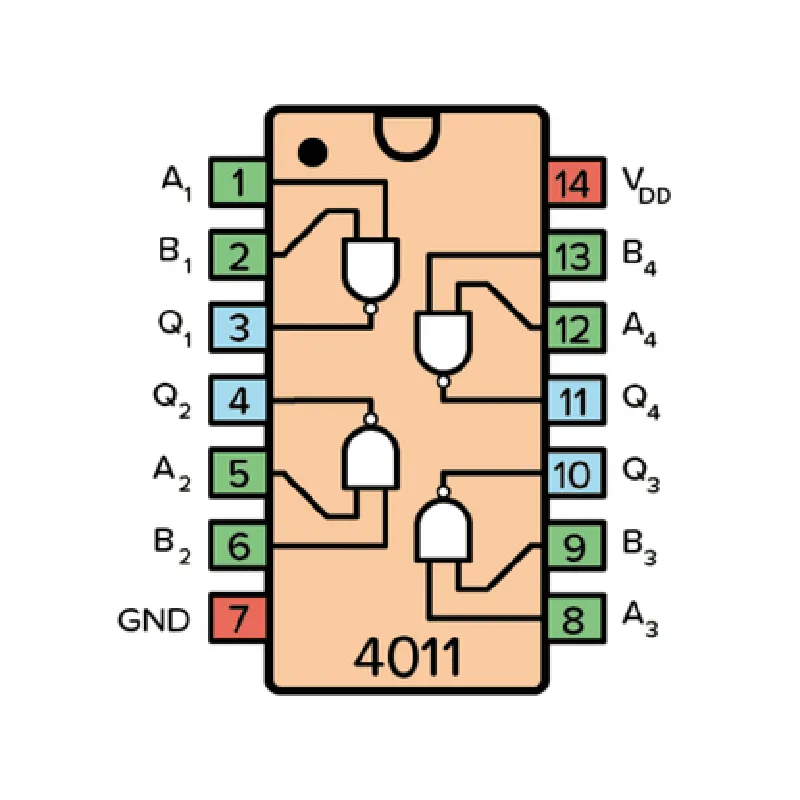
  • The CD4011 is a quad 2-input NAND gate IC, a popular digital logic component used in various electronic circuits. It consists of four independent NAND gates, each with two input pins and one output pin. Here's a detailed explanation of each pin and how to connect them:
  • Pinout:
  • 1. Pin 1: VCC ( Supply Voltage)
  • Function: Positive power supply pin
  • Connection: Connect to a positive power supply (usually +5V) through a decoupling capacitor (e.g., 100nF)
  • 2. Pin 2: 1A (Input 1 of Gate 1)
  • Function: Input pin for Gate 1
  • Connection: Connect to a digital signal source (e.g., microcontroller output, logic gate output)
  • 3. Pin 3: 1B (Input 2 of Gate 1)
  • Function: Input pin for Gate 1
  • Connection: Connect to a digital signal source (e.g., microcontroller output, logic gate output)
  • 4. Pin 4: 1Y (Output of Gate 1)
  • Function: Output pin of Gate 1
  • Connection: Connect to a load (e.g., LED, relay, another logic gate input)
  • 5. Pin 5: 2A (Input 1 of Gate 2)
  • Function: Input pin for Gate 2
  • Connection: Connect to a digital signal source (e.g., microcontroller output, logic gate output)
  • 6. Pin 6: 2B (Input 2 of Gate 2)
  • Function: Input pin for Gate 2
  • Connection: Connect to a digital signal source (e.g., microcontroller output, logic gate output)
  • 7. Pin 7: 2Y (Output of Gate 2)
  • Function: Output pin of Gate 2
  • Connection: Connect to a load (e.g., LED, relay, another logic gate input)
  • 8. Pin 8: GND (Ground)
  • Function: Ground pin
  • Connection: Connect to the system ground (0V)
  • 9. Pin 9: 3A (Input 1 of Gate 3)
  • Function: Input pin for Gate 3
  • Connection: Connect to a digital signal source (e.g., microcontroller output, logic gate output)
  • 10. Pin 10: 3B (Input 2 of Gate 3)
  • Function: Input pin for Gate 3
  • Connection: Connect to a digital signal source (e.g., microcontroller output, logic gate output)
  • 11. Pin 11: 3Y (Output of Gate 3)
  • Function: Output pin of Gate 3
  • Connection: Connect to a load (e.g., LED, relay, another logic gate input)
  • 12. Pin 12: 4A (Input 1 of Gate 4)
  • Function: Input pin for Gate 4
  • Connection: Connect to a digital signal source (e.g., microcontroller output, logic gate output)
  • 13. Pin 13: 4B (Input 2 of Gate 4)
  • Function: Input pin for Gate 4
  • Connection: Connect to a digital signal source (e.g., microcontroller output, logic gate output)
  • 14. Pin 14: 4Y (Output of Gate 4)
  • Function: Output pin of Gate 4
  • Connection: Connect to a load (e.g., LED, relay, another logic gate input)
  • Connection Structure:
  • When connecting the CD4011 IC, follow these steps:
  • 1. Connect the power supply (VCC) to Pin 1 and the ground (GND) to Pin 8.
  • 2. Connect the input signals to the input pins (A and B) of each gate.
  • 3. Connect the output pins (Y) of each gate to the desired load or next logic gate input.
  • Example Connection:
  • Suppose you want to use Gate 1 to implement a simple AND logic function. Connect:
  • Pin 2 (1A) to a microcontroller output (e.g., digital pin 2)
  • Pin 3 (1B) to a button or a sensor output
  • Pin 4 (1Y) to an LED anode through a current-limiting resistor (e.g., 1k)
  • LED cathode to GND (Pin 8)
  • In this example, the LED will turn on only when both inputs (1A and 1B) are high.
  • Remember to follow proper IC handling and soldering techniques when working with the CD4011 IC.

Code Examples

CD4011 - Quad 2-Input NAND Gate IC Documentation
Overview
The CD4011 is a quad 2-input NAND gate integrated circuit (IC) that belongs to the 4000 series of CMOS logic gates. It is a widely used component in digital electronics and is suitable for a variety of applications, including IoT projects. The CD4011 provides four independent 2-input NAND gates, each with two input pins and one output pin.
Pinout
The CD4011 has a 14-pin DIP (Dual In-Line Package) package. The pinout is as follows:
| Pin Number | Pin Name | Function |
| --- | --- | --- |
| 1-2 | 1A, 1B | Input pins for Gate 1 |
| 3 | 1Y | Output pin for Gate 1 |
| 4-5 | 2A, 2B | Input pins for Gate 2 |
| 6 | 2Y | Output pin for Gate 2 |
| 7-8 | 3A, 3B | Input pins for Gate 3 |
| 9 | 3Y | Output pin for Gate 3 |
| 10-11 | 4A, 4B | Input pins for Gate 4 |
| 12 | 4Y | Output pin for Gate 4 |
| 13 | VCC | Positive power supply |
| 14 | GND | Ground |
Truth Table
The CD4011 NAND gate follows the standard NAND gate truth table:
| A | B | Y |
| --- | --- | --- |
| 0 | 0 | 1 |
| 0 | 1 | 1 |
| 1 | 0 | 1 |
| 1 | 1 | 0 |
Code Examples
Here are a few code examples that demonstrate how to use the CD4011 in various contexts:
Example 1: Simple NAND Gate Using Arduino
In this example, we will use the CD4011 to create a simple NAND gate using an Arduino board.
```c++
const int inputA = 2;
const int inputB = 3;
const int outputPin = 4;
void setup() {
  pinMode(inputA, INPUT);
  pinMode(inputB, INPUT);
  pinMode(outputPin, OUTPUT);
}
void loop() {
  bool a = digitalRead(inputA);
  bool b = digitalRead(inputB);
  bool y = !(a && b);  // NAND gate implementation
  digitalWrite(outputPin, y);
  delay(100);
}
```
Example 2: Debouncing a Switch Using CD4011 and Raspberry Pi
In this example, we will use the CD4011 to debounce a switch using a Raspberry Pi.
```python
import RPi.GPIO as GPIO
import time
GPIO.setmode(GPIO.BCM)
switch_pin = 17
debounced_pin = 23
GPIO.setup(switch_pin, GPIO.IN, pull_up_down=GPIO.PUD_UP)
GPIO.setup(debounced_pin, GPIO.OUT)
while True:
  a = GPIO.input(switch_pin)
  b = not a  # Invert the switch state
  y = not (a and b)  # NAND gate implementation
  GPIO.output(debounced_pin, y)
  time.sleep(0.01)
```
Example 3: Clock Divider Circuit Using CD4011
In this example, we will use the CD4011 to create a clock divider circuit that divides an input clock signal by two.
```c++
const int clk_in = 5;
const int clk_out = 6;
void setup() {
  pinMode(clk_in, INPUT);
  pinMode(clk_out, OUTPUT);
}
void loop() {
  bool clk_in_state = digitalRead(clk_in);
  bool clk_div_state = !(clk_in_state && clk_in_state);  // NAND gate implementation
  digitalWrite(clk_out, clk_div_state);
  delay(1);
}
```
These code examples demonstrate how to use the CD4011 quad 2-input NAND gate IC in various IoT projects. The CD4011 is a versatile component that can be used in a wide range of applications, including logic circuits, clock circuits, and interface circuits.