

Stufin
Home Quick Cart Profile

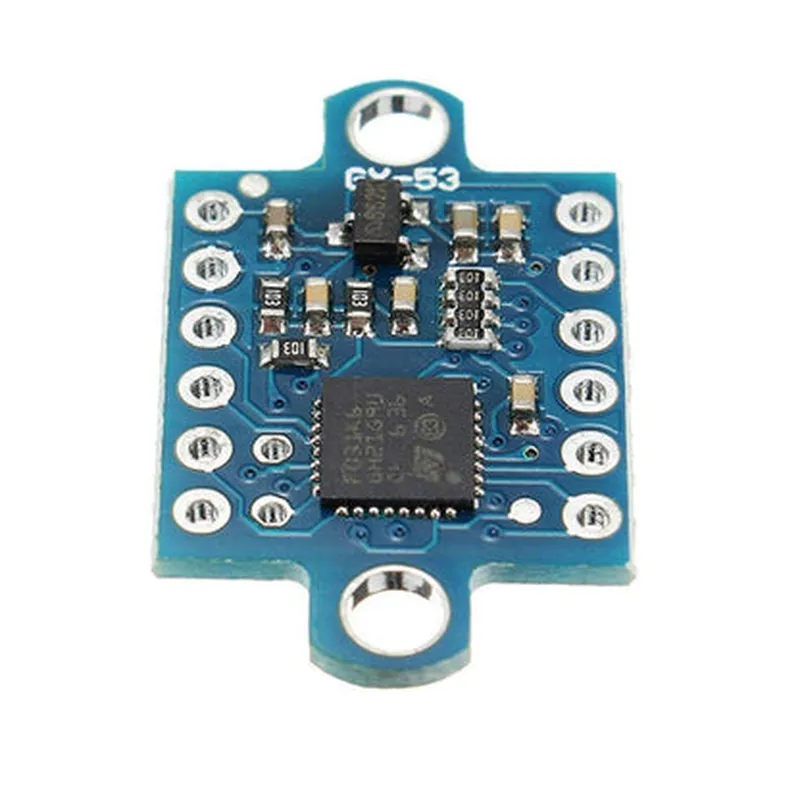
GY-53 VL53L0X Laser ToF Flight Time Range Sensor

Buy Now on Stufin

Component Documentation

GY-53 VL53L0X Laser ToF Flight Time Range Sensor

Overview

The GY-53 VL53L0X is a high-accuracy Laser Time-of-Flight (ToF) distance sensor module based on the VL53L0X chip from STMicroelectronics. This sensor module provides a reliable and efficient way to measure distances up to 2 meters with high precision and speed.

Functionality

The GY-53 VL53L0X sensor module uses a laser diode to emit a light pulse and measures the time-of-flight (ToF) of the pulse reflected from a target object. The sensor then calculates the distance based on the round-trip time of the pulse. This non-contact measurement technique allows for accurate and reliable distance measurements in various applications.

Key Features

  • High-Accuracy Distance Measurement: The GY-53 VL53L0X module can measure distances up to 2 meters with an accuracy of 1% and a resolution of 1 mm.
  • Fast Measurement Rate: The sensor can take up to 50 distance measurements per second, making it suitable for dynamic measurement applications.
  • Laser-Based Measurement: The use of a laser diode ensures accurate measurements even in environments with high levels of ambient light.
  • Multi-Mode Operation: The module can operate in various modes, including single-shot, continuous, and ranging modes, allowing for flexibility in different application scenarios.
  • IC Interface: The GY-53 VL53L0X module communicates with microcontrollers or other devices using the IC (Inter-Integrated Circuit) interface, making it easy to integrate into various systems.
  • Compact Design: The module features a compact design, making it suitable for use in space-constrained applications.
  • Low Power Consumption: The module has a low power consumption of typically 20 mA during operation, making it suitable for battery-powered devices.
  • Operating Temperature Range: The module operates over a wide temperature range of -40C to 85C, allowing its use in various environmental conditions.

Application Areas

  • Robotics and automation
  • Object detection and tracking
  • Gesture recognition
  • Proximity sensing
  • Level sensing
  • Smart home devices
  • Industrial automation
  • Autonomous vehicles
The GY-53 VL53L0X Laser ToF Flight Time Range Sensor module is suitable for various applications, including

Pinout and Dimensions

The GY-53 VL53L0X module has the following pinout

VCC

Power supply (3.3V or 5V)

GND

Ground

SCL

IC clock signal

SDA

IC data signal

XSHUT

Shutdown pin (active low)

Length

24 mm

Width

12 mm

Height

5 mm

Technical Specifications

Distance measurement range

Up to 2 meters

Accuracy

1%

Resolution

1 mm

Measurement rate

Up to 50 Hz

Laser wavelength

940 nm

Power consumption

Typically 20 mA

Operating temperature range

-40C to 85C

By providing high-accuracy distance measurements with fast measurement rates and low power consumption, the GY-53 VL53L0X Laser ToF Flight Time Range Sensor module is an ideal choice for various IoT applications requiring precise distance sensing capabilities.

Pin Configuration

  • GY-53 VL53L0X Laser ToF Flight Time Range Sensor Documentation
  • Overview
  • The GY-53 VL53L0X is a high-accuracy Laser ToF (Time of Flight) Flight Time Range Sensor module, designed for distance measurement applications. It uses laser light to measure the distance to an object, with a range of up to 2 meters.
  • Pinout Description
  • The GY-53 VL53L0X module has a total of 8 pins, which are described below:
  • Pin 1: VCC (Power Supply)
  • Description: Power supply pin for the module (typically 2.8V to 5.5V)
  • Function: Provides power to the VL53L0X sensor and other components on the module
  • Connection: Connect to a power source (e.g., Arduino board's 5V or 3.3V output)
  • Pin 2: GND (Ground)
  • Description: Ground pin for the module
  • Function: Provides a common ground reference for the module
  • Connection: Connect to a ground pin on the microcontroller or boards (e.g., Arduino board's GND)
  • Pin 3: SCL (Serial Clock)
  • Description: Clock pin for I2C communication
  • Function: Used for I2C communication between the module and the microcontroller
  • Connection: Connect to the SCL pin on the microcontroller (e.g., Arduino board's SCL)
  • Pin 4: SDA (Serial Data)
  • Description: Data pin for I2C communication
  • Function: Used for I2C communication between the module and the microcontroller
  • Connection: Connect to the SDA pin on the microcontroller (e.g., Arduino board's SDA)
  • Pin 5: XSHUT (Shutdown)
  • Description: Shutdown pin for the module
  • Function: Used to shut down the module when not in use, reducing power consumption
  • Connection: Typically left unconnected or tied to VCC (if not using shutdown functionality)
  • Pin 6: GPIO1 (General Purpose Input/Output)
  • Description: General-purpose input/output pin
  • Function: Can be used as an input or output pin for custom applications
  • Connection: Depends on the specific application and usage
  • Pin 7: No Connection
  • Description: No internal connection
  • Function: None
  • Connection: Leave unconnected
  • Pin 8: No Connection
  • Description: No internal connection
  • Function: None
  • Connection: Leave unconnected
  • Connection Structure
  • To connect the GY-53 VL53L0X module to a microcontroller (such as an Arduino board), follow this structure:
  • VCC (Pin 1) 5V or 3.3V output on the microcontroller
  • GND (Pin 2) GND pin on the microcontroller
  • SCL (Pin 3) SCL pin on the microcontroller
  • SDA (Pin 4) SDA pin on the microcontroller
  • XSHUT (Pin 5) Leave unconnected or tie to VCC if not using shutdown functionality
  • GPIO1 (Pin 6) Depends on the specific application and usage
  • Pin 7 and Pin 8: Leave unconnected
  • Note: Make sure to check the specific documentation for your microcontroller and ensure the I2C pins (SCL and SDA) are properly configured for communication with the GY-53 VL53L0X module.

Code Examples

GY-53 VL53L0X Laser ToF Flight Time Range Sensor Documentation
Overview
The GY-53 VL53L0X is a high-accuracy laser Time-of-Flight (ToF) range sensor module based on the VL53L0X chip from STMicroelectronics. This sensor module provides accurate distance measurements up to 2 meters, with a high level of precision and stability. It is widely used in various IoT applications, including robotics, drones, smart home devices, and more.
Technical Specifications
Measurement range: up to 2 meters
 Accuracy: 1% of the distance
 Resolution: 1 mm
 Update rate: up to 50 Hz
 Power supply: 2.8V to 5V
 Communication interface: I2C
Code Examples
### Example 1: Basic Distance Measurement using Arduino
This example demonstrates how to use the GY-53 VL53L0X sensor module with an Arduino board to measure the distance to an object.
```cpp
#include <Wire.h>
#include <VL53L0X.h>
VL53L0X sensor;
void setup() {
  Wire.begin();
  sensor.init();
  sensor.setTimeout(500);
}
void loop() {
  sensor.startContinuous();
  int distance = sensor.readRangeContinuousMillimeters();
  Serial.print("Distance: ");
  Serial.print(distance);
  Serial.println(" mm");
  delay(50);
}
```
In this example, we include the `Wire` library for I2C communication and the `VL53L0X` library for interacting with the sensor. We initialize the sensor in the `setup()` function and set a timeout value. In the `loop()` function, we start the continuous measurement mode and read the distance using the `readRangeContinuousMillimeters()` function. The distance is then printed to the serial console.
### Example 2: Object Detection using Raspberry Pi (Python)
This example demonstrates how to use the GY-53 VL53L0X sensor module with a Raspberry Pi to detect the presence of an object within a certain distance.
```python
import smbus
bus = smbus.SMBus(1)  # Use I2C bus 1 on Raspberry Pi
def read_distance():
    bus.write_byte(0x29, 0x00)  # Reset sensor
    bus.write_byte(0x29, 0x04)  # Set mode to continuous measurement
    distance = bus.read_word(0x29, 0x85)  # Read distance register
    return distance / 4  # Convert to millimeters
while True:
    distance = read_distance()
    if distance < 500:  # Object detected within 500 mm
        print("Object detected!")
    else:
        print("No object detected.")
    time.sleep(0.1)
```
In this example, we use the `smbus` library to interact with the I2C bus on the Raspberry Pi. We define a function `read_distance()` to read the distance register on the sensor and convert the value to millimeters. In the main loop, we continuously read the distance and check if an object is within a certain range (500 mm in this example). If an object is detected, we print a message to the console.
Note: These examples are for illustration purposes only and may require modification to suit specific use cases and hardware configurations.