

Stufin
Home Quick Cart Profile

ATmega16

Buy Now on Stufin

Component Name

ATmega16

Description

The ATmega16 is a high-performance, low-power 8-bit AVR microcontroller (MCU) from Atmel Corporation (now part of Microchip Technology). This device is designed for a wide range of applications, including industrial control systems, automotive systems, consumer electronics, and IoT devices. The ATmega16 offers a rich set of features and peripherals, making it an ideal choice for projects requiring small size, low power consumption, and high performance.

Functionality

The ATmega16 is a general-purpose microcontroller that can be used for a variety of applications, including

Digital Signal Processing

The ATmega16 can perform digital signal processing tasks, such as filtering, convolution, and Fast Fourier Transforms (FFTs).

Real-time ControlThe microcontroller is suitable for real-time control applications, where high-speed processing and precise timing are required.

Communication

The ATmega16 can be used for various communication protocols, including UART, SPI, and I2C, making it suitable for IoT devices.

Analog-to-Digital ConversionThe device features a built-in Analog-to-Digital Converter (ADC) for converting analog signals to digital values.

Microcontroller Core

The ATmega16 is based on the AVR RISC (Reduced Instruction Set Computing) architecture, which provides high code density and efficient execution of instructions.

Memory

The device features 16 KB of In-System Programmable Flash memory, 1 KB of SRAM, and 512 bytes of EEPROM.

Clock Speed

16 MHz (maximum)

Communication Interfaces

The device supports various communication protocols, including UART, SPI, and I2C, making it suitable for IoT devices.

Power Management

The ATmega16 has a built-in power-on reset circuit, brown-out detection, and watchdog timer, which ensure reliable operation and power management.

Operating Voltage

The device can operate at a voltage range of 4.5V to 5.5V, making it suitable for battery-powered applications.

Operating Temperature

-40C to +85C

Package and Pinout

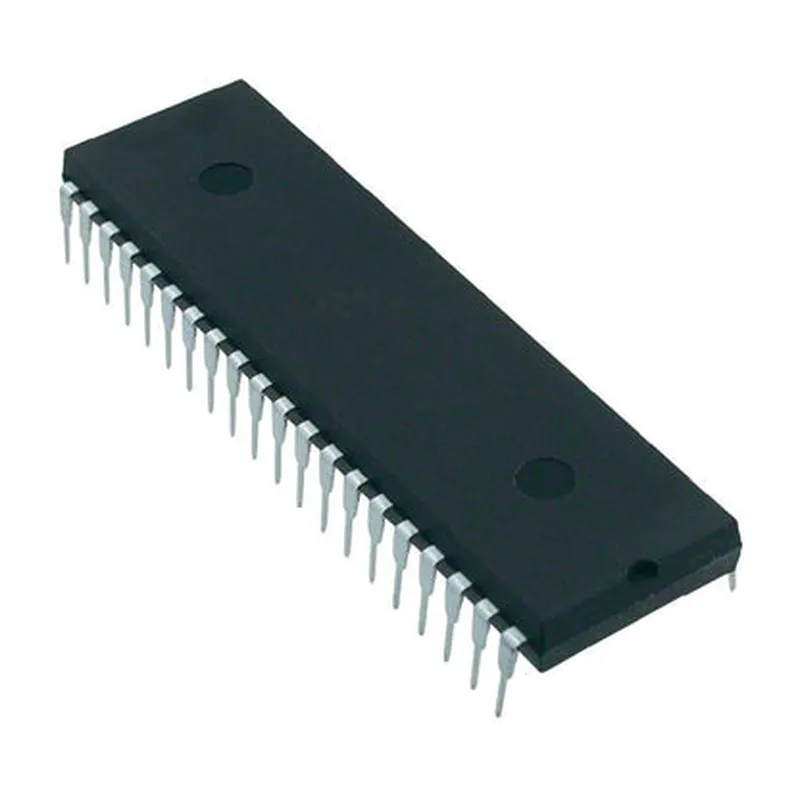
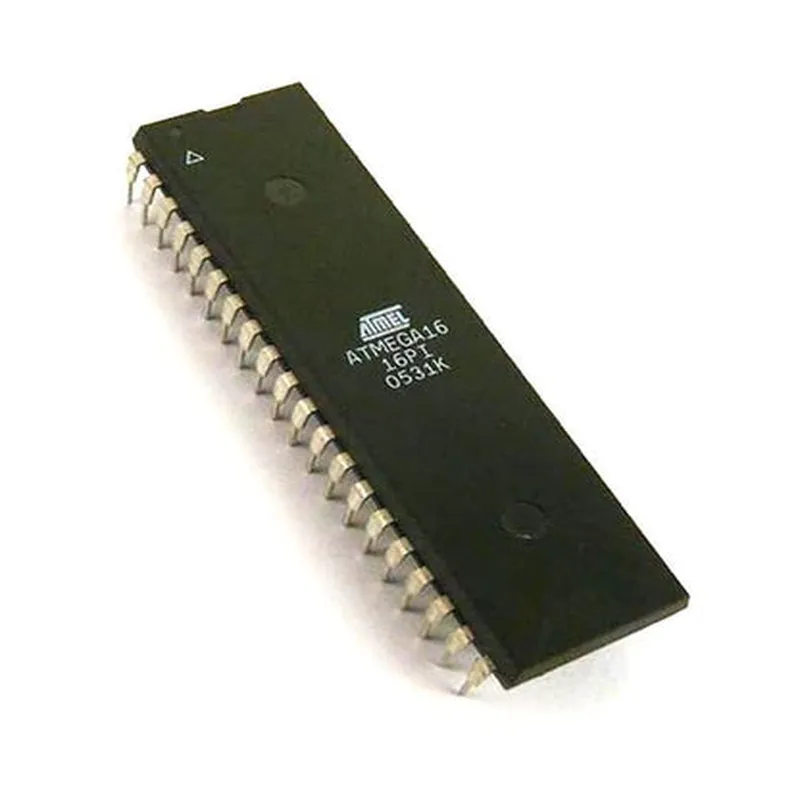
The ATmega16 is available in a 40-pin PDIP (Plastic Dual In-Line Package) or a 32-pin QFN (Quad Flat No-Lead) package. The pinout is as follows

PDIP Package

40 pins, with 32 I/O pins, 4 VCC pins, 2 GND pins, and 2 reset pins.

QFN Package

32 pins, with 24 I/O pins, 4 VCC pins, 2 GND pins, and 2 reset pins.

Supply Voltage

4.5V to 5.5V

Flash Memory

16 KB

SRAM

1 KB

EEPROM

512 bytes

ADC Resolution

10 bits

ADC Channels

8

Datasheet

Available from Microchip Technology's website

The ATmega16 is a versatile and feature-rich microcontroller suitable for a wide range of applications, from simple IoT devices to complex industrial control systems. Its high performance, low power consumption, and compact size make it an ideal choice for designers and developers.

Pin Configuration

  • ATmega16 Microcontroller Pinout Explanation
  • The ATmega16 is a popular 8-bit AVR microcontroller from Atmel (now Microchip) with 16KB flash memory, 1KB SRAM, and 512 bytes of EEPROM. It has 40 pins, which can be broadly classified into input/output pins, power supply pins, and special function pins. Here's a detailed explanation of each pin:
  • Power Supply Pins:
  • 1. VCC (Pin 40): Positive power supply pin, typically connected to a 5V or 3.3V voltage source.
  • 2. GND (Pin 10, 20, 30): Ground pins, connected to the negative terminal of the power supply or the system ground.
  • Input/Output Pins:
  • Port A (PA0-PA7):
  • 3. PA0 (Pin 1): Digital input/output pin, can be used as a general-purpose I/O pin or as an analog-to-digital converter (ADC) input.
  • 4. PA1 (Pin 2): Digital input/output pin, can be used as a general-purpose I/O pin or as an ADC input.
  • 5. PA2 (Pin 3): Digital input/output pin, can be used as a general-purpose I/O pin or as an ADC input.
  • 6. PA3 (Pin 4): Digital input/output pin, can be used as a general-purpose I/O pin or as an ADC input.
  • 7. PA4 (Pin 5): Digital input/output pin, can be used as a general-purpose I/O pin or as an ADC input.
  • 8. PA5 (Pin 6): Digital input/output pin, can be used as a general-purpose I/O pin or as an ADC input.
  • 9. PA6 (Pin 7): Digital input/output pin, can be used as a general-purpose I/O pin or as an ADC input.
  • 10. PA7 (Pin 8): Digital input/output pin, can be used as a general-purpose I/O pin or as an ADC input.
  • Port B (PB0-PB7):
  • 11. PB0 (Pin 9): Digital input/output pin, can be used as a general-purpose I/O pin or as a timer/counter output.
  • 12. PB1 (Pin 10): Digital input/output pin, can be used as a general-purpose I/O pin or as a timer/counter output.
  • 13. PB2 (Pin 11): Digital input/output pin, can be used as a general-purpose I/O pin or as a timer/counter output.
  • 14. PB3 (Pin 12): Digital input/output pin, can be used as a general-purpose I/O pin or as a timer/counter output.
  • 15. PB4 (Pin 13): Digital input/output pin, can be used as a general-purpose I/O pin or as a timer/counter output.
  • 16. PB5 (Pin 14): Digital input/output pin, can be used as a general-purpose I/O pin or as a timer/counter output.
  • 17. PB6 (Pin 15): Digital input/output pin, can be used as a general-purpose I/O pin or as a timer/counter output.
  • 18. PB7 (Pin 16): Digital input/output pin, can be used as a general-purpose I/O pin or as a timer/counter output.
  • Port C (PC0-PC7):
  • 19. PC0 (Pin 17): Digital input/output pin, can be used as a general-purpose I/O pin or as an ADC input.
  • 20. PC1 (Pin 18): Digital input/output pin, can be used as a general-purpose I/O pin or as an ADC input.
  • 21. PC2 (Pin 19): Digital input/output pin, can be used as a general-purpose I/O pin or as an ADC input.
  • 22. PC3 (Pin 20): Digital input/output pin, can be used as a general-purpose I/O pin or as an ADC input.
  • 23. PC4 (Pin 21): Digital input/output pin, can be used as a general-purpose I/O pin or as an ADC input.
  • 24. PC5 (Pin 22): Digital input/output pin, can be used as a general-purpose I/O pin or as an ADC input.
  • 25. PC6 (Pin 23): Digital input/output pin, can be used as a general-purpose I/O pin or as an ADC input.
  • 26. PC7 (Pin 24): Digital input/output pin, can be used as a general-purpose I/O pin or as an ADC input.
  • Special Function Pins:
  • 27. Reset (Pin 9): Active-low reset input, connected to a reset button or a voltage source.
  • 28. XTAL1 (Pin 10): Input to the internal oscillator, connected to a crystal oscillator or a ceramic resonator.
  • 29. XTAL2 (Pin 11): Output from the internal oscillator, connected to a crystal oscillator or a ceramic resonator.
  • 30. SCK (Pin 12): Serial clock input/output for SPI communication.
  • 31. MISO (Pin 13): Master in, slave out data input/output for SPI communication.
  • 32. MOSI (Pin 14): Master out, slave in data input/output for SPI communication.
  • 33. SS (Pin 15): Slave select input/output for SPI communication.
  • Note:
  • The ATmega16 has a few pins that are not available for use as general-purpose I/O pins, as they are used for special functions such as reset, oscillator inputs, and SPI communication.
  • Some pins have multiple functions, and the specific function is determined by the configuration and programming of the microcontroller.
  • The pinout explanation provided is specific to the PDIP (Plastic Dual In-Line Package) version of the ATmega16. Other package types, such as QFN (Quad Flat No-Leads) or TQFP (Thin Quad Flat Package), may have different pinouts.
  • Connection Structure:
  • To connect the pins of the ATmega16, follow these general guidelines:
  • Power supply pins (VCC and GND) should be connected to a suitable power source and ground, respectively.
  • Input/output pins can be connected to peripherals such as sensors, actuators, LEDs, or other microcontrollers using suitable wiring and interface circuits.
  • Special function pins should be connected according to their specific function, such as reset, oscillator, or SPI communication.
  • Ensure that the pin connections are made according to the datasheet and application requirements to avoid damage to the microcontroller or other components.
  • Remember to consult the ATmega16 datasheet and application notes for more detailed information on pin connections and usage.

Code Examples

ATmega16 Microcontroller Documentation
Overview
The ATmega16 is a 8-bit microcontroller from the AVR family, manufactured by Atmel (now Microchip Technology). It's a popular choice for various IoT projects due to its compact size, low power consumption, and robust feature set. This documentation provides an overview of the ATmega16 microcontroller, its pinouts, and code examples to get you started with your IoT projects.
Pinouts and Features
The ATmega16 has 40 pins, with the following features:
16 KB of flash memory
 1 KB of SRAM
 512 bytes of EEPROM
 32 general-purpose I/O lines
 1 UART, 1 SPI, and 1 I2C interface
 8-channel, 10-bit ADC
 2-channel, 8-bit DAC
 External and internal interrupts
 Power-saving modes (idle, power-down, and power-save)
Code Examples
Here are a few code examples to demonstrate how to use the ATmega16 microcontroller in different contexts:
### Example 1: Blinking an LED using a GPIO Pin
In this example, we'll use the ATmega16 to blink an LED connected to pin PB0.
```c
#include <avr/io.h>
#include <util/delay.h>
int main(void) {
    // Set pin PB0 as output
    DDRB |= (1 << PB0);
while (1) {
        // Set pin PB0 high (turn on the LED)
        PORTB |= (1 << PB0);
        _delay_ms(500);
// Set pin PB0 low (turn off the LED)
        PORTB &= ~(1 << PB0);
        _delay_ms(500);
    }
return 0;
}
```
### Example 2: Reading Analog Values from a Sensor using ADC
In this example, we'll use the ATmega16's ADC to read analog values from a sensor connected to pin PC0.
```c
#include <avr/io.h>
#include <avr/interrupt.h>
#define ADC_VREF 2.56 // Vref (volts)
int main(void) {
    // Initialize ADC
    ADMUX = (1 << REFS0) | (1 << REFS1); // Vref = 2.56V
    ADCSRA = (1 << ADEN) | (1 << ADPS2) | (1 << ADPS1); // Enable ADC, prescaler = 64
while (1) {
        // Start ADC conversion
        ADCSRA |= (1 << ADSC);
// Wait for conversion to complete
        while (ADCSRA & (1 << ADSC));
// Read ADC value (0-1023)
        uint16_t adc_value = ADC;
// Calculate voltage (0-2.56V)
        float voltage = (adc_value  ADC_VREF) / 1024.0;
// Print or use the voltage value as needed
        // ...
    }
return 0;
}
```
These examples demonstrate the basic usage of the ATmega16 microcontroller's GPIO and ADC features. You can use these examples as a starting point for your IoT projects, such as home automation, robotics, or environmental monitoring.
Additional Resources
ATmega16 datasheet: <https://www.microchip.com/wwwdatasheets/ATmega16-32.pdf>
 AVR Libc documentation: <https://www.nongnu.org/avr-libc/user-manual/index.html>
Note: These code examples assume a basic understanding of C programming and AVR microcontrollers. For a more comprehensive understanding, please refer to the ATmega16 datasheet and AVR Libc documentation.