Stufin
Home Quick Cart Profile

Fermion MEMS Gas Detection Sensor Carbon Monoxide (CO) (Breakout, 5-5000ppm)


Buy Now on Stufin

Component Name

Fermion MEMS Gas Detection Sensor Carbon Monoxide (CO) (Breakout, 5-5000ppm)
Description

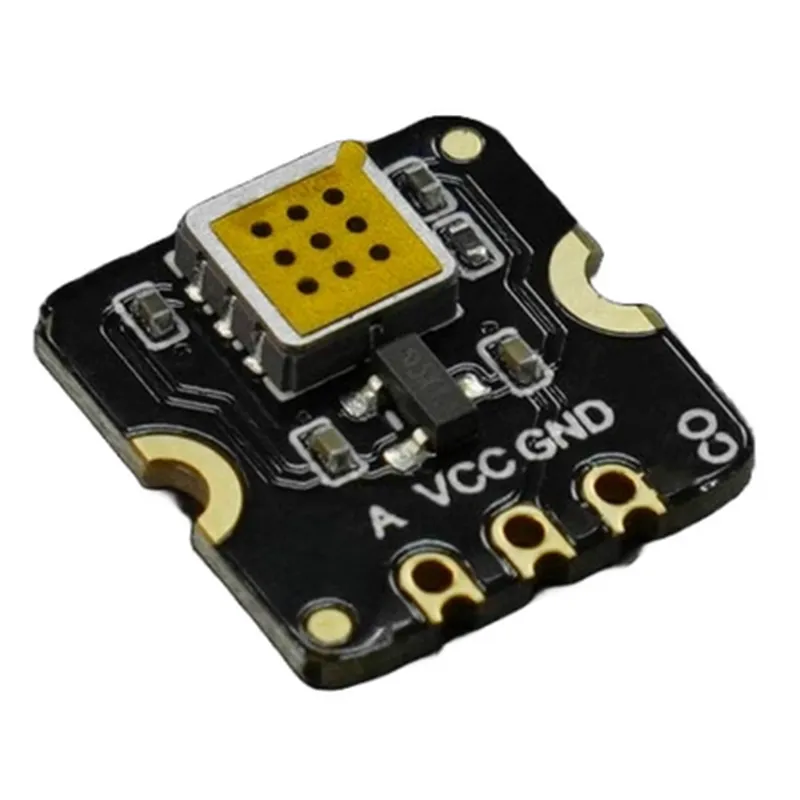
The Fermion MEMS Gas Detection Sensor is a microelectromechanical systems (MEMS) based sensor designed to detect Carbon Monoxide (CO) gas concentrations in the air. This breakout board sensor is capable of measuring CO levels ranging from 5 ppm to 5000 ppm, making it suitable for a wide range of applications, including industrial, commercial, and residential settings.

Functionality

The Fermion MEMS Gas Detection Sensor is designed to detect the presence of Carbon Monoxide gas in the air and provide an analog output signal proportional to the gas concentration. The sensor operates on the principle of MEMS technology, which involves the use of micro-machined sensing elements to detect changes in the air due to the presence of CO gas. The sensor's output signal can be easily connected to an microcontroller, analog-to-digital converter, or other electronic circuits for further processing and analysis.

Key Features

  • High Sensitivity: The Fermion MEMS Gas Detection Sensor has a high sensitivity to CO gas, allowing it to detect even small concentrations of the gas.
  • Wide Measurement Range: The sensor can measure CO concentrations ranging from 5 ppm to 5000 ppm, making it suitable for a wide range of applications.
  • MEMS Technology: The sensor uses micro-machined sensing elements, which provide high accuracy and reliability in CO gas detection.
  • Analog Output: The sensor provides an analog output signal, making it compatible with a wide range of electronic circuits and devices.
  • Low Power Consumption: The sensor has a low power consumption, making it suitable for battery-powered devices and energy-efficient systems.
  • Compact Design: The breakout board design allows for easy integration into a variety of applications, including handheld devices, IoT devices, and industrial equipment.
  • Multi-Point Calibration: The sensor can be calibrated at multiple points to ensure high accuracy and reliability in CO gas detection.
  • Operating Temperature: The sensor operates in a temperature range of -20C to 50C, making it suitable for use in a variety of environments.

Sensing Element

MEMS-based CO gas sensor

Measurement Range

5 ppm to 5000 ppm

Sensitivity

10% FS (Full Scale)

Output Signal

Analog (0-5V)

Power Supply

5V DC (10%)

Current Consumption

15mA

Response Time

30 seconds

Operating Temperature

-20C to 50C

Storage Temperature

-30C to 70C

Humidity

20-90% RH (non-condensing)

Applications

Industrial gas detection systems

Commercial and residential CO detection systems

IoT devices for air quality monitoring

Handheld CO detectors

Medical and healthcare devices

Automotive and aerospace applications

Notes

The Fermion MEMS Gas Detection Sensor requires proper calibration and integration into a suitable electronic circuit or device to ensure accurate and reliable CO gas detection.

It is essential to follow the manufacturer's guidelines and safety precautions when handling and using the sensor to avoid any potential risks or hazards.

The sensor should be used in accordance with local regulations and guidelines for CO gas detection and safety.

Pin Configuration

  • Fermion MEMS Gas Detection Sensor Carbon Monoxide (CO) Breakout - Pinout and Connection Guide
  • The Fermion MEMS Gas Detection Sensor Carbon Monoxide (CO) Breakout is a highly sensitive and accurate gas sensor module designed for detecting Carbon Monoxide (CO) concentrations in the range of 5-5000ppm. This module features a compact breakout board with a 6-pin interface, making it easy to integrate into various IoT and gas detection projects.
  • Pinout:
  • The Fermion MEMS Gas Detection Sensor Carbon Monoxide (CO) Breakout has the following pinout:
  • 1. VCC: Supply Voltage (Typ. 3.3V or 5V)
  • This pin provides the power supply to the sensor module. A stable voltage source between 3.3V and 5V is recommended.
  • 2. GND: Ground
  • This pin is the ground connection for the sensor module and should be connected to the ground of the microcontroller or power supply.
  • 3. OUT: Analog Output (Voltage)
  • This pin provides an analog output voltage proportional to the detected CO concentration. The output voltage range is 0-3.3V or 0-5V, depending on the supply voltage.
  • 4. INT: Interrupt Output (Digital)
  • This pin is an optional interrupt output that can be used to trigger an interrupt when the detected CO concentration exceeds a predetermined threshold.
  • 5. SCL: I2C Clock (Optional)
  • This pin is part of the I2C interface and is used to clock data transmission. However, note that the Fermion MEMS Gas Detection Sensor does not natively support I2C communication. This pin can be left unconnected if not using I2C.
  • 6. SDA: I2C Data (Optional)
  • This pin is part of the I2C interface and is used to transmit data. Like the SCL pin, this pin is not used by the Fermion MEMS Gas Detection Sensor and can be left unconnected if not using I2C.
  • Connection Guide:
  • To connect the Fermion MEMS Gas Detection Sensor Carbon Monoxide (CO) Breakout to a microcontroller or other devices, follow these steps:
  • Analog Output Connection:
  • Connect the VCC pin to a stable power supply (3.3V or 5V) using a suitable voltage regulator or power source.
  • Connect the GND pin to the ground of the microcontroller or power supply.
  • Connect the OUT pin to an analog-to-digital converter (ADC) input on your microcontroller or an analog input on a data acquisition device.
  • Interrupt Output Connection (Optional):
  • Connect the INT pin to an interrupt-enabled digital input on your microcontroller, if desired.
  • Important Note:
  • The Fermion MEMS Gas Detection Sensor Carbon Monoxide (CO) Breakout does not require any external resistors or capacitors for operation.
  • Make sure to handle the sensor module with care, as it is sensitive to environmental factors such as temperature, humidity, and exposure to gas contaminants.
  • Refer to the datasheet for the Fermion MEMS Gas Detection Sensor for specific temperature and humidity operating ranges, as well as calibration and measurement procedures.
  • By following this pinout and connection guide, you can successfully integrate the Fermion MEMS Gas Detection Sensor Carbon Monoxide (CO) Breakout into your IoT or gas detection projects, enabling accurate and reliable CO concentration measurements.

Code Examples

Fermion MEMS Gas Detection Sensor Carbon Monoxide (CO) Breakout (5-5000ppm) Documentation
Overview
The Fermion MEMS Gas Detection Sensor is a high-accuracy, low-power gas sensor designed to detect carbon monoxide (CO) concentrations in the air. This breakout board is suitable for a wide range of applications, from industrial safety monitoring to air quality monitoring in IoT devices.
Technical Specifications
Detection Range: 5-5000ppm
 Sensitivity: 1ppm
 Response Time: <30 seconds
 Power Consumption: 15mA (average), 50mA (peak)
 Operating Voltage: 3.3V to 5.5V
 Communication Interface: Analog output (0-3.3V)
Hardware Setup
1. Connect the VCC pin to a 3.3V or 5.5V power source.
2. Connect the GND pin to a common ground.
3. Connect the OUT pin to an analog-to-digital converter (ADC) or a microcontroller's analog input.
Software Examples
### Example 1: Basic Analog Readout using Arduino
This example demonstrates how to read the analog output of the Fermion MEMS Gas Detection Sensor using an Arduino board.
```cpp
const int sensorPin = A0;  // Analog input pin
void setup() {
  Serial.begin(9600);
}
void loop() {
  int sensorValue = analogRead(sensorPin);
  float voltage = sensorValue  (3.3 / 1023.0);
  float coConcentration = (voltage - 0.5) / 0.1; // Convert voltage to CO concentration (ppm)
  
  Serial.print("CO Concentration: ");
  Serial.print(coConcentration);
  Serial.println(" ppm");
  
  delay(1000);
}
```
### Example 2: IC Interface using Raspberry Pi (Python)
This example demonstrates how to interface the Fermion MEMS Gas Detection Sensor with a Raspberry Pi using an IC ADC converter (e.g., ADS1115).
```python
import Adafruit_ADS1x15
# Set up IC ADC converter
adc = Adafruit_ADS1x15.ADS1115(address=0x48)
while True:
    # Read analog output from sensor
    sensorValue = adc.read_adc(0, gain=1)
    voltage = sensorValue  (3.3 / 32767.0)
    coConcentration = (voltage - 0.5) / 0.1  # Convert voltage to CO concentration (ppm)
    
    print("CO Concentration: {:.2f} ppm".format(coConcentration))
    
    time.sleep(1)
```
### Example 3: Gas Threshold Alert using ESP32 (MicroPython)
This example demonstrates how to use the Fermion MEMS Gas Detection Sensor to trigger an alert when the CO concentration exceeds a certain threshold.
```python
import machine
import utime
# Set up analog input pin
sensorPin = machine.ADC(machine.Pin(32))
# Set threshold value (500ppm)
threshold = 500
while True:
    # Read analog output from sensor
    sensorValue = sensorPin.read()
    voltage = sensorValue  (3.3 / 4095.0)
    coConcentration = (voltage - 0.5) / 0.1  # Convert voltage to CO concentration (ppm)
    
    if coConcentration > threshold:
        print("CO Concentration Alert: {:.2f} ppm".format(coConcentration))
        # Trigger alert (e.g., LED, buzzer, notification)
    
    utime.sleep(1)
```
Note: In each example, the sensor output voltage is converted to a CO concentration value using the sensor's datasheet specifications. The examples provided are for illustrative purposes only and may require calibration and additional error handling for production use.