

Stufin
Home Quick Cart Profile

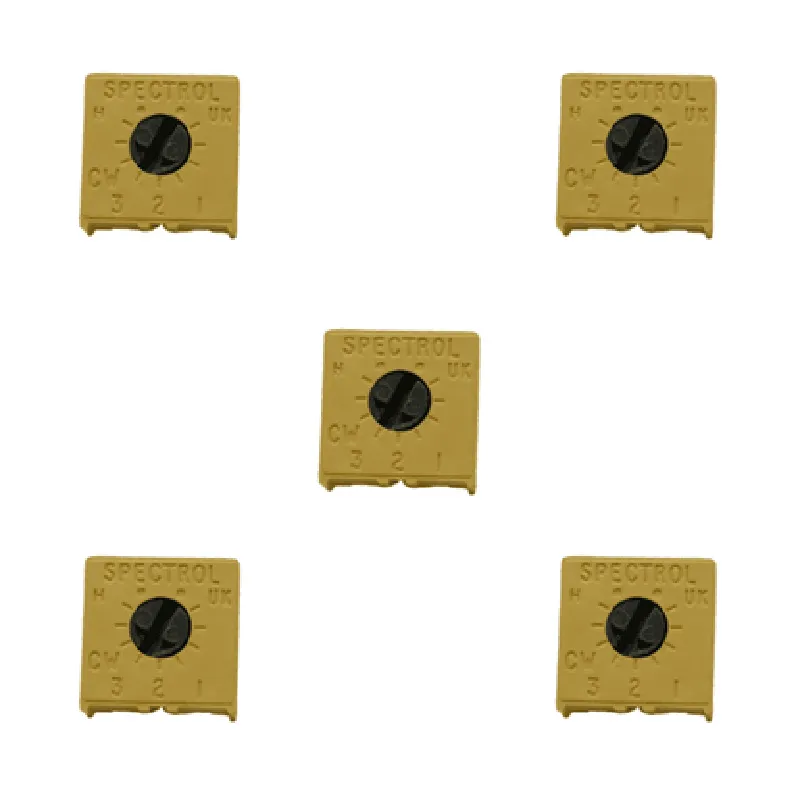
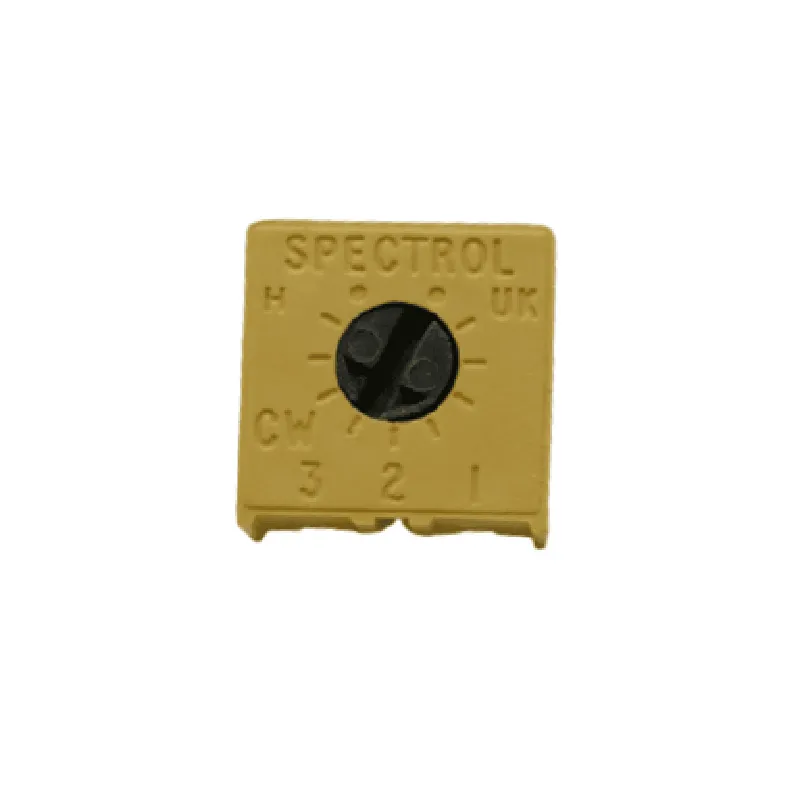
20E 3386P Trimpot(Pack of 5)

Buy Now on Stufin

Component Datasheet

20E 3386P Trimpot (Pack of 5)

Overview

The 20E 3386P Trimpot is a high-precision, compact trimmer potentiometer designed for precise adjustment of electrical signals in a wide range of applications. This component is provided in a pack of 5, offering convenience and cost-effectiveness for designers, engineers, and hobbyists.

Functionality

The 20E 3386P Trimpot is a three-terminal variable resistor that allows for precise adjustment of resistance values within a specific range. It consists of a rotating shaft connected to a wiper that moves along a resistive track, dividing the track into two resistive paths. The wiper's position determines the resistance ratio between the two paths, enabling the user to adjust the output signal to a desired level.

Key Features

  • Compact Size: The 20E 3386P Trimpot has a compact design, making it suitable for use in space-constrained applications.
  • High Precision: The trimmer potentiometer offers high precision and stability, ensuring accurate signal adjustment.
  • Adjustable Resistance: The 20E 3386P Trimpot allows for continuous adjustment of resistance values within a specific range (see specifications below).
  • Three-Terminal Design: The component has three terminals: two fixed ends and a movable wiper, allowing for easy integration into a variety of circuits.
  • Robust Construction: The trimmer potentiometer is built with a durable plastic case and a metal shaft, ensuring reliable operation in harsh environments.
  • Low Temperature Coefficient: The 20E 3386P Trimpot has a low temperature coefficient, minimizing the effect of temperature changes on its performance.

Specifications

Resistance Range

20 k

Tolerance

20%

Power Rating

0.5 W

Insulation Resistance

100 M

Operating Temperature

-40C to +150C

Shaft Torque

1.5 Ncm

Rotational Life

1000 cycles

Dimensions

9.5 mm x 4.5 mm x 3.5 mm (L x W x H)

Applications

The 20E 3386P Trimpot is suitable for use in a wide range of applications, including

Audio equipment

Medical devices

Industrial control systems

Automotive systems

Consumer electronics

Robotics and automation

Packaging Information

The 20E 3386P Trimpot is provided in a pack of 5, with each component individually wrapped to prevent damage during shipping and storage. The pack includes

5 x 20E 3386P Trimpot components

1 x datasheet

Ordering Information

To order the 20E 3386P Trimpot (Pack of 5), please use the following part number20E-3386P-PACK5.

Pin Configuration

  • 20E 3386P Trimpot (Pack of 5) Documentation
  • Overview
  • The 20E 3386P Trimpot is a 3-terminal variable resistor, also known as a trimpot or trimmer potentiometer. It is a compact, screw-driven potentiometer designed for precision adjustment of electrical circuits. This documentation provides a detailed explanation of the pins and how to connect them.
  • Pinout
  • The 20E 3386P Trimpot has three pins, labeled as follows:
  • Pin 1: CCW (Counter-ClockWise) Terminal
  • Function: Connects to one end of the resistive element
  • Description: This pin is connected to one end of the resistive material inside the trimpot. When the screwdriver is turned counterclockwise, the wiper (center pin) moves towards this pin, increasing the resistance between the wiper and this pin.
  • Pin 2: Wiper (Center) Terminal
  • Function: Connects to the movable wiper contact
  • Description: This pin is connected to the movable wiper contact that slides along the resistive material. The wiper contact divides the resistive material into two segments, and its position determines the resistance ratio between the two segments.
  • Pin 3: CW (ClockWise) Terminal
  • Function: Connects to the other end of the resistive element
  • Description: This pin is connected to the other end of the resistive material inside the trimpot. When the screwdriver is turned clockwise, the wiper (center pin) moves towards this pin, decreasing the resistance between the wiper and this pin.
  • Connection Structure
  • To connect the 20E 3386P Trimpot, follow these steps:
  • 1. Connect Pin 1 (CCW) to a fixed reference voltage (e.g., GND or VCC) or a fixed impedance (e.g., a resistor).
  • 2. Connect Pin 2 (Wiper) to the signal or voltage to be adjusted (e.g., an analog signal, a voltage divider, or a sensor output).
  • 3. Connect Pin 3 (CW) to the load or the circuit being controlled (e.g., an amplifier, a filter, or a microcontroller input).
  • Example Connection Diagram
  • Here is an example connection diagram:
  • ```
  • +-----------+
  • | |
  • | Trimpot |
  • | 20E 3386P |
  • | |
  • +-----------+
  • |
  • |
  • v
  • +---------------+---------------+---------------+
  • | | | |
  • | GND | Signal | Load |
  • | (Pin 1) | (Pin 2) | (Pin 3) |
  • | | | |
  • +---------------+---------------+---------------+
  • ```
  • In this example, the trimpot is used to adjust the voltage divider ratio between the signal and the load. The CCW terminal (Pin 1) is connected to GND, the Wiper terminal (Pin 2) is connected to the signal, and the CW terminal (Pin 3) is connected to the load.
  • Important Notes
  • Make sure to use a screwdriver with a suitable torque to avoid damaging the trimpot.
  • Avoid over-tightening or over-loosening the screw, as this can cause mechanical damage or affect the trimpot's performance.
  • Use the trimpot within its specified operating range and environmental conditions to ensure optimal performance and longevity.
  • By following this documentation, you should be able to connect and utilize the 20E 3386P Trimpot effectively in your IoT projects.

Code Examples

20E 3386P Trimpot (Pack of 5) Documentation
Overview
The 20E 3386P Trimpot is a precision potentiometer designed for electronic circuits that require accurate and reliable variable resistance. This component is suitable for a wide range of IoT applications, including sensor calibration, signal conditioning, and analog circuit tuning.
Key Features
Resistance range: 20k
 Tolerance: 10%
 Power rating: 0.25W
 Operating temperature: -40C to +125C
 Linear taper
 Compact size: 9.5mm x 6.5mm x 3.5mm
Pinout
The trimpot has three pins:
Pin 1: CW (Clockwise) terminal
 Pin 2: CCW (Counterclockwise) terminal
 Pin 3: Wiper terminal
Code Examples
### Example 1: Analog Signal Attenuation using Arduino
In this example, we will use the trimpot to attenuate an analog signal from a sensor.
```cpp
const int sensorPin = A0;  // Sensor output
const int trimpotPin = A1;  // Trimpot wiper pin
const int outputPin = 9;   // Output pin
void setup() {
  pinMode(trimpotPin, INPUT);
  pinMode(outputPin, OUTPUT);
}
void loop() {
  int sensorValue = analogRead(sensorPin);
  int attenuationValue = analogRead(trimpotPin);
  int attenuatedValue = sensorValue  (attenuationValue / 1023.0);
  analogWrite(outputPin, attenuatedValue);
  delay(10);
}
```
### Example 2: Sensor Calibration using Raspberry Pi (Python)
In this example, we will use the trimpot to calibrate a sensor output using a Raspberry Pi.
```python
import RPi.GPIO as GPIO
import time
# Set up GPIO mode
GPIO.setmode(GPIO.BCM)
# Define trimpot and sensor pins
trimpot_pin = 17
sensor_pin = 18
# Set up trimpot and sensor pins as inputs
GPIO.setup(trimpot_pin, GPIO.IN)
GPIO.setup(sensor_pin, GPIO.IN)
while True:
    # Read trimpot value (0-1023)
    trimpot_value = GPIO.input(trimpot_pin)
# Read sensor value (0-1023)
    sensor_value = GPIO.input(sensor_pin)
# Calculate calibrated sensor value
    calibrated_value = sensor_value  (trimpot_value / 1023.0)
# Print calibrated value
    print("Calibrated sensor value: ", calibrated_value)
# Wait for 100ms
    time.sleep(0.1)
```
Important Notes
When using the trimpot, ensure that the wiper terminal is connected to a high-impedance input or a buffer amplifier to minimize loading effects.
 The trimpot's mechanical design allows for multiple turns, but excessive turns can lead to mechanical wear and reduced accuracy. Use a reasonable number of turns (<10) for optimal performance.
 For precise applications, consider using a more accurate trimpot with a tighter tolerance (e.g., 5% or 1%).