NRF24L01+PA+LNA


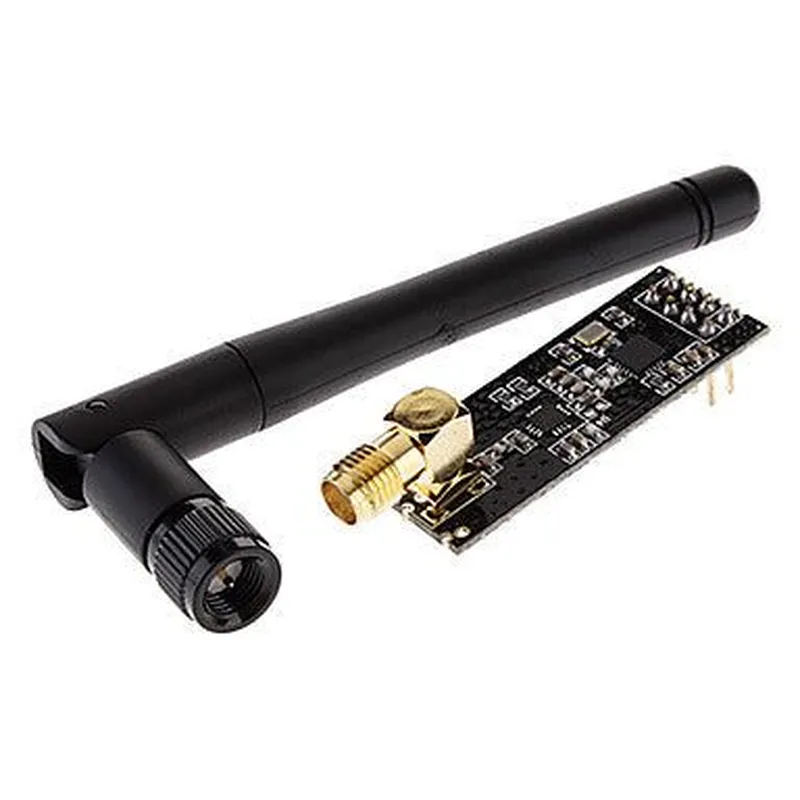
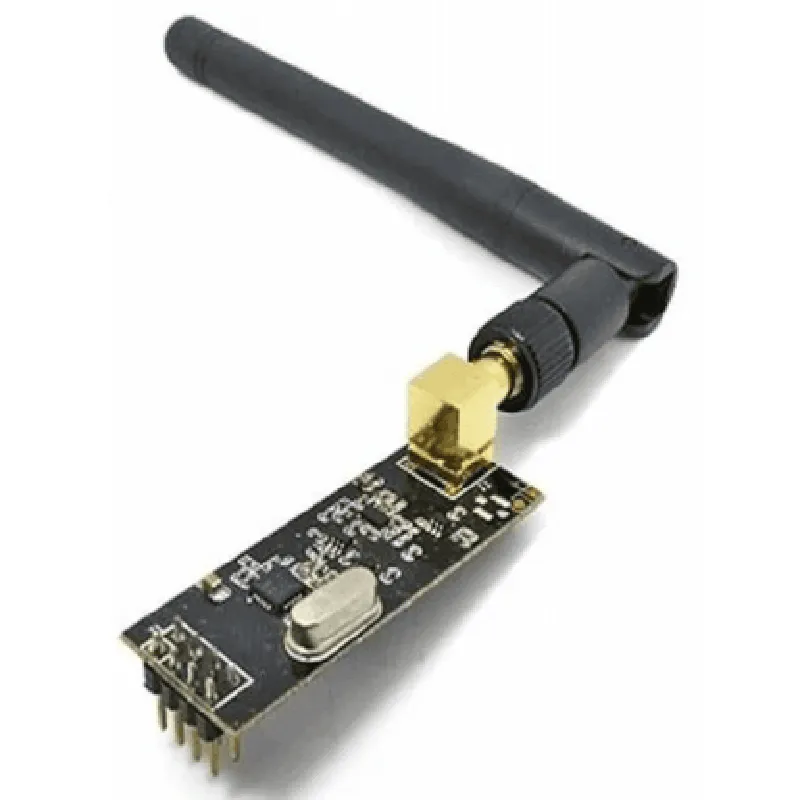
NRF24L01+PA+LNA
The NRF24L01+PA+LNA is a low-power, low-cost, and highly integrated 2.4GHz transceiver module designed for wireless communication in the Internet of Things (IoT) and other applications. This module is a variant of the popular NRF24L01 transceiver, enhanced with a Power Amplifier (PA) and a Low Noise Amplifier (LNA) to improve transmission distance and reception sensitivity.
The NRF24L01+PA+LNA module operates as a transceiver, allowing it to both transmit and receive data wirelessly. It is designed to work in the 2.4 GHz frequency band, which is widely used for IoT applications, wireless keyboards, and mice. The module uses the Gaussian Frequency Shift Keying (GFSK) modulation scheme and supports data transfer rates up to 2 Mbps.
The onboard Power Amplifier (PA) increases the transmission power, enabling the module to transmit data over longer distances, making it suitable for applications that require stronger signals.
The Low Noise Amplifier (LNA) boosts the received signal, allowing the module to detect weaker signals, which is essential for reliable communication in noisy environments.
The NRF24L01+PA+LNA module has a low power consumption, making it suitable for battery-powered devices and IoT applications where energy efficiency is crucial.
The module has a compact design, making it easy to integrate into small devices and IoT projects.
The module supports data transfer rates up to 2 Mbps, enabling fast communication between devices.
The NRF24L01+PA+LNA module is a cost-effective solution for wireless communication in IoT applications.
| The module can operate in multiple modes, including | |
| TX (Transmit) mode | for transmitting data |
| RX (Receive) mode | for receiving data |
for low-power consumption when not actively transmitting or receiving
for ultra-low power consumption when the module is not in use
The module uses a 4-wire SPI (Serial Peripheral Interface) bus for communication with microcontrollers and other devices.
The module operates on a voltage range of 1.9V to 3.6V, making it suitable for a wide range of power sources.
The module operates in a temperature range of -40C to +85C, making it suitable for use in various environmental conditions.
Overall, the NRF24L01+PA+LNA module is a reliable and cost-effective solution for wireless communication in IoT applications, offering improved transmission distance, reception sensitivity, and low power consumption.
NRF24L01+PA+LNA Component DocumentationOverviewThe NRF24L01+PA+LNA is a low-power, low-cost, and highly integrated 2.4GHz transceiver module that combines a Bluetooth Low Energy (BLE) radio with a Power Amplifier (PA) and Low Noise Amplifier (LNA) for enhanced range and performance. This module is commonly used in Internet of Things (IoT) applications, robotics, and wireless sensor networks.Features2.4GHz ISM band operation
Up to 2Mbps data transfer rate
32-byte payload and 6-byte header
125 channels with automatic frequency hopping
Received Signal Strength Indicator (RSSI) for link quality monitoring
Low power consumption (13mA in transmit mode, 22mA in receive mode)
Support for point-to-point and point-to-multipoint configurationsPinout| Pin | Function |
| --- | --- |
| VCC | Power supply (1.9-3.6V) |
| GND | Ground |
| CE | Chip Enable (active high) |
| CSN | Chip Select (active low) |
| SCK | Clock (up to 10MHz) |
| MOSI | Master Out Slave In (data transmission) |
| MISO | Master In Slave Out (data reception) |
| IRQ | Interrupt Request (active low) |Code Examples### Example 1: Basic Wireless Communication using ArduinoThis example demonstrates how to use the NRF24L01+PA+LNA module to establish a wireless connection between two Arduino boards.Transmitter Code
```cpp
#include <RF24.h>RF24 radio(9, 10); // CE, CSN pinsconst char message = "Hello, world!";void setup() {
Serial.begin(9600);
radio.begin();
radio.setPALevel(RF24_PA_HIGH);
radio.setDataRate(RF24_2MBPS);
radio.openWritingPipe((const char)0xF0F0F0F0E1LL);
}void loop() {
radio.stopListening();
radio.startTransmit();
radio.write((const void)message, strlen(message));
radio.stopTransmit();
delay(1000);
}
```
Receiver Code
```cpp
#include <RF24.h>RF24 radio(9, 10); // CE, CSN pinsvoid setup() {
Serial.begin(9600);
radio.begin();
radio.setPALevel(RF24_PA_HIGH);
radio.setDataRate(RF24_2MBPS);
radio.openReadingPipe((const char)0xF0F0F0F0E1LL);
radio.startListening();
}void loop() {
if (radio.available()) {
char message[32];
radio.read(message, 32);
Serial.println(message);
}
delay(1000);
}
```
### Example 2: Wireless Sensor Node using Raspberry Pi (Python)This example demonstrates how to use the NRF24L01+PA+LNA module to create a wireless sensor node using a Raspberry Pi and Python.Sensor Node Code
```python
import RPi.GPIO as GPIO
import spidev# Configure GPIO pins
GPIO.setmode(GPIO.BCM)
GPIO.setup(17, GPIO.OUT) # CE pin
GPIO.setup(22, GPIO.OUT) # CSN pin# Initialize SPI interface
spi = spidev.SpiDev()
spi.open(0, 0)# Send temperature data
def send_data(temp):
message = struct.pack('f', temp)
spi.xfer2([0x01, 0x02, 0x03, 0x04, message])
GPIO.output(17, GPIO.HIGH)
time.sleep(0.1)
GPIO.output(17, GPIO.LOW)# Read temperature data from sensor
def read_temp():
# Simulate temperature sensor read
temp = 25.0 + random.uniform(-1.0, 1.0)
return tempwhile True:
temp = read_temp()
send_data(temp)
time.sleep(1)
```
Note: The above code examples are simplified and assume a basic understanding of the NRF24L01+PA+LNA module and the respective development boards. You may need to modify the code to suit your specific application requirements.ImportantEnsure the NRF24L01+PA+LNA module is properly connected to the development board and configured correctly.
Use the correct pinout and voltage levels to avoid damage to the module or development board.
The code examples provided are for illustrative purposes only and may require additional modifications and error handling for production-ready applications.