[Insert diameter]


[Insert diameter]
[Insert length]
[Insert lead spacing]
[Insert weight]
Operating Conditions
-40C to 85C
-40C to 85C
95% relative humidity (RH) max
Safety Precautions
Handle the capacitor by its body or radial leads to prevent damage to the internal components.
Avoid exceeding the maximum voltage rating to prevent electrical shock, capacitor failure, or damage to adjacent components.
Ensure proper polarity when installing the capacitor to prevent damage or electrical shock.
By understanding the functionality and key features of the 4700uF 25V Electrolytic Capacitor, designers and engineers can effectively integrate this component into their projects to achieve reliable and efficient performance.
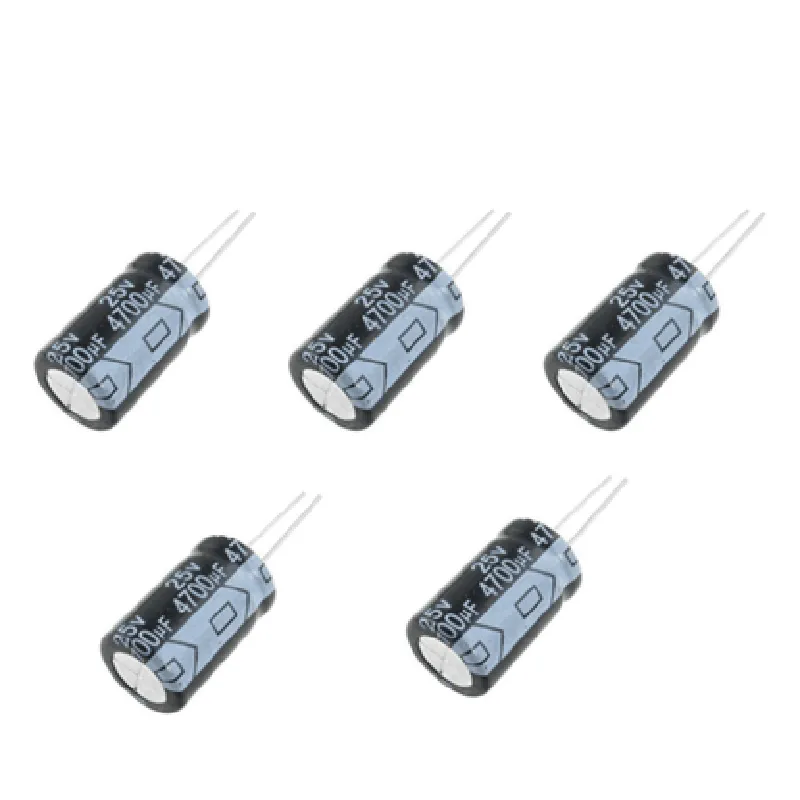
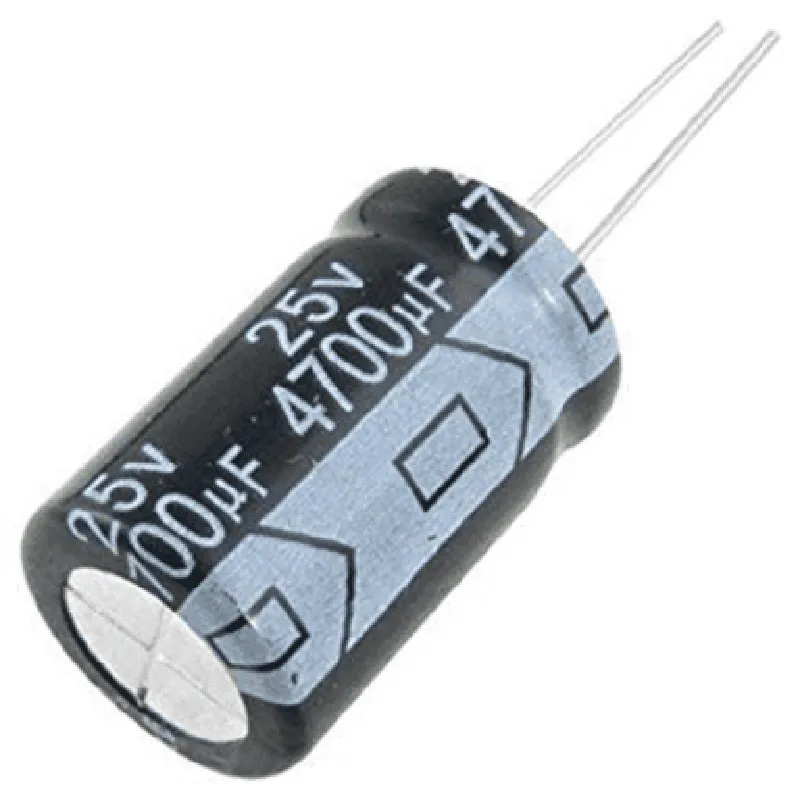
Component Documentation: 4700uF 25V Electrolytic Capacitor (Pack of 5)OverviewThe 4700uF 25V Electrolytic Capacitor is a high-capacitance, radial-lead electrolytic capacitor designed for use in a wide range of applications, including power supplies, audio equipment, and electrical circuits. This component is suitable for both industrial and hobbyist projects.Technical SpecificationsCapacitance: 4700uF (microfarads)
Voltage Rating: 25V
ESR (Equivalent Series Resistance): 500 mohm
Operating Temperature: -40C to +85C
Package Type: Radial lead
Size: 13mm (diameter) x 25mm (height)Usage and ApplicationsThe 4700uF 25V Electrolytic Capacitor is commonly used in:Power supplies and filtering circuits
Audio equipment, such as amplifiers and speakers
Motor control and motor drive circuits
Electronic devices, such as computers and televisionsCode Examples### Example 1: Power Supply Filtering Circuit (Arduino)In this example, we will use the 4700uF 25V Electrolytic Capacitor to filter the output voltage of a power supply to reduce ripple and noise.```c++
// Define the capacitor pin connections
const int VIN_PIN = A0; // Input voltage pin
const int VOUT_PIN = A1; // Output voltage pin
const int GND_PIN = GND; // Ground pin
const int CAP_PIN = 2; // Capacitor pinvoid setup() {
pinMode(VIN_PIN, INPUT);
pinMode(VOUT_PIN, OUTPUT);
pinMode(GND_PIN, OUTPUT);
pinMode(CAP_PIN, OUTPUT);
}void loop() {
// Read the input voltage
int vin = analogRead(VIN_PIN);// Apply the voltage to the capacitor
analogWrite(VOUT_PIN, vin);// Filter the output voltage using the capacitor
analogRead(CAP_PIN);// Read the filtered output voltage
int vout = analogRead(VOUT_PIN);// Print the filtered output voltage
Serial.print("Filtered Output Voltage: ");
Serial.print(vout);
Serial.println(" mV");
}
```### Example 2: Audio Filter Circuit (Raspberry Pi)In this example, we will use the 4700uF 25V Electrolytic Capacitor to create a simple low-pass filter for an audio signal using a Raspberry Pi.```python
import RPi.GPIO as GPIO
import time# Define the capacitor pin connections
VIN_PIN = 17 # Input audio signal pin
VOUT_PIN = 23 # Output audio signal pin
GND_PIN = 25 # Ground pin
CAP_PIN = 24 # Capacitor pin# Set up the GPIO pins
GPIO.setmode(GPIO.BCM)
GPIO.setup(VIN_PIN, GPIO.IN)
GPIO.setup(VOUT_PIN, GPIO.OUT)
GPIO.setup(GND_PIN, GPIO.OUT)
GPIO.setup(CAP_PIN, GPIO.OUT)# Define the filter constants
C = 4700e-6 # Capacitance (Farads)
R = 1000 # Resistance (Ohms)# Define the filter cutoff frequency (Hz)
fc = 1 / (2 math.pi math.sqrt(R C))while True:
# Read the input audio signal
vin = GPIO.input(VIN_PIN)# Apply the audio signal to the capacitor
GPIO.output(VOUT_PIN, vin)# Filter the audio signal using the capacitor
time.sleep(1 / fc)# Read the filtered audio signal
vout = GPIO.input(VOUT_PIN)# Print the filtered audio signal
print("Filtered Audio Signal:", vout)
```Note: These code examples are simplified and may require additional components and configuration to function properly. They are intended to demonstrate the basic usage of the 4700uF 25V Electrolytic Capacitor in different contexts.