

Stufin
Home Quick Cart Profile

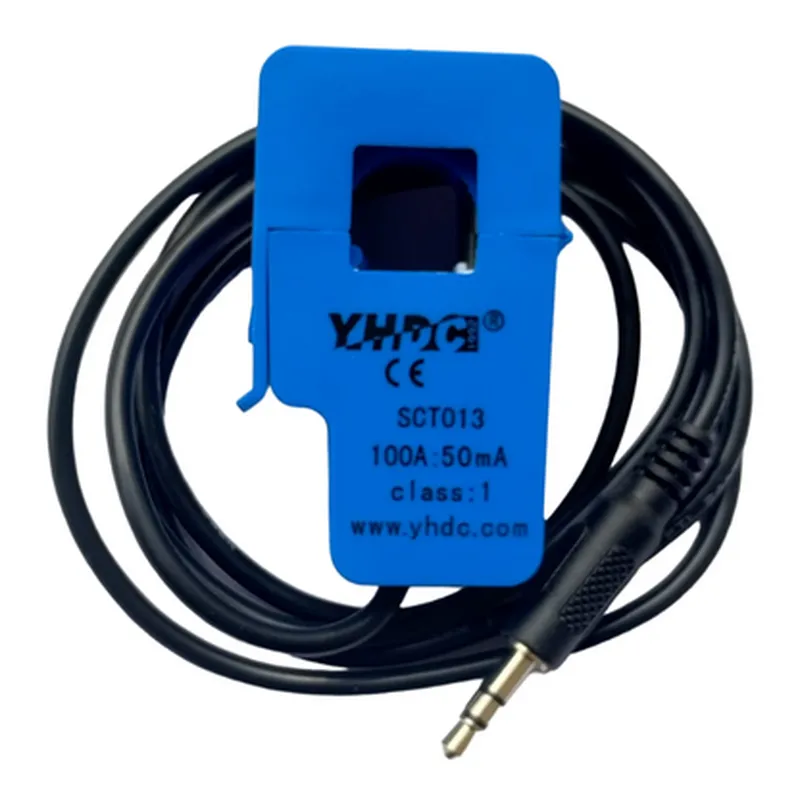
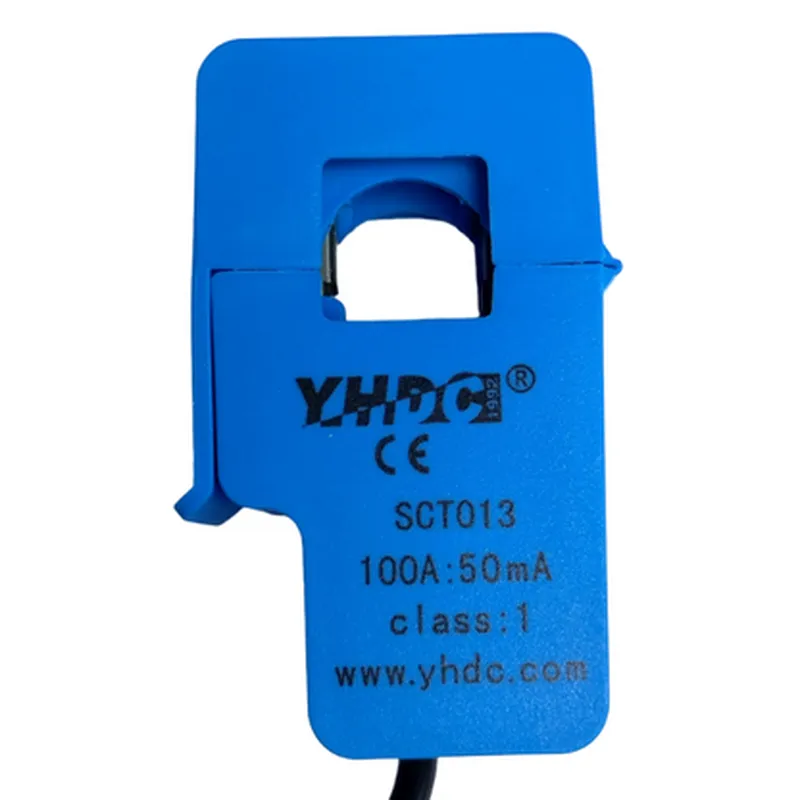
100A YHDC Non-invasive AC Current Sensor

Buy Now on Stufin

Component Name

100A YHDC Non-invasive AC Current Sensor

Overview

The 100A YHDC Non-invasive AC Current Sensor is a highly accurate and reliable sensor designed to measure alternating current (AC) in a non-invasive manner, without interrupting the circuit or making physical contact with the conductor. This sensor is ideal for a wide range of applications, including energy monitoring, power quality analysis, and industrial automation.

Functionality

The 100A YHDC Non-invasive AC Current Sensor uses the principle of magnetic field sensing to measure the AC current flowing through a conductor. The sensor consists of a toroidal core and a Hall effect sensor, which detects the magnetic field generated by the current-carrying conductor. The sensor then converts the detected magnetic field into a proportional analog output voltage signal, allowing for accurate current measurement.

Key Features

  • High Accuracy: The 100A YHDC Non-invasive AC Current Sensor provides accurate current measurements with a precision of 1% over a wide range of currents.
  • Non-invasive Measurement: The sensor does not require physical contact with the conductor, making it safe and convenient for use in a variety of applications.
  • Wide Current Range: The sensor can measure currents up to 100A AC, making it suitable for use in industrial, commercial, and residential applications.
  • Low Power Consumption: The sensor has a low power consumption of 5V/10mA, making it suitable for use in battery-powered devices.
  • Compact Design: The sensor has a compact design, making it easy to integrate into existing systems and devices.
  • High Frequency Response: The sensor has a high-frequency response of up to 1 kHz, allowing for accurate measurement of current waveforms.
  • Electromagnetic Interference (EMI) Immunity: The sensor is designed to operate in environments with high EMI, ensuring reliable and accurate measurements.
  • Operating Temperature Range: The sensor operates over a wide temperature range of -25C to 85C, making it suitable for use in a variety of environments.
  • Output Signal: The sensor provides an analog output voltage signal, which can be easily interfaced with microcontrollers, data acquisition systems, and other devices.

Technical Specifications

Current Range

0-100A AC

Accuracy

1%

Sensitivity

100mV/A

Power Supply

5V DC

Power Consumption

10mA

Frequency Response

up to 1 kHz

Operating Temperature Range

-25C to 85C

Storage Temperature Range

-40C to 125C

Humidity

up to 80% RH

Dimensions

32mm x 22mm x 15mm

Applications

Energy monitoring and power quality analysis

Industrial automation and control systems

Building automation and management systems

Electric vehicle charging stations

Renewable energy systems

IoT devices and sensors

Certifications and Compliance

CE marked

RoHS compliant

REACH compliant

Warranty and Support

1-year warranty

Technical support and documentation available online

Manufacturer's support team available for assistance

Pin Configuration

  • 100A YHDC Non-invasive AC Current Sensor Pinout Guide
  • The 100A YHDC Non-invasive AC Current Sensor is a popular IoT component used to measure alternating current (AC) without physical contact with the conductor. This guide provides a detailed explanation of each pin on the sensor, along with connection instructions.
  • Pinout Structure:
  • The 100A YHDC Non-invasive AC Current Sensor has a total of 5 pins, labeled as follows:
  • 1. VCC (Power Supply Pin)
  • Function: Positive power supply voltage input
  • Recommended voltage range: 3.3V to 5V
  • Description: Connect this pin to a stable power supply source, such as a battery or a regulated voltage source.
  • 2. GND (Ground Pin)
  • Function: Negative power supply voltage input (Ground)
  • Description: Connect this pin to the negative terminal of the power supply source or the system ground.
  • 3. OUT (Output Pin)
  • Function: Analog output voltage proportional to the measured AC current
  • Description: Connect this pin to an analog-to-digital converter (ADC) or a microcontroller's analog input pin to read the output voltage.
  • 4. None (Reserved Pin)
  • Function: Reserved pin, do not connect
  • Description: This pin is reserved for internal use and should not be connected to any external circuitry.
  • 5. SIG (Signal Pin)
  • Function: Input pin for AC current measurement
  • Description: Connect this pin to the conductor or wire carrying the AC current to be measured. Ensure the sensor is properly aligned and positioned around the conductor for accurate measurements.
  • Connection Instructions:
  • 1. Connect the VCC pin to a stable power supply source (3.3V to 5V).
  • 2. Connect the GND pin to the negative terminal of the power supply source or the system ground.
  • 3. Connect the OUT pin to an analog-to-digital converter (ADC) or a microcontroller's analog input pin.
  • 4. Leave the Reserved Pin (None) unconnected.
  • 5. Connect the SIG pin to the conductor or wire carrying the AC current to be measured.
  • Important Notes:
  • Ensure proper insulation and clearance between the sensor and the conductor or wire carrying the AC current to avoid electrical shock or damage.
  • Follow the recommended voltage range and power supply configuration to ensure accurate measurements and to prevent damage to the sensor.
  • Consult the datasheet and application notes for specific usage guidelines, calibration, and measurement considerations.
  • By following this pinout guide and connection instructions, you can correctly integrate the 100A YHDC Non-invasive AC Current Sensor into your IoT project or application.

Code Examples

100A YHDC Non-invasive AC Current Sensor Documentation
Overview
The 100A YHDC Non-invasive AC Current Sensor is a compact and accurate device for measuring AC currents up to 100A without interrupting the circuit. It uses the principle of magnetic induction to detect changes in the magnetic field around the current-carrying conductor, allowing for non-invasive measurement. This sensor is ideal for IoT applications, such as energy monitoring, power quality analysis, and industrial automation.
Technical Specifications
Measurement range: 0-100A AC
 Accuracy: 1% (at 50Hz, 1A-100A)
 Sensitivity: 100mV/A
 Output signal: Analog voltage (0-5V)
 Operating frequency: 50/60Hz
 Power supply: 5V DC (typical)
 Dimensions: 64mm x 25mm x 15mm
Interfacing and Code Examples
### Example 1: Arduino-based Current Measurement
Connect the sensor's output to an analog input pin of an Arduino board. Use the following code to read the current value:
```c++
const int sensorPin = A0;  // Analog input pin
const float sensitivity = 100.0;  // mV/A
const float voltageRef = 5.0;  // V
void setup() {
  Serial.begin(9600);
}
void loop() {
  int sensorValue = analogRead(sensorPin);
  float voltage = sensorValue  (voltageRef / 1023.0);
  float current = voltage / sensitivity;
  Serial.print("Current: ");
  Serial.print(current, 2);
  Serial.println(" A");
  delay(1000);
}
```
This code reads the analog voltage output from the sensor, converts it to a digital value, and calculates the current using the sensitivity value.
### Example 2: Raspberry Pi-based Energy Monitoring
Connect the sensor's output to an analog input pin of a Raspberry Pi (e.g., GPIO 18). Use the following Python code to read the current value and calculate energy consumption:
```python
import RPi.GPIO as GPIO
import time
GPIO.setmode(GPIO.BCM)
GPIO.setup(18, GPIO.IN)
sensitivity = 100.0  # mV/A
voltage_ref = 3.3  # V
while True:
    sensor_value = GPIO.input(18)
    voltage = (sensor_value  voltage_ref) / 1023.0
    current = voltage / sensitivity
    power = current  230.0  # assuming 230V AC
    energy_consumption = power  0.1  # calculate energy consumption in Wh
    print(f"Current: {current:.2f} A, Power: {power:.2f} W, Energy: {energy_consumption:.2f} Wh")
    time.sleep(1)
```
This code uses the RPi.GPIO library to read the analog input, calculates the current value, and estimates the power and energy consumption based on the measured current.
Additional Information
The 100A YHDC Non-invasive AC Current Sensor requires a 5V DC power supply, which can be provided by an external power source or a USB connection (if connected to a USB-enabled device).
 Ensure proper insulation and electrical safety when working with AC circuits.
 For accurate measurements, the sensor should be installed in close proximity to the current-carrying conductor and in a location with minimal electromagnetic interference.
By following these examples and considering the technical specifications, you can effectively integrate the 100A YHDC Non-invasive AC Current Sensor into your IoT applications.