

Stufin
Home Quick Cart Profile

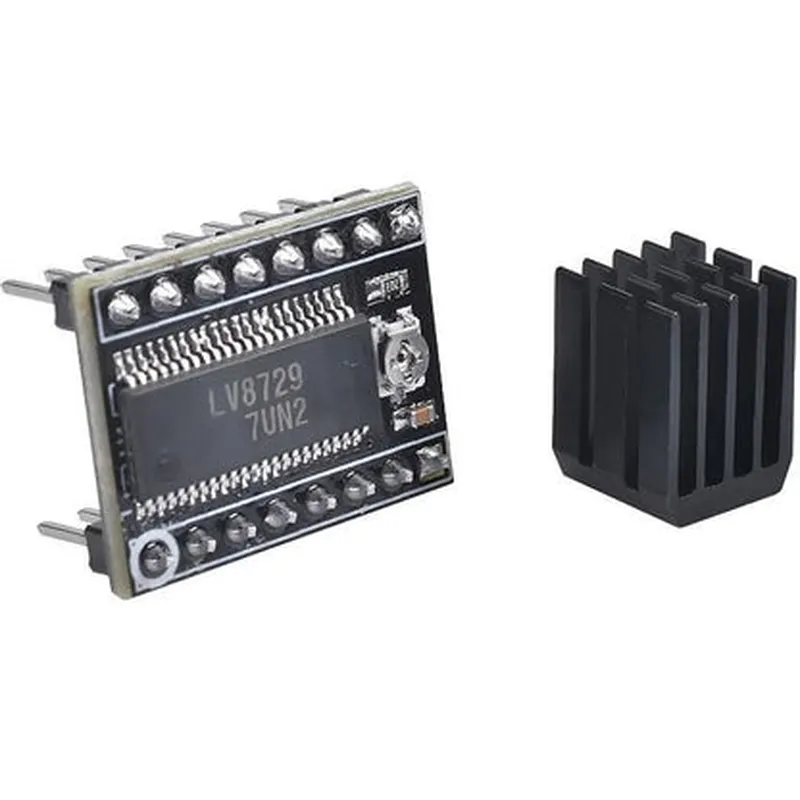
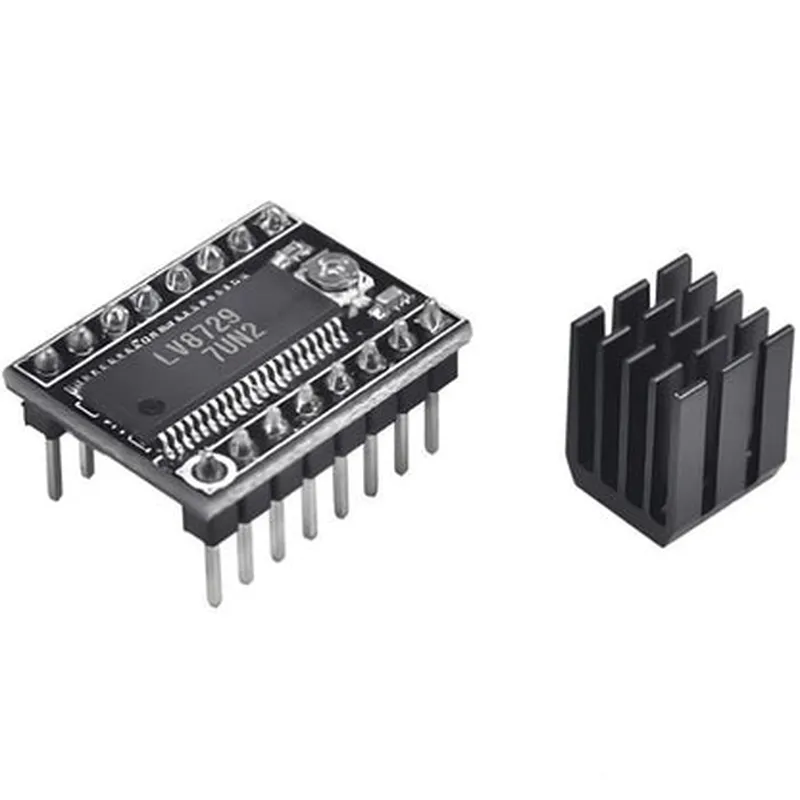
Ultra-silent 4-layer Substrate MKS-LV8729 Stepper Motor Driver with Heat Sink

Buy Now on Stufin

Component Name

Ultra-silent 4-layer Substrate MKS-LV8729 Stepper Motor Driver with Heat Sink

Overview

The MKS-LV8729 is a high-performance, ultra-silent 4-layer substrate stepper motor driver designed for precision control and smooth operation. This component is specifically tailored for demanding applications that require low noise, high torque, and efficient heat dissipation. The integrated heat sink ensures reliable performance even in challenging thermal environments.

Functionality

The MKS-LV8729 stepper motor driver is designed to control bipolar stepper motors, providing precise control over motor rotation, direction, and speed. The driver's advanced microstepping technology allows for smooth, quiet operation, making it suitable for applications that require low vibration and noise.

Key Features

  • Ultra-Silent Operation: The MKS-LV8729 features an advanced silent-chop technology, which significantly reduces motor noise and vibration, making it ideal for applications that require quiet operation.
  • 4-Layer Substrate: The driver's 4-layer substrate design provides excellent thermal performance, enabling efficient heat dissipation and reduced thermal resistance.
  • High-Torque Output: The MKS-LV8729 is capable of delivering high-torque output, making it suitable for applications that require precise control and high-force motor operation.
  • Microstepping Technology: The driver supports microstepping, allowing for precise motor control and smooth operation.
  • Integrated Heat Sink: The built-in heat sink ensures efficient heat dissipation, allowing the driver to operate reliably even in high-temperature environments.
  • Compact Design: The MKS-LV8729 features a compact design, making it easy to integrate into various applications and systems.
  • Low Power Consumption: The driver has low power consumption, reducing heat generation and increasing overall system efficiency.
  • Wide Operating Voltage Range: The MKS-LV8729 operates with a wide input voltage range of 12-48V, making it suitable for various power supply configurations.
  • Overcurrent Protection: The driver features overcurrent protection, preventing damage to the motor and driver in the event of excessive current draw.
  • Error Detection and Reporting: The MKS-LV8729 has built-in error detection and reporting capabilities, enabling quick identification and troubleshooting of issues.

Technical Specifications

Input Voltage

12-48V

Output Current

Up to 2.5A per phase

Microstepping Resolution

Up to 128 microsteps

Step Frequency

Up to 200 kHz

Operating Temperature

-20C to 85C

Storage Temperature

-40C to 125C

Dimensions

36 x 36 x 15mm (L x W x H)

Applications

The MKS-LV8729 Ultra-silent 4-layer Substrate Stepper Motor Driver with Heat Sink is suitable for a wide range of applications, including

3D printing and CNC machines

Industrial automation

Medical devices

Robotics

Musical instruments and audio equipment

Scientific instruments and laboratory equipment

Conclusion

The MKS-LV8729 stepper motor driver offers a unique combination of ultra-silent operation, high-torque output, and efficient heat dissipation, making it an ideal choice for demanding applications that require precision control and smooth motor operation.

Pin Configuration

  • Ultra-silent 4-layer Substrate MKS-LV8729 Stepper Motor Driver with Heat Sink
  • Pinout Description:
  • The MKS-LV8729 Stepper Motor Driver is a high-performance driver IC that operates at a high frequency, resulting in ultra-silent operation. It features a 4-layer substrate design with a built-in heat sink for efficient heat dissipation. The driver has a total of 16 pins, which are explained below:
  • Pin Description:
  • 1. VCC (Pin 1):
  • Function: Power supply input
  • Description: Connect to a 3.3V or 5V power source (depending on the logic voltage requirement)
  • 2. GND (Pin 2):
  • Function: Ground connection
  • Description: Connect to the system ground or negative terminal of the power supply
  • 3. EN (Pin 3):
  • Function: Enable input
  • Description: Active high input to enable the driver. Connect to a logic high (VCC) to enable the driver, or logic low (GND) to disable
  • 4. RST (Pin 4):
  • Function: Reset input
  • Description: Active low input to reset the driver. Connect to a logic low (GND) to reset the driver, or float or logic high (VCC) to normal operation
  • 5. DIR (Pin 5):
  • Function: Direction input
  • Description: Set the direction of the stepper motor rotation. Logic high (VCC) for clockwise rotation, logic low (GND) for counterclockwise rotation
  • 6. STEP (Pin 6):
  • Function: Step input
  • Description: Pulse input to control the stepper motor steps. A rising edge on this pin will increment the motor position by one step
  • 7. M1 (Pin 7):
  • Function: Microstep resolution selection input (MS1)
  • Description: Sets the microstep resolution for the motor. Logic high (VCC) for full-step mode, logic low (GND) for half-step mode
  • 8. M2 (Pin 8):
  • Function: Microstep resolution selection input (MS2)
  • Description: Sets the microstep resolution for the motor. Logic high (VCC) for 1/4-step mode, logic low (GND) for 1/8-step mode (when M1 is high)
  • 9. M3 (Pin 9):
  • Function: Microstep resolution selection input (MS3)
  • Description: Sets the microstep resolution for the motor. Logic high (VCC) for 1/16-step mode, logic low (GND) for 1/32-step mode (when M1 and M2 are high)
  • 10. A1 (Pin 10):
  • Function: Motor phase A output
  • Description: Connect to the stepper motor phase A winding
  • 11. A2 (Pin 11):
  • Function: Motor phase A output
  • Description: Connect to the stepper motor phase A winding
  • 12. B1 (Pin 12):
  • Function: Motor phase B output
  • Description: Connect to the stepper motor phase B winding
  • 13. B2 (Pin 13):
  • Function: Motor phase B output
  • Description: Connect to the stepper motor phase B winding
  • 14. NC (Pin 14):
  • Function: No connection
  • Description: This pin is not connected internally and should be left floating
  • 15. NC (Pin 15):
  • Function: No connection
  • Description: This pin is not connected internally and should be left floating
  • 16. TH (Pin 16):
  • Function: Thermal sensor output
  • Description: An analog output that indicates the temperature of the heat sink. Can be connected to a microcontroller for temperature monitoring
  • Connection Structure:
  • Power Connection:
  • VCC (Pin 1) 3.3V or 5V power supply
  • GND (Pin 2) System ground or negative terminal of the power supply
  • Control Connection:
  • EN (Pin 3) Logic high (VCC) to enable the driver, or logic low (GND) to disable
  • RST (Pin 4) Logic low (GND) to reset the driver, or float or logic high (VCC) to normal operation
  • DIR (Pin 5) Logic high (VCC) for clockwise rotation, logic low (GND) for counterclockwise rotation
  • STEP (Pin 6) Pulse input to control the stepper motor steps
  • M1 (Pin 7), M2 (Pin 8), and M3 (Pin 9) Set the microstep resolution for the motor according to the desired mode
  • Motor Connection:
  • A1 (Pin 10) Stepper motor phase A winding
  • A2 (Pin 11) Stepper motor phase A winding
  • B1 (Pin 12) Stepper motor phase B winding
  • B2 (Pin 13) Stepper motor phase B winding
  • Other Connections:
  • TH (Pin 16) Microcontroller or temperature monitoring circuit (optional)
  • Note:
  • Ensure proper heat sink installation and thermal management to prevent overheating.
  • Follow the recommended voltage and current ratings for the power supply and stepper motor.
  • Refer to the datasheet for detailed specifications, timing diagrams, and application notes.

Code Examples

Ultra-silent 4-layer Substrate MKS-LV8729 Stepper Motor Driver with Heat Sink
Overview
The MKS-LV8729 is a high-performance stepper motor driver with a 4-layer substrate and heat sink, designed for ultra-silent operation. This driver is suitable for a wide range of applications, including 3D printers, CNC machines, and other precision motion control systems.
Key Features
4-layer substrate for improved thermal performance and noise reduction
 Heat sink for efficient heat dissipation
 Supports up to 2.5A peak current per phase
 Microstep resolution up to 128 steps per full step
 Integrated overcurrent protection and thermal monitoring
 Compatible with 2-phase and 4-phase stepper motors
Pinout
The MKS-LV8729 has a 16-pin interface, with the following pinout:
| Pin # | Function |
| --- | --- |
| 1 | VCC | Power supply (3.3V or 5V) |
| 2-3 | DIR | Direction control ( LOW = CW, HIGH = CCW) |
| 4-5 | STEP | Step control (rising edge triggers step) |
| 6-7 | ENABLE | Enable control ( LOW = enabled, HIGH = disabled) |
| 8-11 | MOSI, MISO, SCK, CS | SPI interface for configuration and monitoring |
| 12-13 | FAULT, THERMAL | Fault detection and thermal monitoring outputs |
| 14-15 | VM, GND | Motor voltage and ground |
| 16 | NC | Not connected |
Code Examples
### Example 1: Basic Stepper Motor Control using Arduino
This example demonstrates how to control a stepper motor using the MKS-LV8729 driver with an Arduino board.
```c++
// Define the pin connections
const int dirPin = 2;
const int stepPin = 3;
const int enablePin = 4;
void setup() {
  // Initialize the pins as outputs
  pinMode(dirPin, OUTPUT);
  pinMode(stepPin, OUTPUT);
  pinMode(enablePin, OUTPUT);
// Set the direction and enable the driver
  digitalWrite(dirPin, LOW); // Set direction to CW
  digitalWrite(enablePin, LOW); // Enable the driver
}
void loop() {
  // Take 100 steps in the CW direction
  for (int i = 0; i < 100; i++) {
    digitalWrite(stepPin, HIGH);
    delayMicroseconds(500); // 500us pulse width
    digitalWrite(stepPin, LOW);
    delayMicroseconds(500); // 500us pulse width
  }
  // Take 100 steps in the CCW direction
  digitalWrite(dirPin, HIGH); // Set direction to CCW
  for (int i = 0; i < 100; i++) {
    digitalWrite(stepPin, HIGH);
    delayMicroseconds(500); // 500us pulse width
    digitalWrite(stepPin, LOW);
    delayMicroseconds(500); // 500us pulse width
  }
}
```
### Example 2: Stepper Motor Control using Raspberry Pi (Python)
This example demonstrates how to control a stepper motor using the MKS-LV8729 driver with a Raspberry Pi board and Python.
```python
import RPi.GPIO as GPIO
import time
# Define the pin connections
dir_pin = 17
step_pin = 23
enable_pin = 24
# Set up the GPIO library
GPIO.setmode(GPIO.BCM)
# Initialize the pins as outputs
GPIO.setup(dir_pin, GPIO.OUT)
GPIO.setup(step_pin, GPIO.OUT)
GPIO.setup(enable_pin, GPIO.OUT)
# Set the direction and enable the driver
GPIO.output(dir_pin, GPIO.LOW) # Set direction to CW
GPIO.output(enable_pin, GPIO.LOW) # Enable the driver
while True:
  # Take 100 steps in the CW direction
  for i in range(100):
    GPIO.output(step_pin, GPIO.HIGH)
    time.sleep(0.0005) # 500us pulse width
    GPIO.output(step_pin, GPIO.LOW)
    time.sleep(0.0005) # 500us pulse width
  # Take 100 steps in the CCW direction
  GPIO.output(dir_pin, GPIO.HIGH) # Set direction to CCW
  for i in range(100):
    GPIO.output(step_pin, GPIO.HIGH)
    time.sleep(0.0005) # 500us pulse width
    GPIO.output(step_pin, GPIO.LOW)
    time.sleep(0.0005) # 500us pulse width
```
Note: In both examples, the pulse width and frequency of the step signal can be adjusted to control the speed and acceleration of the stepper motor.