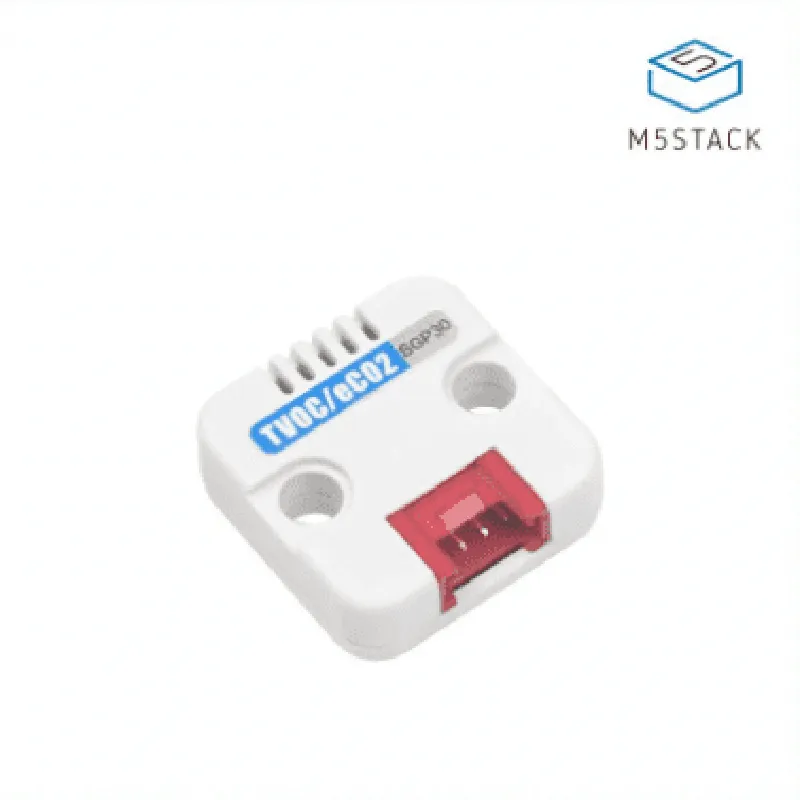
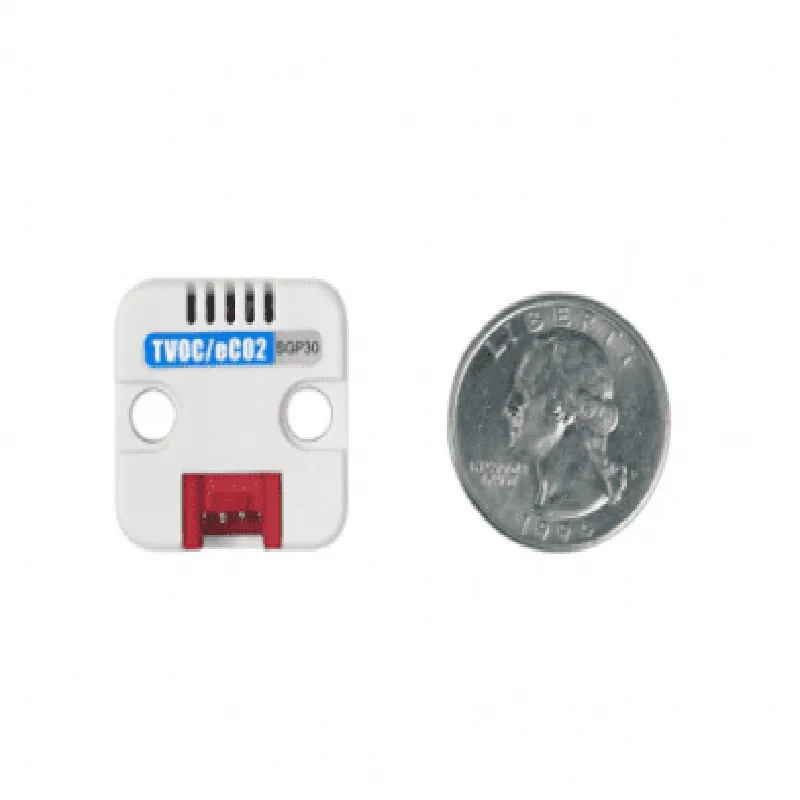
M5Stack TVOC/eCO2 Gas Unit (SGP30) Documentation
The M5Stack TVOC/eCO2 Gas Unit (SGP30) is a high-performance gas sensor module designed for detecting Total Volatile Organic Compounds (TVOC) and equivalent Carbon Dioxide (eCO2) levels. The module is based on the SGP30 gas sensor chip from Sensirion, which offers high accuracy and reliability in measuring indoor air quality.
Measures TVOC (ppb) and eCO2 (ppm) levels
 High accuracy and reliability
 Low power consumption
 I2C interface for easy communication
 Operating voltage: 3.3V - 5V
 Compatible with M5Stack development boards
VCC: Power supply (3.3V - 5V)
 GND: Ground
 SCL: I2C clock signal
 SDA: I2C data signal
Example 1: Basic TVOC and eCO2 Measurement
This example demonstrates how to use the M5Stack TVOC/eCO2 Gas Unit (SGP30) to measure TVOC and eCO2 levels using an M5Stack development board.
```c++
#include <M5Stack.h>
#include <Wire.h>
#define SGP30_ADDRESS 0x58
void setup() {
  M5.begin();
  Wire.begin();
  Serial.begin(115200);
// Initialize SGP30 sensor
  Wire.beginTransmission(SGP30_ADDRESS);
  Wire.write(0x00);
  Wire.write(0x03); // Init command
  Wire.endTransmission();
  delay(10);
}
void loop() {
  uint16_t tvoc, eco2;
// Read TVOC and eCO2 values
  Wire.beginTransmission(SGP30_ADDRESS);
  Wire.write(0x00);
  Wire.write(0x05); // Read TVOC command
  Wire.endTransmission();
  Wire.requestFrom(SGP30_ADDRESS, 2);
  tvoc = Wire.read() << 8 | Wire.read();
Wire.beginTransmission(SGP30_ADDRESS);
  Wire.write(0x00);
  Wire.write(0x06); // Read eCO2 command
  Wire.endTransmission();
  Wire.requestFrom(SGP30_ADDRESS, 2);
  eco2 = Wire.read() << 8 | Wire.read();
Serial.print("TVOC: ");
  Serial.print(tvoc);
  Serial.println(" ppb");
  Serial.print("eCO2: ");
  Serial.print(eco2);
  Serial.println(" ppm");
Example 2: Air Quality Monitoring with Display
This example demonstrates how to use the M5Stack TVOC/eCO2 Gas Unit (SGP30) to display air quality data on an M5Stack development board with an LCD display.
```c++
#include <M5Stack.h>
#include <Wire.h>
#define SGP30_ADDRESS 0x58
void setup() {
  M5.begin();
  Wire.begin();
  Serial.begin(115200);
  M5.Lcd.begin();
// Initialize SGP30 sensor
  Wire.beginTransmission(SGP30_ADDRESS);
  Wire.write(0x00);
  Wire.write(0x03); // Init command
  Wire.endTransmission();
  delay(10);
}
void loop() {
  uint16_t tvoc, eco2;
  char airQuality[20];
// Read TVOC and eCO2 values
  Wire.beginTransmission(SGP30_ADDRESS);
  Wire.write(0x00);
  Wire.write(0x05); // Read TVOC command
  Wire.endTransmission();
  Wire.requestFrom(SGP30_ADDRESS, 2);
  tvoc = Wire.read() << 8 | Wire.read();
Wire.beginTransmission(SGP30_ADDRESS);
  Wire.write(0x00);
  Wire.write(0x06); // Read eCO2 command
  Wire.endTransmission();
  Wire.requestFrom(SGP30_ADDRESS, 2);
  eco2 = Wire.read() << 8 | Wire.read();
// Calculate air quality index
  if (tvoc < 100) {
    strcpy(airQuality, "Excellent");
  } else if (tvoc < 200) {
    strcpy(airQuality, "Good");
  } else if (tvoc < 400) {
    strcpy(airQuality, "Fair");
  } else {
    strcpy(airQuality, "Poor");
  }
// Display air quality data
  M5.Lcd.clear(BLACK);
  M5.Lcd.setTextSize(2);
  M5.Lcd.setCursor(10, 10);
  M5.Lcd.println("Air Quality:");
  M5.Lcd.println(airQuality);
  M5.Lcd.print("TVOC: ");
  M5.Lcd.print(tvoc);
  M5.Lcd.println(" ppb");
  M5.Lcd.print("eCO2: ");
  M5.Lcd.print(eco2);
  M5.Lcd.println(" ppm");
These examples demonstrate the basic functionality of the M5Stack TVOC/eCO2 Gas Unit (SGP30) and its ability to measure TVOC and eCO2 levels. You can modify and expand these examples to suit your specific application requirements.