ELECROW LR1262 Node Board LoRaWan Node Module for Long Range Communication (868Mhz/915Mhz)


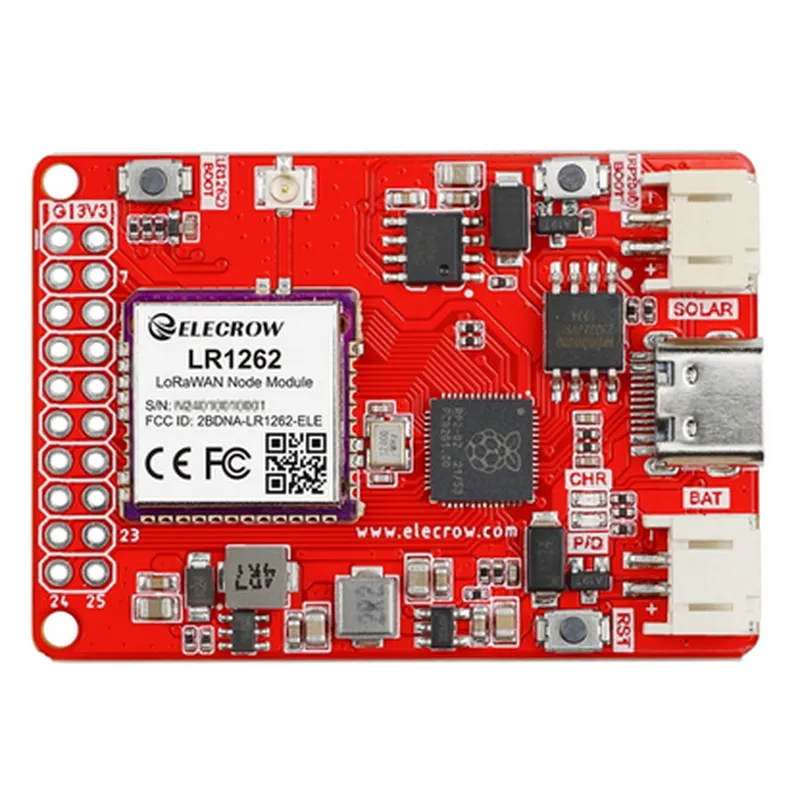
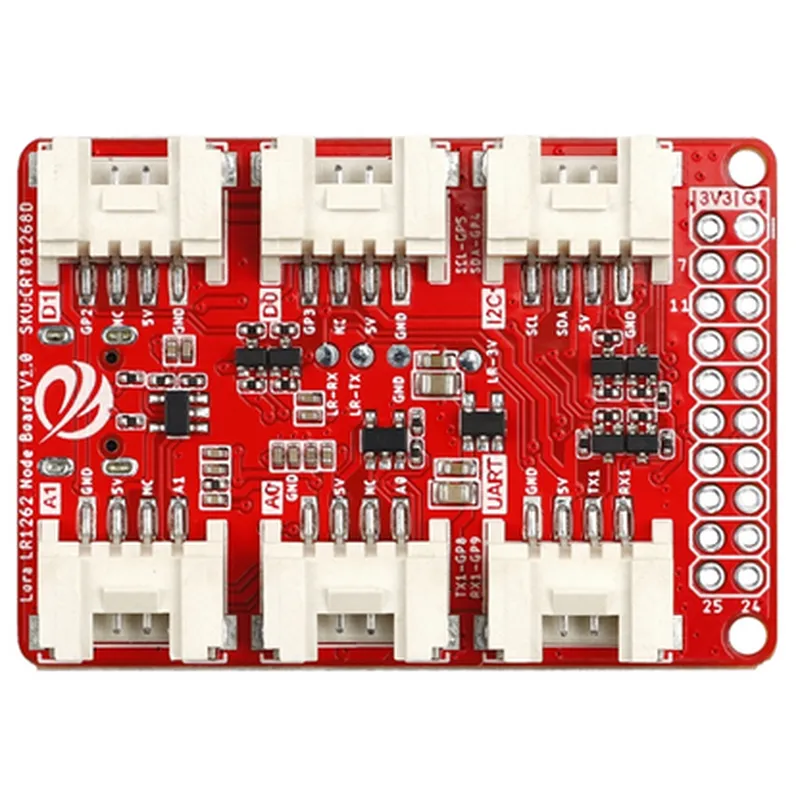
ELECROW LR1262 Node Board LoRaWan Node Module for Long Range Communication (868Mhz/915Mhz)
The module operates at a frequency of 868 MHz, making it suitable for European and Indian regions.
The module operates on the LoRaWAN protocol, which provides a low-power, low-data-rate, and long-range wireless communication solution.
Up to 20 dBm transmission power ensures reliable communication over long distances.
### Microcontroller
| STM32L072CZ Microcontroller | The module is based on the STM32L072CZ microcontroller, which provides a low-power, 32-bit ARM Cortex-M0+ core. |
192 KB of internal flash memory and 20 KB of internal RAM provide ample storage for application code and data.
### Power Management
The module is designed for low power consumption, making it suitable for battery-powered devices.
The module features an onboard voltage regulator, which accepts an input voltage range of 2.5 V to 5.5 V.
### Interfaces
The module provides a UART interface for serial communication with other devices.
The module features an SPI interface for connecting peripherals such as sensors, displays, and memory devices.
14 GPIO pins provide flexibility for connecting peripherals and sensors.
### Antenna and RF
The module features an internal antenna, which provides a reliable and compact wireless communication solution.
The module's RF transceiver is designed for high sensitivity and selectivity, ensuring reliable communication in noisy environments.
### Operating Conditions
The module operates within a temperature range of -40C to 85C.
The module can be stored within a temperature range of -40C to 125C.
Dimensions and Package
The ELECROW LR1262 Node Board measures 30 mm x 55 mm in size and comes in a compact, surface-mount package.
Applications
| The ELECROW LR1262 Node Board is suitable for a variety of IoT applications, including |
Smart cities
Industrial automation
Environmental monitoring
Smart homes
Wearable devices
Conclusion
The ELECROW LR1262 Node Board is a reliable and efficient LoRaWAN node module for long-range wireless communication applications. Its low power consumption, compact design, and robust wireless communication capabilities make it an ideal choice for IoT projects requiring wireless communication.
ELECROW LR1262 Node Board LoRaWan Node Module DocumentationOverviewThe ELECROW LR1262 Node Board is a LoRaWan node module designed for long-range communication applications. It operates at a frequency of 868 MHz and is suitable for use in various IoT projects, including industrial automation, smart cities, and environmental monitoring.FeaturesLoRaWAN protocol compliance
868 MHz frequency band
Long-range communication capability (up to 10 km)
Low power consumption (down to 2 A in sleep mode)
Supports various communication protocols (UART, SPI, I2C)
Onboard antenna for easy integrationTechnical SpecificationsFrequency: 868 MHz
Bandwidth: 125 kHz
Spreading factor: 7-12
RF output power: up to 20 dBm
Sensitivity: -148 dBm
Operating temperature: -40C to 85C
Power supply: 2.0 V to 3.6 VProgramming and ExamplesThe ELECROW LR1262 Node Board can be programmed using the Arduino IDE or other microcontroller development environments. The following examples demonstrate how to use the module in various contexts:Example 1: Simple LoRaWan Node using ArduinoThis example demonstrates how to use the ELECROW LR1262 Node Board as a LoRaWan node to send data to a gateway using the Arduino IDE.```cpp
#include <LoRaWan.h>#define LORA_SCK 5
#define LORA_MISO 19
#define LORA_MOSI 27
#define LORA_RST 14LoRaWan lorawan(LORA_SCK, LORA_MISO, LORA_MOSI, LORA_RST);void setup() {
Serial.begin(9600);
lorawan.begin();
lorawan.join();
}void loop() {
lorawan.send("Hello, LoRaWan!");
delay(10000);
}
```Example 2: IoT Environmental Monitoring using Python and MicropythonThis example demonstrates how to use the ELECROW LR1262 Node Board to send environmental temperature and humidity data to a server using Python and Micropython.```python
import machine
import ubinascii
import urequests
import ujson# Initialize LoRaWan module
lora = machine.LoRa(mode=machine.LoRa.LORAWAN)# Initialize temperature and humidity sensor
temp_hum_sensor = machine.I2C(scl=machine.Pin(5), sda=machine.Pin(4))while True:
# Read temperature and humidity data
temp_data = temp_hum_sensor.read(0x40, 2)
temp = (temp_data[0] << 8) | temp_data[1]
hum_data = temp_hum_sensor.read(0x40, 2)
hum = (hum_data[0] << 8) | hum_data[1]# Create JSON payload
payload = {"temperature": temp, "humidity": hum}
payload_str = ujson.dumps(payload)# Send data to server using LoRaWan
lora.send(payload_str)# Wait for 10 minutes before sending next data packet
machine.sleep(600000)
```Example 3: LoRaWan Gateway Using Raspberry PiThis example demonstrates how to use the ELECROW LR1262 Node Board as a LoRaWan gateway using a Raspberry Pi and the Raspbian operating system.```python
import os
import time
import socket
import struct# Initialize LoRaWan module
lora_socket = socket.socket(socket.AF_PACKET, socket.SOCK_RAW)
lora_socket.bind(("wlan0", 0x0003))while True:
# Receive data from LoRaWan nodes
data, addr = lora_socket.recvfrom(1024)# Parse received data
packet = struct.unpack("<BBHHH", data[:10])
if packet[0] == 0x01: # Data packet
# Extract payload from packet
payload = data[10:]
print("Received payload:", payload.decode())# Wait for 1 second before receiving next data packet
time.sleep(1)
```These examples demonstrate the basic functionality of the ELECROW LR1262 Node Board and can be modified to suit specific IoT project requirements.