25 x 20.5 mm (1 x 0.81 in)


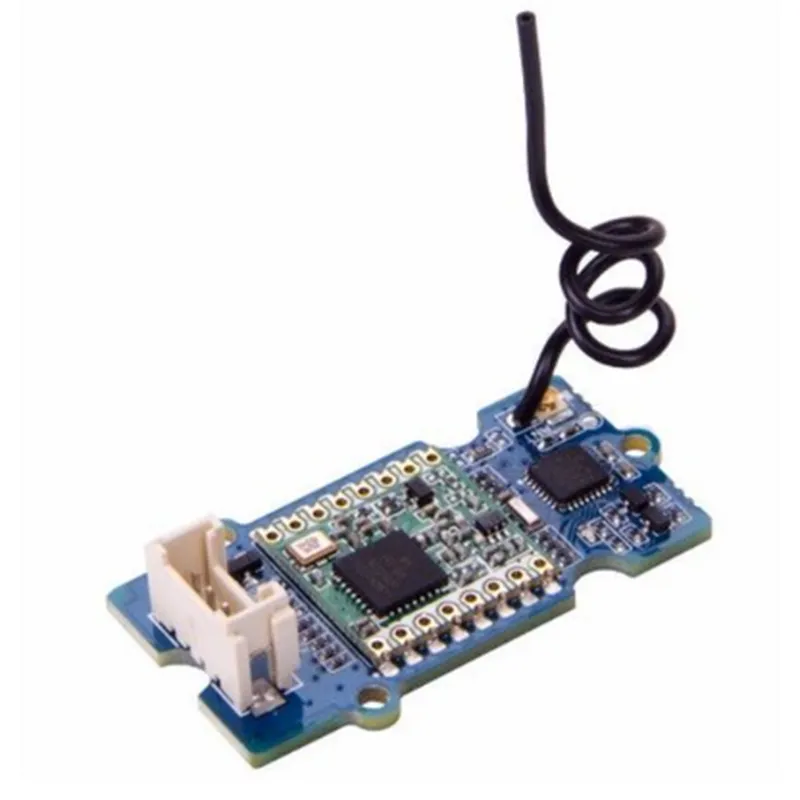
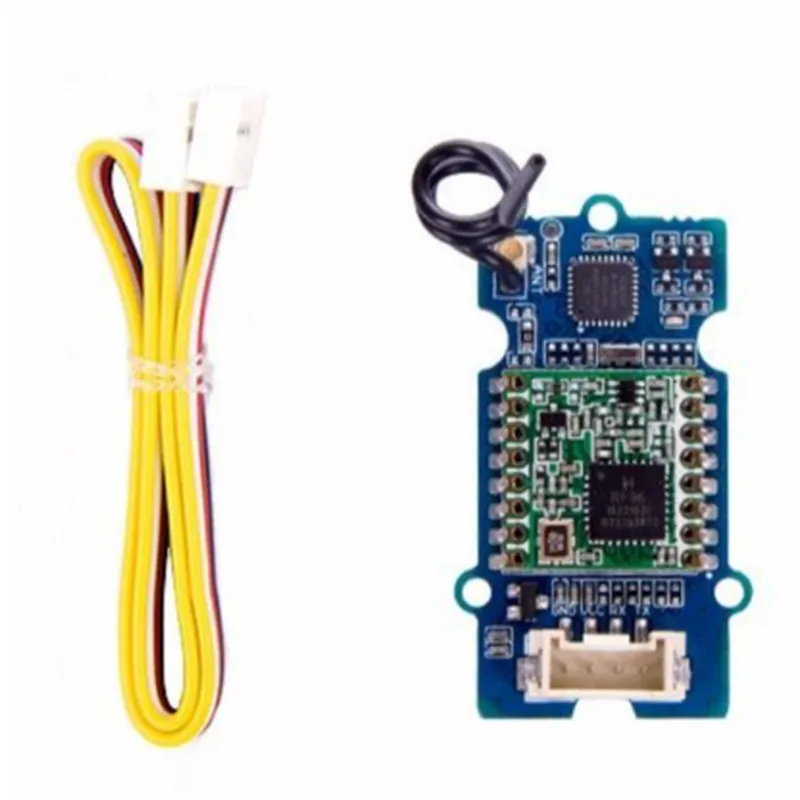
25 x 20.5 mm (1 x 0.81 in)
5g (0.18 oz)
4-pin Grove connector
3.3V to 5.5V
External antenna connector (U.FL connector)
Applications
| The Grove - Long Range Radio 868MHz RFM95 LoRa Module is suitable for a wide range of IoT applications, including |
Wireless sensor networks
IoT devices
M2M (Machine-to-Machine) communication
Remote monitoring and control systems
Smart home automation
Industrial automation
Conclusion
The Grove - Long Range Radio 868MHz RFM95 LoRa Module is a versatile and reliable wireless communication module that is suitable for a wide range of IoT applications. Its long-range communication capabilities, low power consumption, and high sensitivity make it an ideal choice for applications that require reliable wireless communication over long distances.
Grove - Long Range Radio 868MHz RFM95 LoRa Module DocumentationOverviewThe Grove - Long Range Radio 868MHz RFM95 LoRa Module is a wireless communication module based on the RFM95 chip, which operates on the 868MHz frequency band and supports LoRa (Long Range) modulation. This module provides a long-range, low-power, and low-data-rate wireless communication solution for IoT applications.PinoutThe module has a 10-pin interface, with the following pinout:| Pin | Function |
| --- | --- |
| 1 | GND |
| 2 | VCC (3.3V) |
| 3 | RST (Reset) |
| 4 | NSS (Chip Select) |
| 5 | SCK (Clock) |
| 6 | MOSI (TX) |
| 7 | MISO (RX) |
| 8 | IRQ (Interrupt) |
| 9 | DIO0 (Data Out 0) |
| 10 | DIO1 (Data Out 1) |ProgrammingThe Grove - Long Range Radio 868MHz RFM95 LoRa Module can be programmed using various microcontrollers, such as Arduino boards. The following examples demonstrate how to use this module in different contexts:### Example 1: Basic LoRa Communication using ArduinoIn this example, we will use two Arduino boards, one as the transmitter and the other as the receiver, to demonstrate basic LoRa communication.Transmitter Code
```cpp
#include <RH_RF95.h>#define RFM95_CS 10
#define RFM95_RST 9
#define RFM95_INT 2RH_RF95 rf95(RFM95_CS, RFM95_RST, RFM95_INT);void setup() {
Serial.begin(9600);
while (!rf95.init()) {
Serial.println("LoRa radio init failed");
delay(1000);
}
Serial.println("LoRa radio init OK");
}void loop() {
char data[] = "Hello, LoRa!";
rf95.send((uint8_t )data, strlen(data));
rf95.waitPacketSent();
delay(1000);
}
```Receiver Code
```cpp
#include <RH_RF95.h>#define RFM95_CS 10
#define RFM95_RST 9
#define RFM95_INT 2RH_RF95 rf95(RFM95_CS, RFM95_RST, RFM95_INT);void setup() {
Serial.begin(9600);
while (!rf95.init()) {
Serial.println("LoRa radio init failed");
delay(1000);
}
Serial.println("LoRa radio init OK");
}void loop() {
if (rf95.waitAvailableTimeout(1000)) {
uint8_t buf[RH_RF95_MAX_MESSAGE_LEN];
uint8_t len = sizeof(buf);
if (rf95.recv(buf, &len)) {
Serial.print("Received: ");
Serial.println((char )buf);
}
}
}
```### Example 2: LoRaWAN Communication using MicroPythonIn this example, we will use a MicroPython board, such as the Pycom LoPy, to connect to a LoRaWAN network.Code
```python
import machine
import loralora.init(mode=lora.LORA_MODE_NODE, freq=lora.LORA_FREQ_868)while True:
payload = "Hello, LoRaWAN!"
lora.send(payload)
print("Packet sent")
machine.sleep(10000) # Send every 10 seconds
```Note: The above examples are basic demonstrations of the module's capabilities. For a more comprehensive and robust implementation, consider using libraries and frameworks specifically designed for LoRa and LoRaWAN communication.ResourcesRFM95 Datasheet: [https://www.hoperf.com/rf_modules/rfm95.html](https://www.hoperf.com/rf_modules/rfm95.html)
LoRaWAN Specification: [https://www.lora-alliance.org/wp-content/uploads/2020/02/lorawan_specification_v1.1.pdf](https://www.lora-alliance.org/wp-content/uploads/2020/02/lorawan_specification_v1.1.pdf)
Grove - Long Range Radio 868MHz RFM95 LoRa Module Documentation: [https://wiki.seeedstudio.com/Grove-Long_Range_Radio_868MHz_RFM95_LoRa_Module/](https://wiki.seeedstudio.com/Grove-Long_Range_Radio_868MHz_RFM95_LoRa_Module/)